Object Status:
Unlocated
Accession Date:
1804
Primary Source Reference:
Peale Museum Accessions Book, Historical Society of Pennsylvania, p. 2
Additional Source Text:
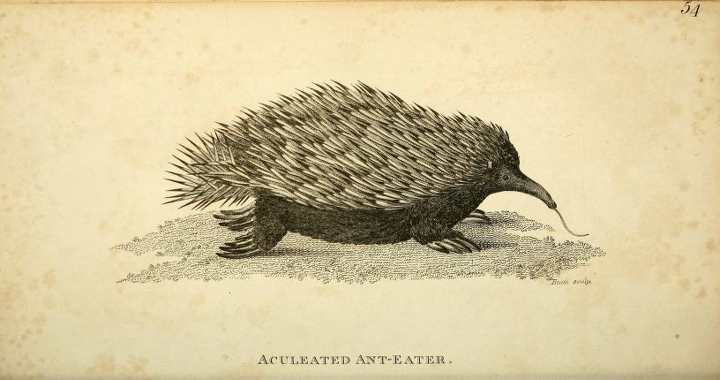
In his "Walk through the Museum" (1805) Peale wrote of this species, "newly discovered from New Holland . . . it is a striking instance of that beautiful gradation, so frequently observed in the animals, by which creratures of one tribe or genus, approach to those of a very different one. Here is a link between the Porcupine and the Anteater -- characters widely different -- having the external appearance of the one, and the peculiar generic characters of the other. It has the tubular snout and small opening at the tip, from whence is protruded a long tongue in the Anteaters."
Notes:
The short-beaked echidna (Tachyglossus aculeatus) is one of four living species of echidna and the only member of the genus Tachyglossus. It was first described by George Shaw in 1792. He named the species Myrmecophaga aculeata, thinking that it might be related to the giant anteater, but in fact it bears no relation to the true anteaters.
On this date Mr. Bryant also donated three quadrupeds.
Specimen Type:
Dead/preserved
Peale's Common Name:
Aculeated ant-eater
Current Common Name:
Short-beaked echidna
Current Scientific Name
Tachyglossus aculeatus