Object Status:
Unlocated
Accession Date:
By 1799
Primary Source Reference:
Natural History Lecture No. 9 (1799), Academy of Natural Sciences of Drexel University
Additional Source Text:
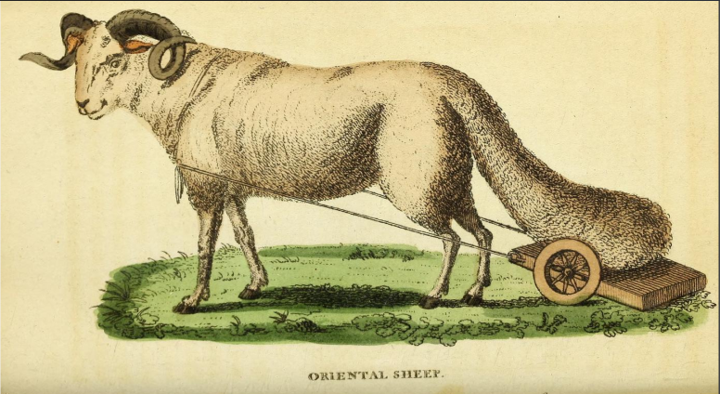
"The Ovis arabia, or broad tailed sheep, are common in Syria, Barbary, and Aethiopia, but are commonly brought into this country from the Cape of Good Hope. Some of their tails end in a point, as does this which we have before us. Others are so long as to trail on the ground, and the Shepherds are obliged to put boards with small wheels under them to keep them from galling. These tails, esteemed a great delicacy, are of a Substance between fat and marrow, and are eaten with the lean the Mutton. Some of them weigh fifty pounds each. This did not weigh more than 12. When this sheep was brought here it had a coarse hair over the whole of its body – but in a short time it began to get a coat of fine wool and no doubt but in time, it would have had a coat equall to this Russian Sheep with four horns. – Sheep carried to the West India Islands soon loose their wool and take a coat of coarse hair, and when first brought from those Islands into this country have a curious look, not cognizable except by their head. The short hair on the body gives it the look of the Goat, with a sheeps head on its shoulders."
Notes:
The fat-tailed sheep is a general type of domestic sheep known for their distinctive large tails and hindquarters. Fat-tailed sheep breeds comprise approximately 25% of the world's sheep population, and are commonly found in northern parts of Africa, the Middle East, and various Central Asian countries all the way to China. The tail fat from those sheep is an important ingredient in many regional cuisines.
The plate from The Naturalist's Pocket Magazine or compleat cabinet of the curiosities and beauties of nature, 7 vols. (London, 1798-1802), vol 7, n.p. depicts the use of board and wheels that Peale described.
Specimen Type:
Living/Live (presumably eventually taxidermied/preserved)
Current Common Name:
Fat-tailed sheep
Current Scientific Name
Ovis aries