Object Status:
Unlocated
Accession Date:
October 29, 1799
Primary Source Reference:
Claypoole's American Daily Advertiser (Philadelphia) 29 Oct 1799
Additional Source Text:
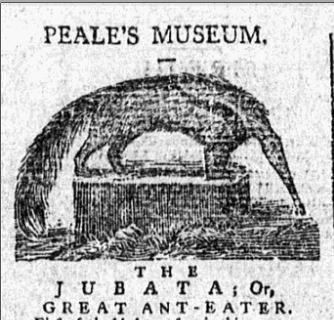
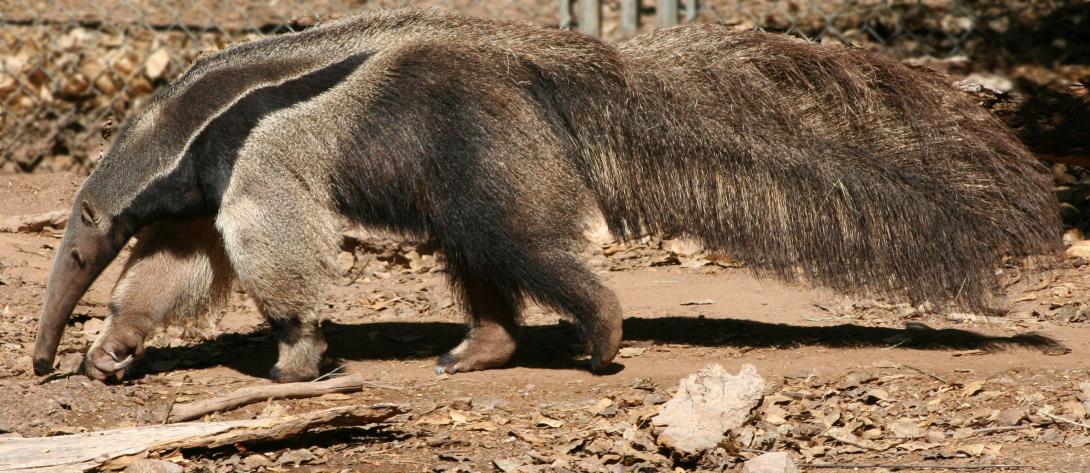
"THE JUBATA; Or, GREAT ANT-EATER. First of the kind ever seen in this country. The most extraordinary and wonderfully formed creature now offered to the inspection of the public, makes an interesting addition to many other curious subjects that have lately been deposited in the Museum. The Great Ant-Eater, or Ant-Bear, is a native of Africa and South-America. The present specimen is among the largest known, and is in a fine state of preservation. It is 7 feet 7 inches in length: being 4 feet 6 from the nose to the insertion of thetail, and thence to the end of the brush 3 feet 1 inch more. The tongue, which is singularly formed, is about 2 feet 6 inches in length, extremely slender, and lies, when at rest, in a double fold within the mouth; Altho’ the Ant-Bear has no teeth -- the nature of his food requiring none: -- yet he may he ranked among the most formidable Quadrupeds of the forest. Armed with claws of uncommon size and strength, and possessing great muscular powers, this curious animal, tho’ naturally inoffensive, when undisturbed, in terrible in his wrath. His food consists entirely of Ants. These he entraps in the following manner: Extending his long slender tongue, which is coated with a viscous substance, be introduces it among the Ant’s. Either alarmed at the intrusion, or attracted by the quality of the clammy matter, the insects soon cover the tongue with their bodies, and thus fall as easy prey. In short --The Ant-Eater, if not the most singular animal in the world, may justly claim a place among the most curious Quadrupeds of the animal Kingdom. October 24"
In his Natural History Lecture No. 3 (Academy of Natural Sciences of Drexel University), Peale wrote: "This Ant Eater has two claws on each of the fore feet. One is longer than the other, and resembles the claws of a Cat. On the hind feet it has four claws, but more equal in length. Its tail is prehensile, and is very useful to it in climbing trees. When a species of Ant builds their nest on the branches, it thrusts its long cylindrical tongue into the Ants nest. The Ants, sticking to it, are then drawn back and thus it is fed and supported.
"Altho’ these Animals have no teeth, yet they can very well defend themselves with their Claws, and once they have got a good hold, its claws are not easily unclinched. They are an Animal so slow in its movement, that if one of them is placed on a walking cane, a Person may walk from one end of the town of Cayenne to the other before it shall descend to the bottom of the cane. It is an inhabitant of South America."
In his Walk through the Museum (1805), pp. 12-13, Peale wrote: "That long and slender head has a mouth so small as scarcely to admit a finger in it. How surprizing that so large an Animal should be wholly supported by feeding on Ants, but it comes from South America where there are immence numbers of those Insects. The Jubata has a tongue of 2 feet 6 In[ches] long, which it projects into the Ant-hills; this tongue is covered with a viscous substance, the ants sticking to it, are drawn out of their nest and devoured, in immence numbers by this patient waiting animal. It is innofensive, yet if attacked, like the bear, it will hug its enemy with such firmness, sticking in those long claws that no force can detach them. The Tyger and this animal, it is said, have died in each others grasps."
Notes:
The giant anteater (Myrmecophaga jubata Linnaeus 1766, now Myrmecophaga tridactyla), also known as the ant bear, is an insectivorous mammal native to Central and South America. It is not native to Africa, as Peale stated.
Peale's Common Name:
Giant anteater
Peale's Scientific Name:
Jubata
Current Common Name:
Giant anteater
Current Scientific Name
Myrmecophaga tridactyla