Object Status:
Extant
Accession Date:
July 27, 1802
Primary Source Reference:
Charles Willson Peale to Thomas Jefferson, 10 June 1802 (Selected Papers, 2, part 1: 434-435 / https://founders.archives.gov/documents/Jefferson/01-37-02-0470-0001 )
Additional Source Text:
Guide to the Philadelphia Museum (Philadelphia, 1805), p. 7: "The pith of the horn measuring 21 inches in circumference -- probably the horns would have measured from 14 to 16 feet from tip to tip. This precious relique belongs to the Philosophical Society, by request of the donor Dr. [Samuel] Brown [1769–1830], to be placed with the Mammoth."
Notes:
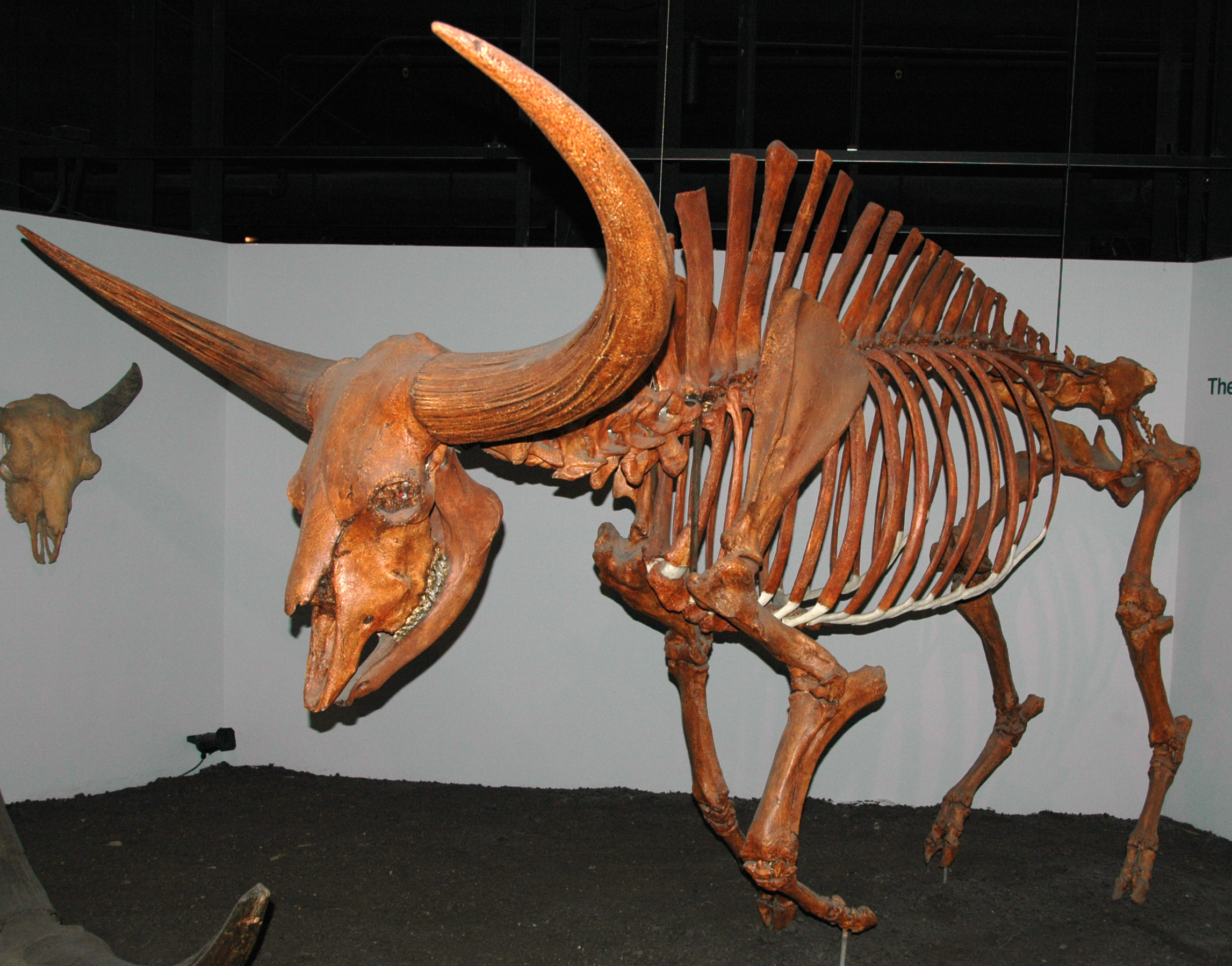
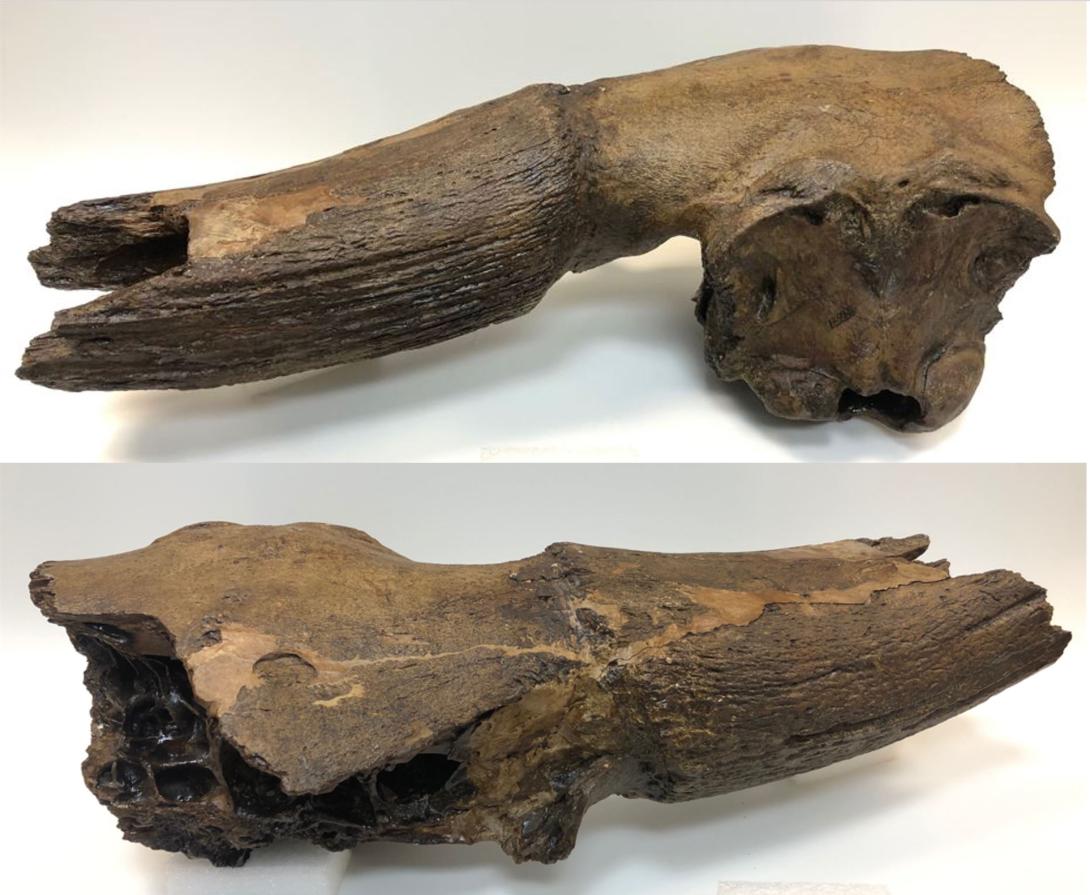
Bison latifrons (also known as the giant bison or long-horned bison) is an extinct species of bison that lived in North America during the Pleistocene epoch ranging from Alaska to Mexico. It was the largest and heaviest bovid ever to live in North America.
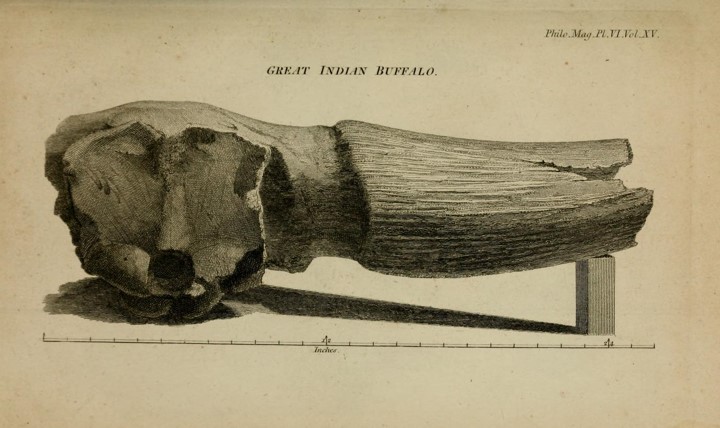
On 10 June 1802 Peale forwarded to the American Philosophical Society the "Cranium of a Bison found by Uriah Hardesty in the bed of a creek, six miles below Licking creek mouth, two or three miles from the Ohio river, and twelve or fourteen north of Big bone; presented with a letter from Mr. John Brown, of Columbia, Boon county, Kentucky, on condition that it remain in the same room with the Mammoth." The Society agreed to provide Peale with a cast, which was first displayed in the Musem on 27 July 1802. The cast is unlocated; the fossilized partial skull, pictured here, is at the Academy of Natural Sciences of Drexel University (ANSP 12993).
The fossil was first described and illustrated by Rembrandt Peale in 1803 ("Account of the Remains of a Species of Gigantic Oxen, found in America and Other Parts of the World," Philosophical Magazine, 15 [Feb-May 1803]: 325-327 / https://www.biodiversitylibrary.org/page/15428721 / and plate 6 (also pictured here) / https://www.biodiversitylibrary.org/page/15428785 ) and was first named by Richard Harlan in 1825 in his Fauna Americana, p. 273 / https://www.biodiversitylibrary.org/page/3194511
Also pictured here is a complete fossil skeleton with an intact skull as diplayed in the Cincinnati Museum of Natural History & Science.
See also Selected Papers, 2, part 1: documents 144, 145, 167, 168, 173; Samuel Brown to Thomas Jeffeson, 24 May 1802, Jefferson Papers, Founders Online, National Archives / https://founders.archives.gov/documents/Jefferson/01-37-02-0394 ; and Earle E. Spamer et al., Study of Fossil Vertebrate Types in The Academy of Natural Sciences of Philadelphia: Taxonomic, Systematic, and Historical Perspectives (Philadelphia, 1995), pp. 219-221.
Specimen Type:
Skeletons/skulls/bones
Peale's Scientific Name:
Bos latifrons
Current Common Name:
Giant bison or long-horned bison
Current Scientific Name
Bison latifrons
Repository:
Academy of Natural Sciences of Drexel University