
Peale Sources
This section of the website lists the many primary sources, both printed and manuscript, that were used to compile the inventory of objects in the two museums.
Newspaper Notices of Recent Donations to Peale’s Museum
Beginning in 1784 Peale began placing notices in newspapers of recent donations and special exhibitions. About 100 of these notices have yielded information on about 500 items that were not recorded in the Accessions Book.
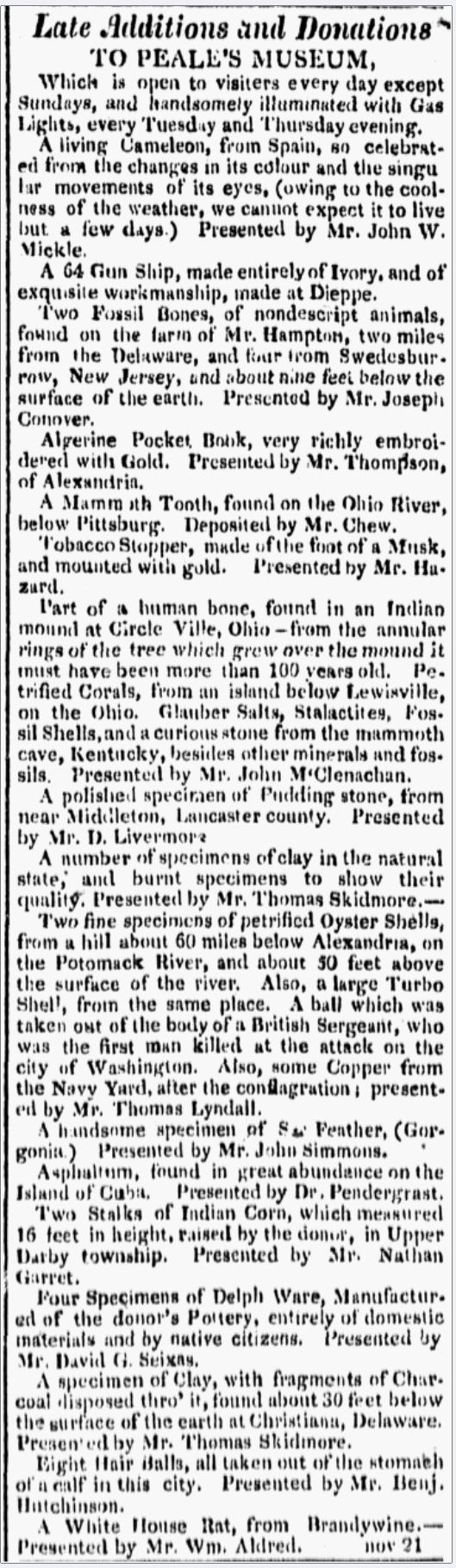
Poulson’s American Daily Advertiser (Philadelphia), 21 November 1817
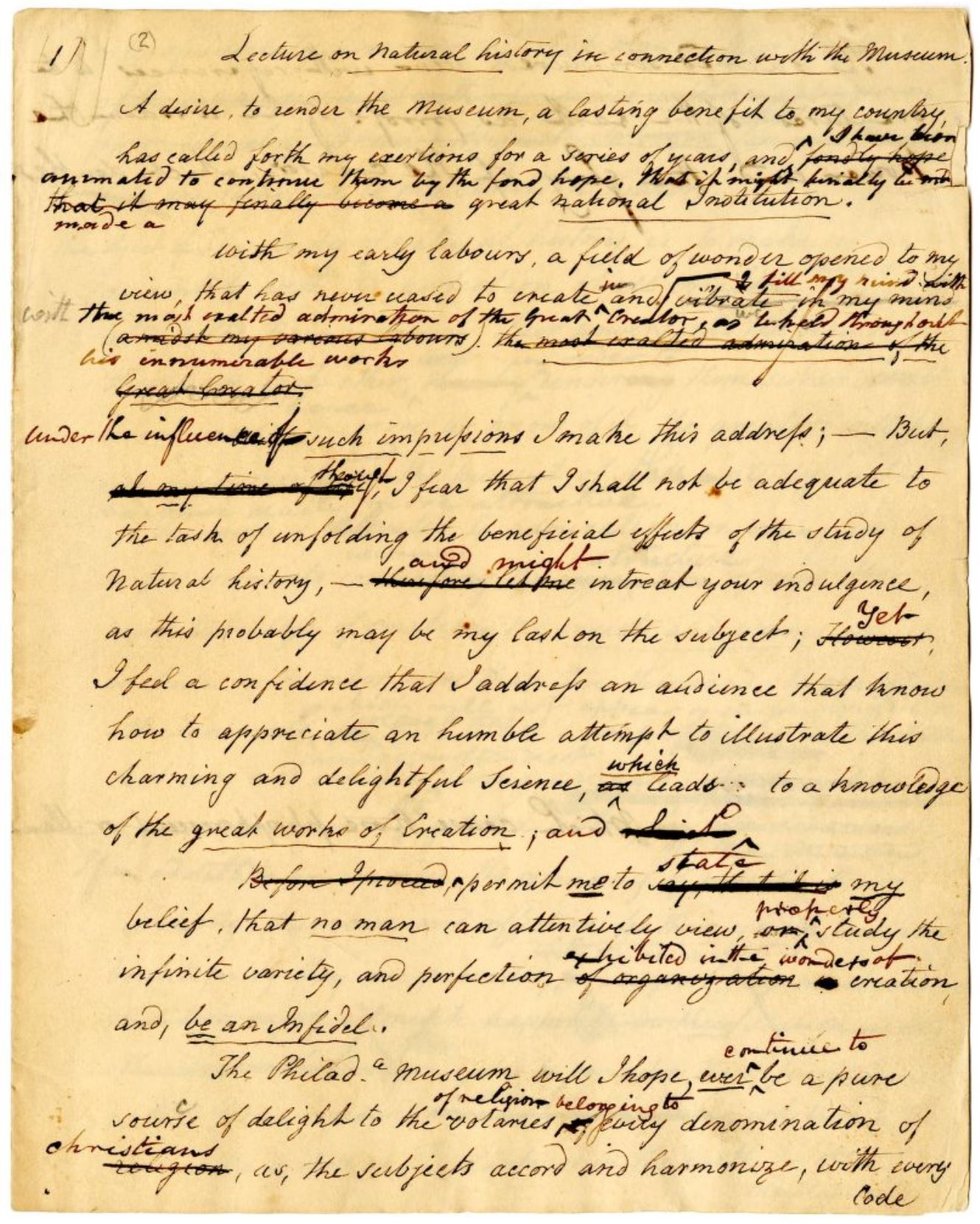
Charles Willson Peale’s Lectures on Natural History, 1799-1802
Over the course of several years Peale gave more than forty lectures on natural history based on the Museum’s collection of specimens. A dozen were dedicated to mammals, and the rest to more than 550 species of birds (according to modern definitions of the word “species”). The lectures were never published, and the manuscripts now reside in the collections of the Academy of Natural Sciences of Drexel University in Philadelphia. See https://ansp.org/research/library/archives/0000-0099/coll0040/
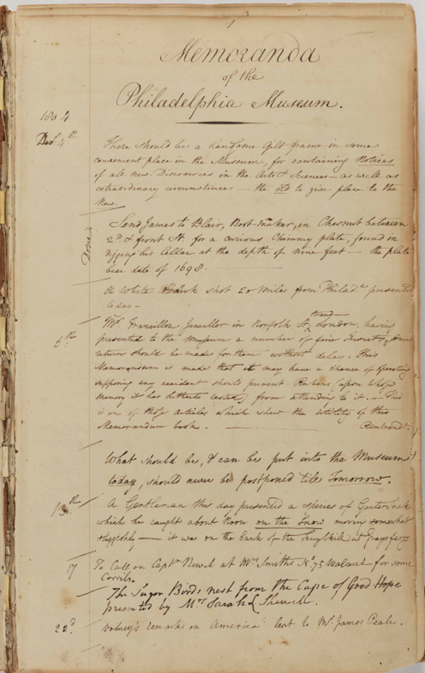
The Peale Museum Accessions Book, 1804-1827
In the Historical Society of Pennsylvania’s Peale Family Papers is a large ledger volume headed “Memoranda of the Philadelphia Museum” that records donations to the Museum beginning in December 1804. More than 2,000 items are listed on 129 pages covering the period from that date to the time of Charles Willson Peale’s death in February 1827.
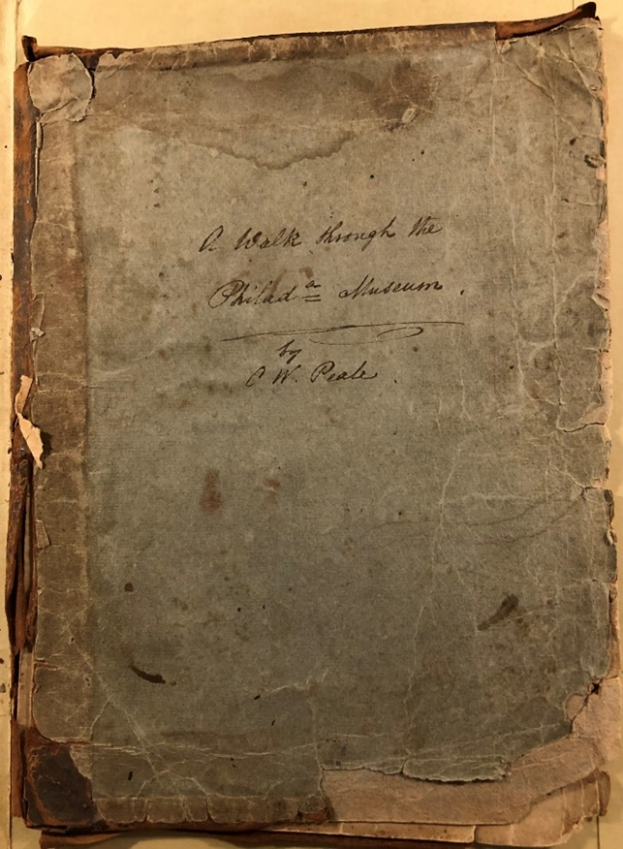
Charles Willson Peale’s “A Walk through the Philad[elphi]a Museum” (1805-1806)
Over the winter of 1805-1806, Peale wrote out a 155-page manuscript (now at the Historical Society of Pennsylvania) that was inspired by a book that had been lent to him by Thomas Jefferson, Jean-Baptiste Pujoulx (1762-1821),
Promenades au Jardin des Plantes, à la Ménagerie et dans les Galeries du Muséum d’Histoire Naturelle</em> (Paris, 1803). Peale attempted to describe, exhibition case by exhibition case, every species of quadruped and bird a “friend” (visitor) would encounter on such a walk. As he wrote to Jefferson on 5 April 1806, “I have now undertaken to write a small Pocket Volume. . . . The part on Quadrupeds will be comprised in about 30 pages and as near as I can judge , that on the birds about 3 times as large – I shall endeavor to make it combine the pleasing with the useful, giving a general view of all the subjects in the several departments of the Museum, and, it will at least have the merits of correcting some mistakes of Authors who have wrote on American subjects.”
Peale intended to publish the manuscript, but it proved to be too long and never appeared in print.
The manuscript as it exists today ends abruptly at the conclusion of his description of the birds in the genus Muscicapa. According to the arrangement established by British ornithologist John Latham in his 1790 Index Ornithologicus (which Peale followed), that genus was followed by the genera Alauda, Motacilla, Sylvia, Pipra, Parus, Hirundo, and Caprimulgus. There is evidence that Peale had included some (if not all) of these genera in the manuscript; information on Peale’s specimens of Sylvia (wood warblers), for instance, was transcribed by Frank L. Burns in his article “Charles W. and Titian R. Peale and the Ornithological Section of the Old Philadelphia Museum,” Wilson Bulletin, 44, no. 1 (March 1932): 23-35.
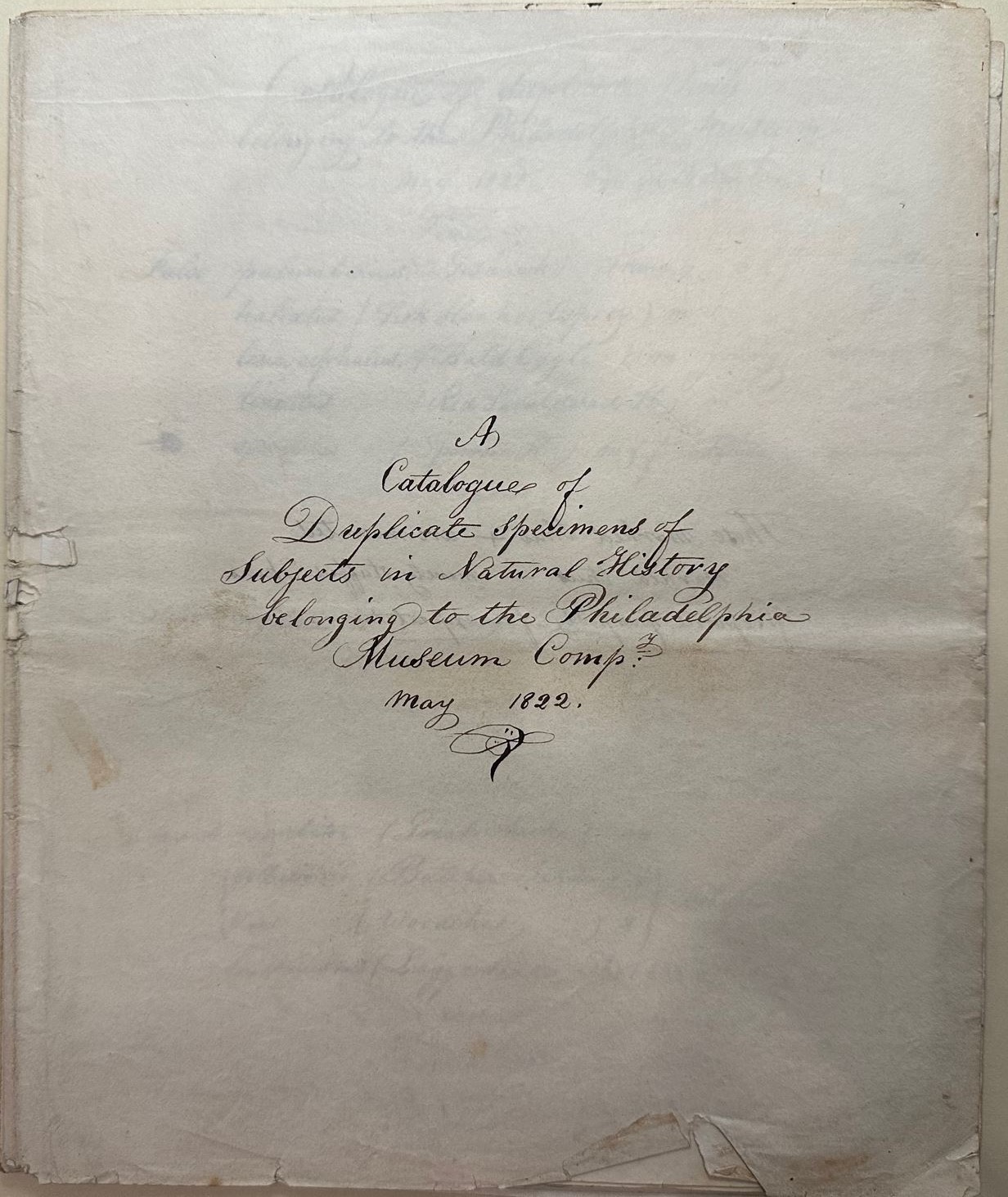
“A Catalogue of Duplicate Specimens of Subjects in Natural History belonging to the Philadelphia Museum Comp[an]y,” May 1822, Peale-Sellers Collection, American Philosophical Society
Published Guides to the Peale Museum Collection
Beginning in 1795 several printed catalogues itemized the Museum’s holdings of paintings, natural history specimens, and other artifacts.
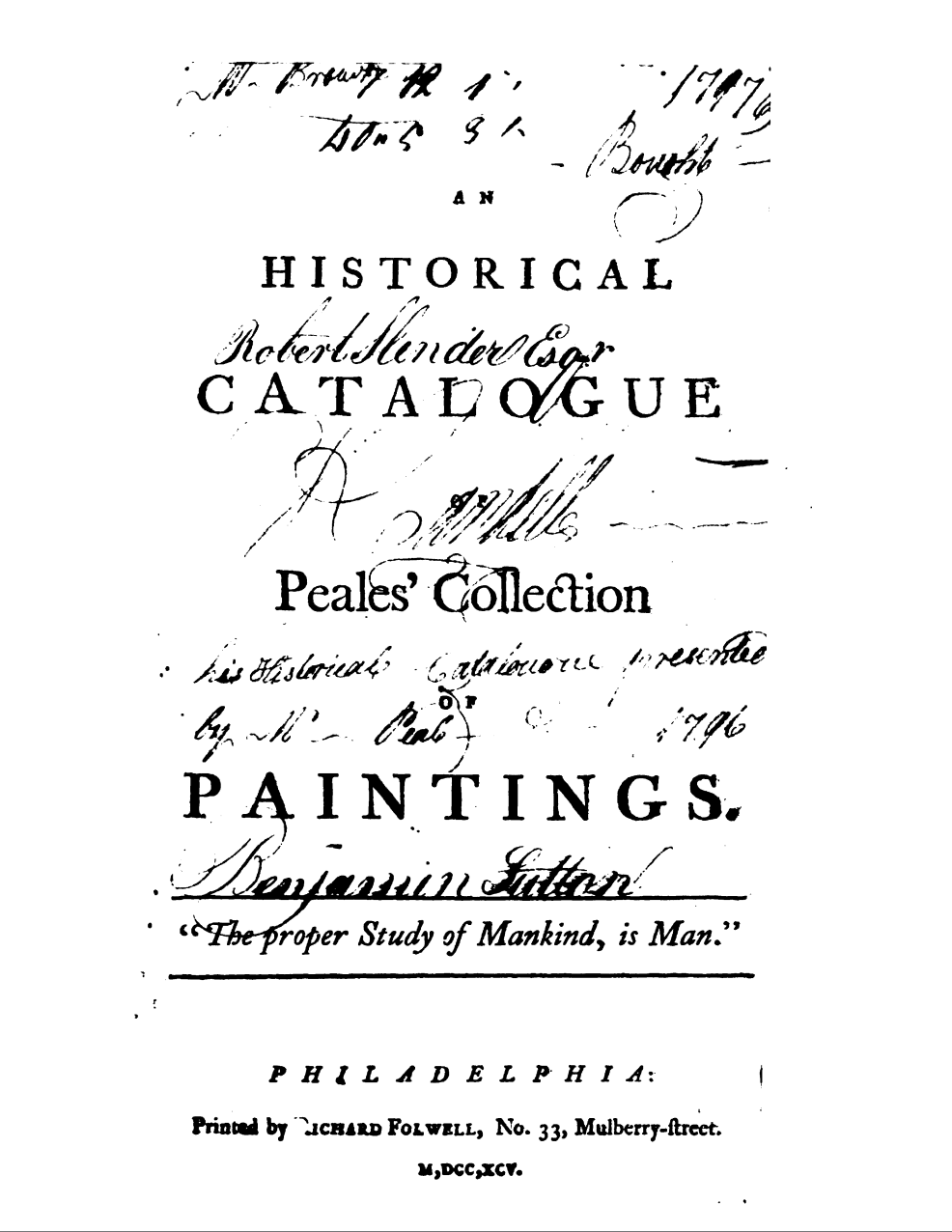
1. An Historical Catalogue of Peale’s Collection of Paintings (1795)
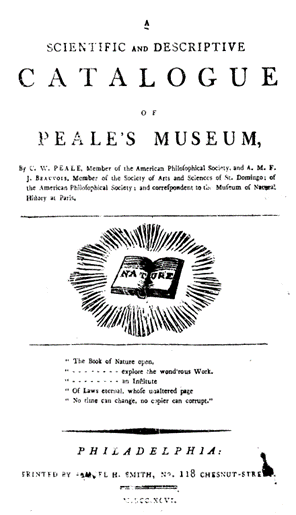
2. A Scientific and Descriptive Catalogue of Peale’s Museum (1796)
Charles Willson Peale intended to publish a catalogue of the collection in several parts. Part 1 appeared in 1796 in both French and English, compiled by Peale and Ambroise Marie François Joseph Palisot, Baron de Beauvois (“Member of the Society of Arts and Sciences of St. Domingo, Member of the American Philosophical Society, and correspondent to the Museum of Natural History at Paris”). No further sections were published.
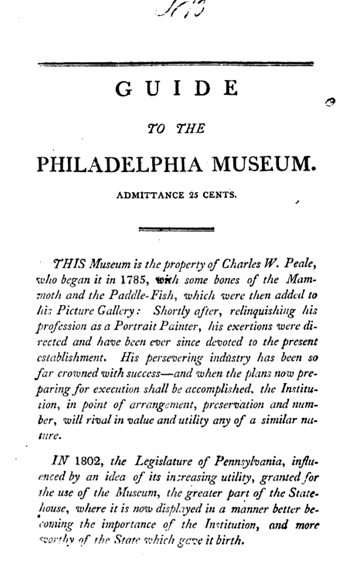
3. Charles Willson Peale’s Guide to the Philadelphia Museum (1804)
In September 1804 Peale published an eight-page pamphlet that provided an overview of the Museum’s holdings and organization. In April 1805 he published a slightly revised version, shown here, which was republished thereafter. The text also appeared in Joseph Dennie’s The Port Folio, new series, 4 (1807): 293-296. The Guide was organized by the layout of the Museum in the State House, taking the reader on a tour through the Lobby, the Quadruped Room, the Long Room, the Marine Room, Arts and Antiquities (in Philosophical Hall), the Mammoth Room, the Model Room, and the Antique Room.
4. Historical Catalogue of the Paintings in the Philadelphia Museum (1813)
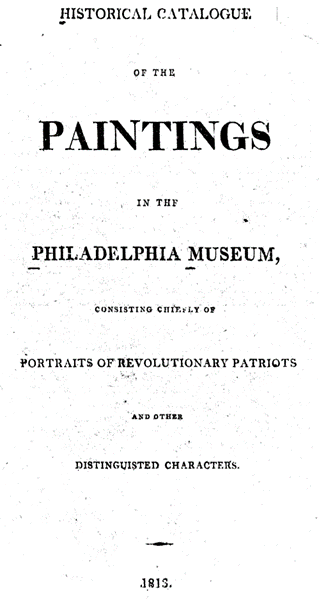
Later Catalogues of the Peale Museum Collection
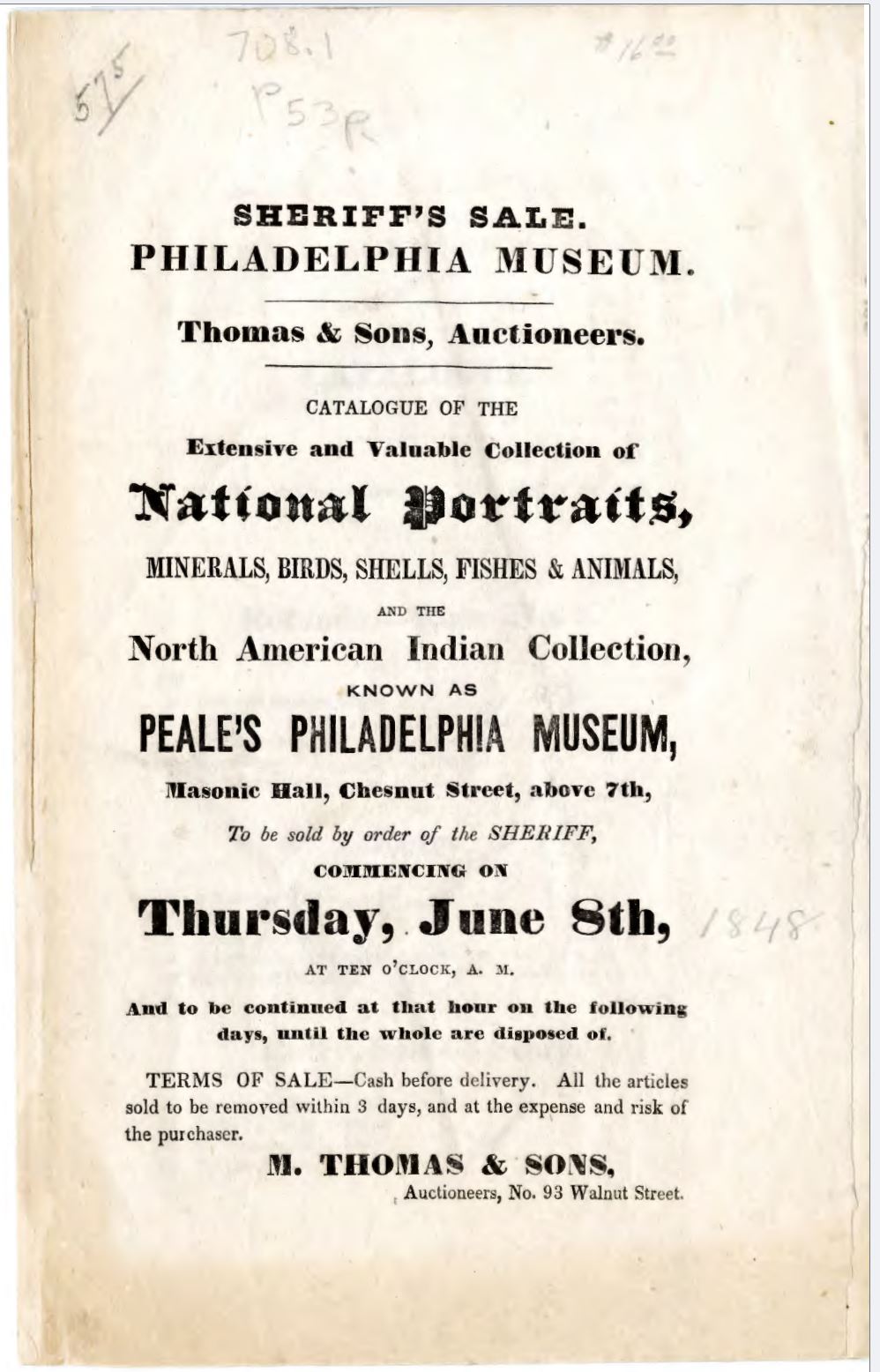
1. Sheriff’s Sale Catalogue (1848)
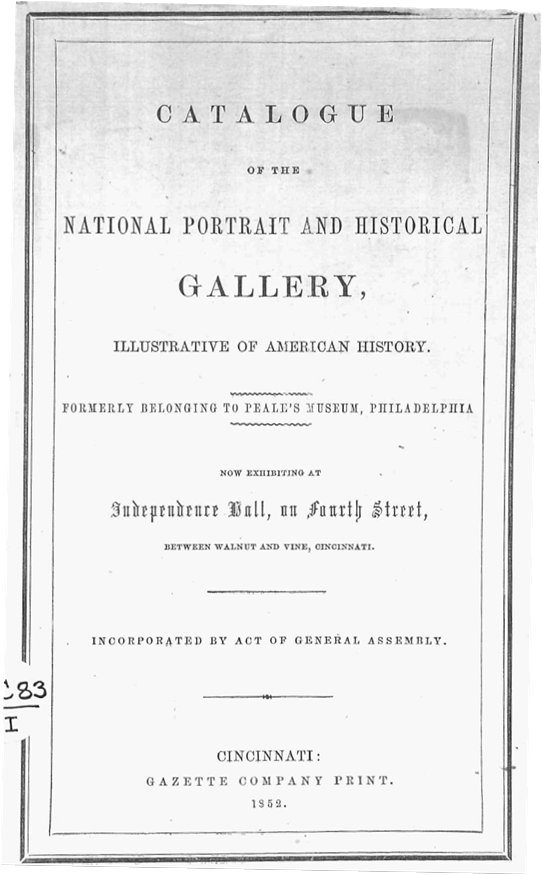
2. Cincinnati Exhibition Catalogue (1852)
3. Peale’s Museum Gallery Auction Catalogue (1854)
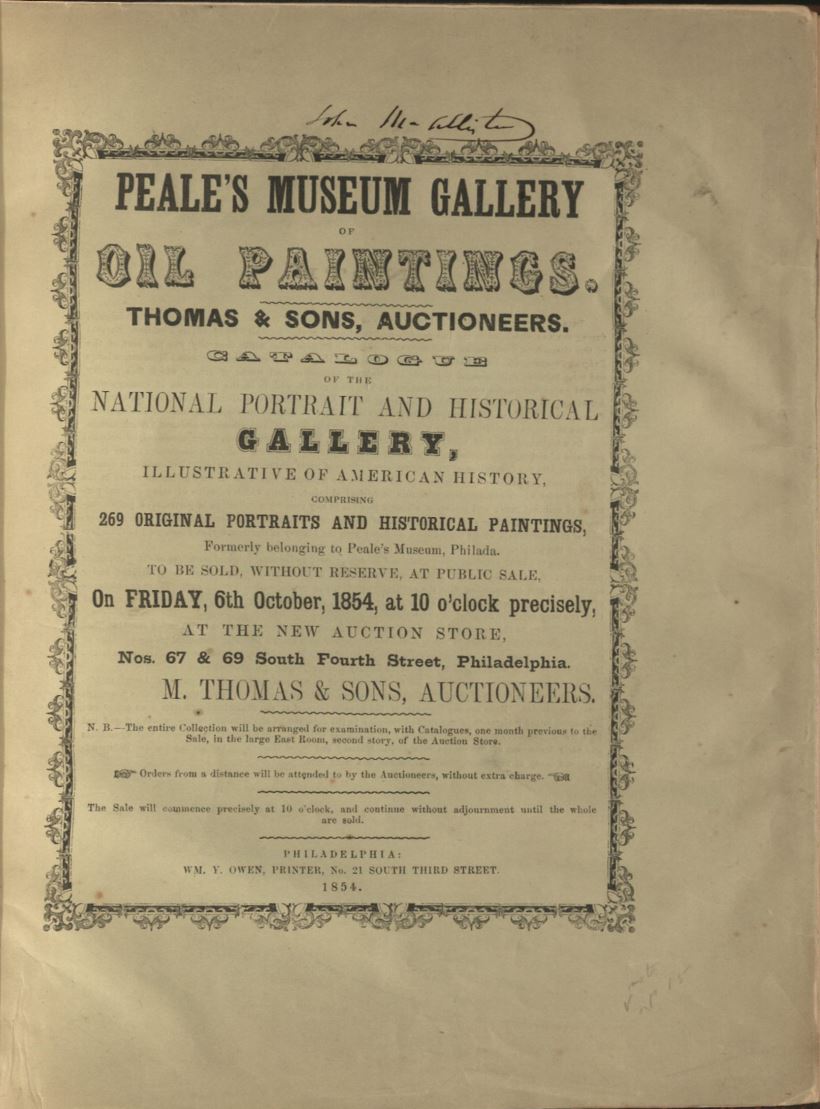
Courtesy Winterthur Museum, Garden & Library
Scientific Publications
The natural history specimens in Peale’s Museum were frequently studied by scientists who presented their findings in papers presented to organizations such as the Academy of Natural Sciences of Philadelphia and subsequently published in the scientific literature, or in books meant for general audiences. When those scientists explicitly stated that their descriptions (and sometimes illustrations) were based on specimens in the Peale Museum (or if they mentioned that examples of the species under discussion could be found in the Museum), those species have been included in the website. When these works are cited on the website a link is provided to an online source.
Charles Lucien Bonaparte (1825). American Ornithology; or, The Natural History of Birds Inhabiting the United States, Not Given by Wilson, Philadelphia: Carey, Lea & Carey
John D. Godman, American Natural History. Part I. Mastology, 3 vols. (Philadelphia, 1826-1828)
Richard Harlan, "Dissection of a Bactracian Animal in a Living State," Journal of the Academy of Natural Sciences of Philadelphia, vol. 3, part 1 (1823): 54-59
Richard Harlan, Fauna Americana: Being a Description of the Mammiferous Animals Inhabiting North America (Philadelphia, 1825)
Richard Harlan, "Notice of the Plesiosaurus, and Other Fossil Reliquæ, from the State of New Jersey," Journal of the Academy of Natural Sciences of Philadelphia, vol. 4, part 2 (1825): 232-236
Richard Harlan, "Description of Two Species of Linnæan Lacerta, Not Before Described, and Construction of the New Genus Cyclura," Journal of the Academy of Natural Sciences of Philadelphia, vol. 4, part 2 (1825): 242-251
Richard Harlan, "Description of a New Species of Biped Seps," Journal of the Academy of Natural Sciences of Philadelphia, vol. 4, part 2 (1825): 284-286
Richard Harlan, "Description of a New Species of Scincus," Journal of the Academy of Natural Sciences of Philadelphia, vol. 4, part 2 (1825): 286-288
Richard Harlan, "Description Two New Species of Agama," Journal of the Academy of Natural Sciences of Philadelphia, vol. 4, part 2 (1825): 296-304
Richard Harlan, "Description of a Variety of the Coluber fulvius, Linn., a New Species of Scincus, and Two New Species of Salamandra," Journal of the Academy of Natural Sciences of Philadelphia, vol. 5, part 1 (1825): 154-158
Richard Harlan, "Description of a Land Tortoise, from the Gallpagos Islands, commonly known as the 'Elephant Tortoise'," Journal of the Academy of Natural Sciences of Philadelphia, vol. 5, part 2 (1827): 284-292
Richard Harlan, "Genera of North American Reptilia, and a Synopsis of the Species," Journal of the Academy of Natural Sciences of Philadelphia, vol. 5, part 2 (1827): 317-372
Richard Harlan, American Herpetology , or Genera of North American Reptilia (Philadelphia, 1827)
Edwin James, Account of an Expedition from Pittsburgh to the Rocky Mountains, Performed in the Years 1819 and '20, by Order of the Hon. J.C. Calhoun, Sec'y of War: Under the Command of Major Stephen H. Long. From the Notes of Major Long, Mr. T. Say, and other Gentlemen of the Exploring Party, 2 vols. (Philadelphia, 1823)
Isaac Lea, "Description of Six New Species of the Genus Unio, Embracing the Anatomy of the Oviduct of One of Them, Together with Some Anatomical Observations on the Genus," Transactions of the American Philosophical Society, new series., 3 (1830): 259-273
Charles Alexandre Lesueur, "Descriptions of Several New Species of North American Fishes," Journal of the Academy of Natural Sciences of Philadelphia, vol. 1, part 2 (1818): 222-235
Charles Alexandre Lesueur, "Descriptions of Several New Species of Cuttle-fish," Journal of the Academy of Natural Sciences of Philadelphia, vol. 2, part 1 (1821): 86-101
Charles Alexandre Lesueur, "Description of a Squalus, of Very Large Size, which was Taken on the Coast of New-Jersey," Journal of the Academy of Natural Sciences of Philadelphia, vol. 2, part 2 (1822): 343-352
Charles Alexandre Lesueur, "Description of Several Species of the Linnaean Genus Raia, of North America," Journal of the Academy of Natural Sciences of Philadelphia, vol. 4, part 1 (1824): 100-121
George Ord, "Account of a New Species of the Genus Arvicola," Journal of the Academy of Natural Sciences of Philadelphia, vol. 4, part 2 (1825): 305-306
Ambroise Marie François Joseph Palisot, Baron de Beauvois, "Description of a New Animal, found in a Swamp in Jersey, near the Delaware," Transactions of the American Philosophical Society, 4 (1799): 279-281
Thomas Say and George Ord, "Description of a New Species of Mammalia, whereon a Genus is Proposed to Be Founded," Journal of the Academy of Natural Sciences of Philadelphia, vol. 4, part 2 (1825): 352-355
Thomas Say, "An Account of the Crustacea of the United States," Journal of the Academy of Natural Sciences of Philadelphia, vol. 1, part 2 (1818): 433-436
Thomas Say, "On a Quadruped, belonging to the Order Rodentia," Journal of the Academy of Natural Sciences of Philadelphia, vol. 2, part 2 (1822): 330-343
Thomas Say, "Appendix to An Account of the Crustacea of the United States," Journal of the Academy of Natural Sciences of Philadelphia, vol. 1, part 2 (1818): 458
Thomas Say, "Descriptions of Univalve Shells of the United States," Journal of the Academy of Natural Sciences of Philadelphia, vol. 2, part 1 (1821): 149-179
Thomas Say, "Description of Coleopterous Insects," Journal of the Academy of Natural Sciences of Philadelphia, vol. 3, part 1 (1823): 139-216
Thomas Say, "On the Fresh Water and Land Tortoises of the United States," Journal of the Academy of Natural Sciences of Philadelphia, vol. 4, part 2 (1825): 203-219
Thomas Say, "Descriptions of Three New Species of Coluber, inhabiting the United States," Journal of the Academy of Natural Sciences of Philadelphia, vol. 4, part 2 (1825): 237-241
Thomas Say, "On Two Genera and Several Species of Crinoidea," Journal of the Academy of Natural Sciences of Philadelphia, vol. 4, part 2 (1825): 289-296
Thomas Say, "On the Species of the Linnæan Genus Asterias, Inhabiting the Coast of the United States,"Journal of the Academy of Natural Sciences of Philadelphia, vol. 5, part 1 (1825): 141-154
Thomas Say, "Descriptions of Marine Shells Recently Discovered on the Coast of the United States," Journal of the Academy of Natural Sciences of Philadelphia, vol. 5, part 2 (1827): 207-221
Wilson, Alexander, American Ornithology, or, The Natural History of the Birds of the United States: Illustrated with Plates Engraved and Colored from Original Drawings Taken from Nature, 9 vols. Philadelphia: Bradford and Inskeep, Robert Carr, 1808-1814