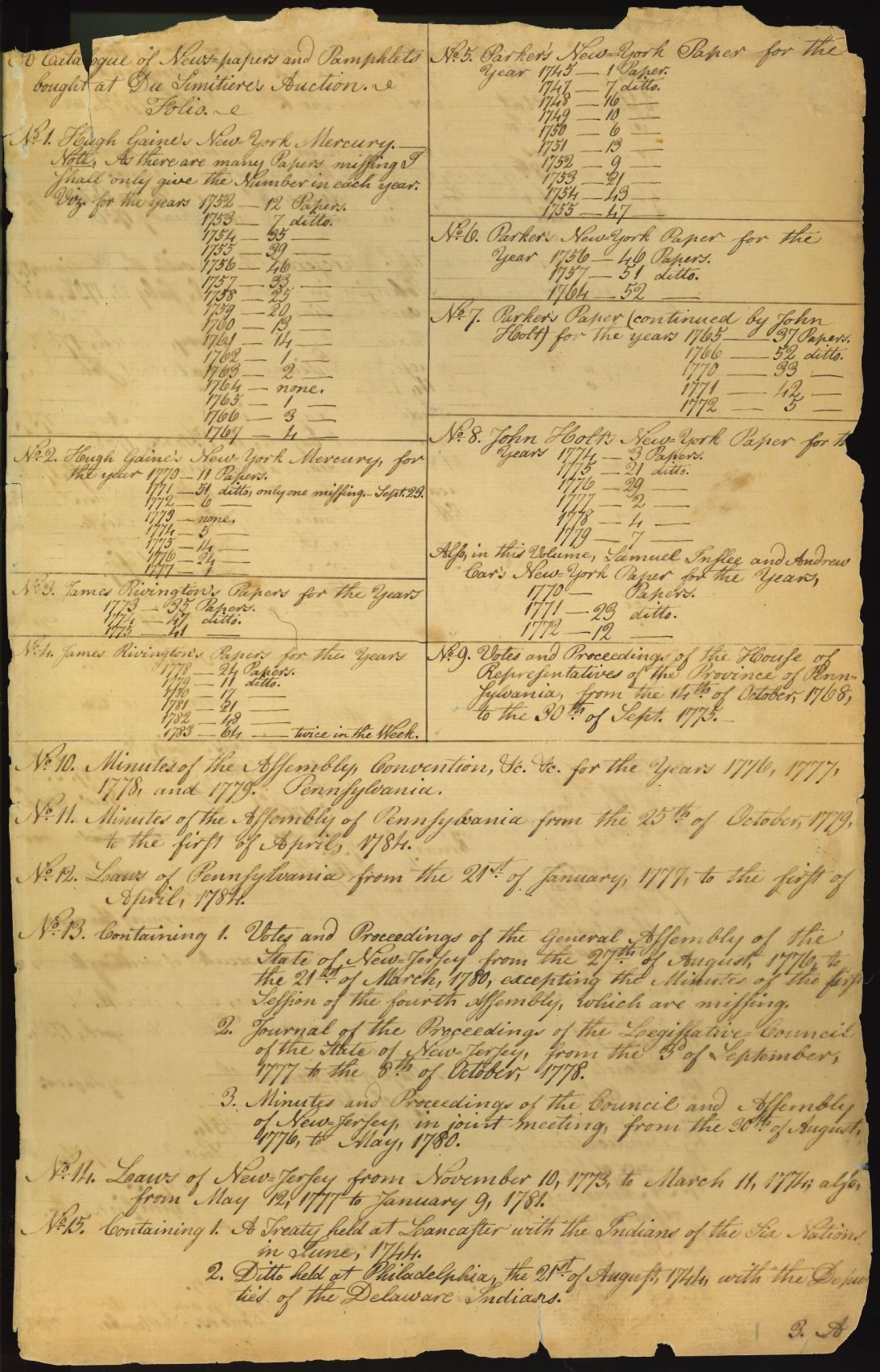
Du Simitière Sources
This section of the website lists the many primary sources, both printed and manuscript, that were used to compile the inventory of objects in the two museums.
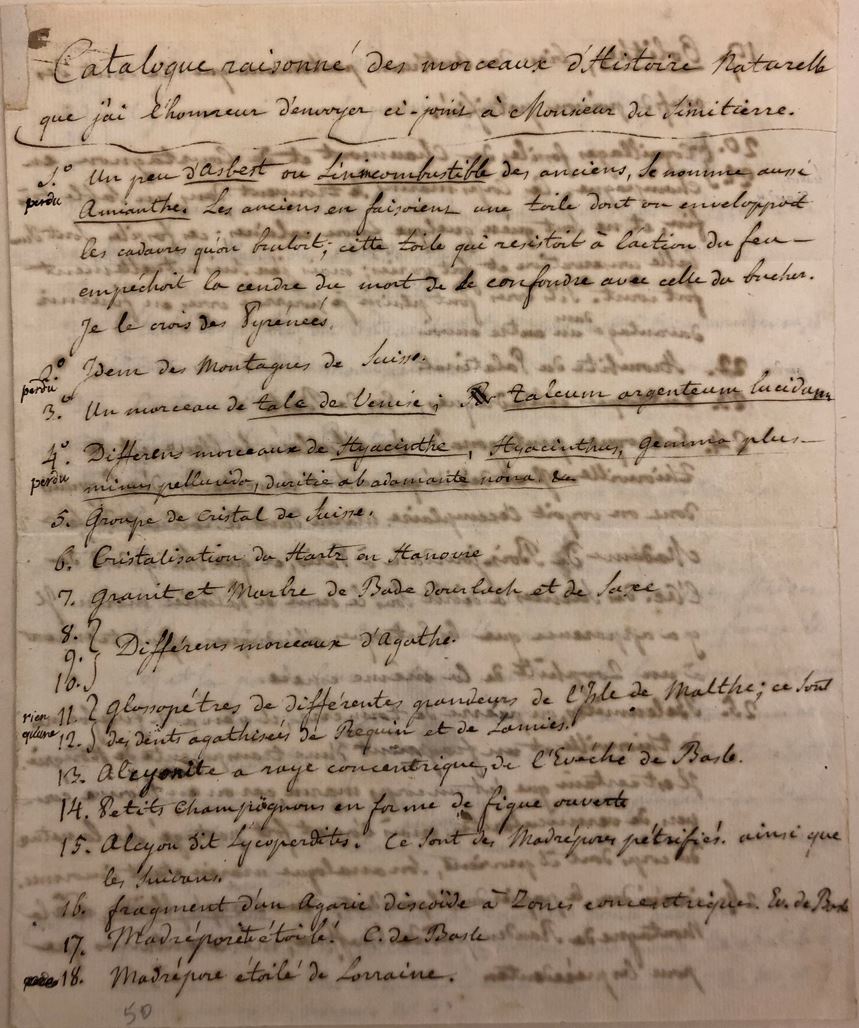
Du Simitière’s Natural History Specimens Donated by Frey, of Basel, ca. 1765-1766
Among Du Simitière’s papers at the Library Company is an undated four-page document (Scraps, No. 50; first page shown here) entitled “Catalogue raisonné des morceaux d’Histoire Naturelle que j’ai l’honneur d’envoyer ci-joint à Monsieur du Simitierre” (Catalog raisonné of the bits of natural history that I have the honor to send attached to Monsieur du Simitière) comprising a donation of more than forty fossils, minerals, and other items.
The author (the donor) is unidentified, but internal evidence suggests that he was a man named Frey, of Basel, Switzerland. He may have met Du Simitière during military campaigns in Flanders. The men corresponded and exchanged natural history specimens in 1765 and 1766.
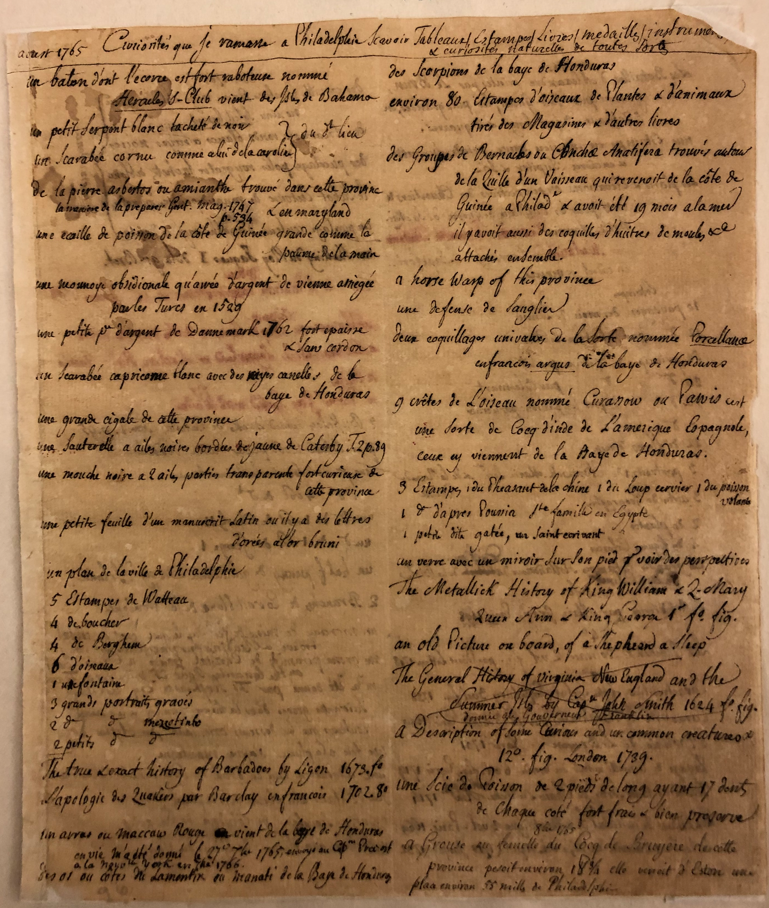
Du Simitière’s List of Curiosities Collected in Philadelphia, 1765-1766
Among Du Simitière’s papers at the Library Company is a four-page document (Scraps, No. 96; first page shown here) with entries dated from August 1765 to April 1766 listing “pictures, prints, books, medals, instruments, and natural curiosities of all sorts.”
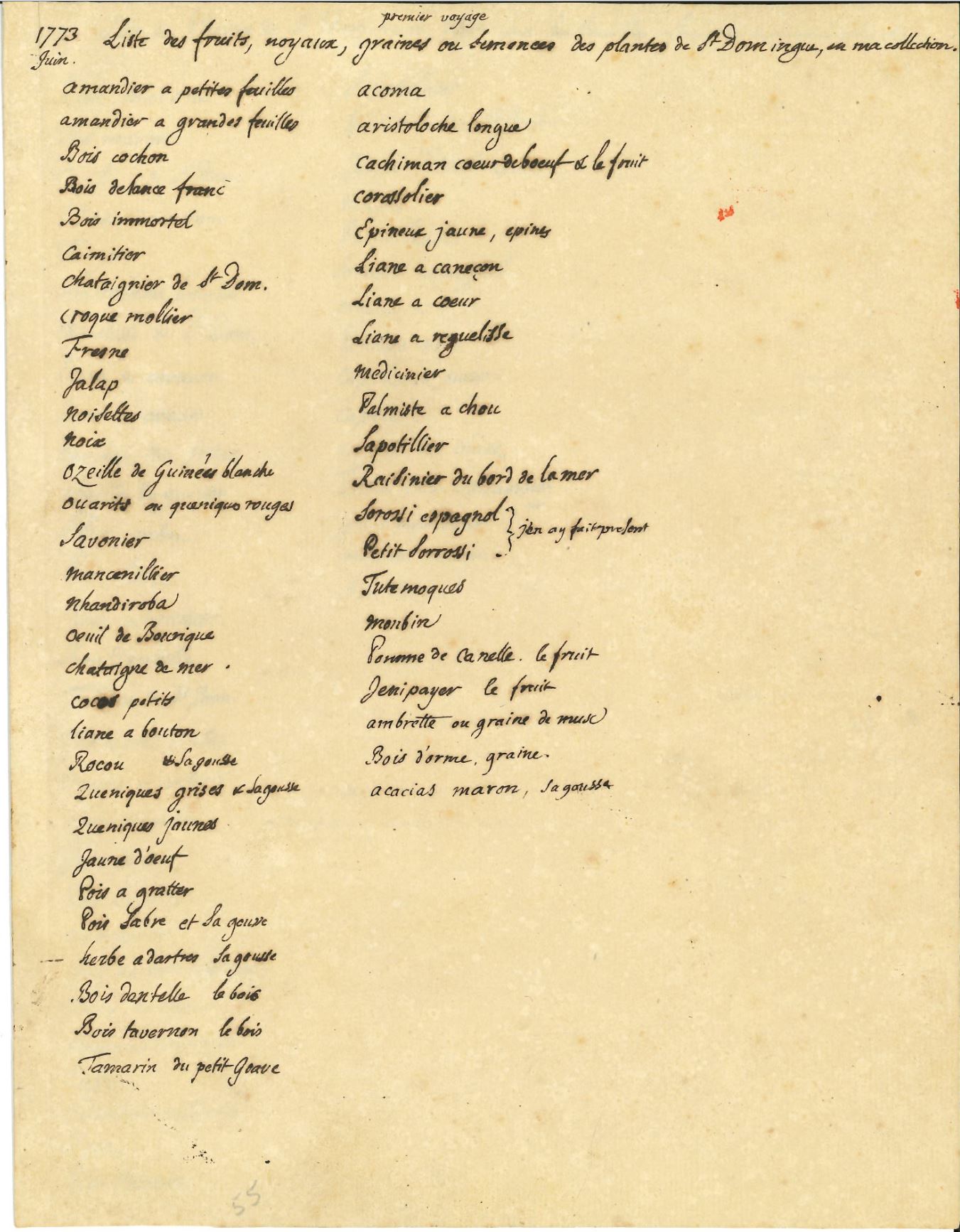
Du Simitière’s Botanical Specimens from Saint-Domingue, ca. 1773
Among Du Simitière’s papers at the Library Company is an undated four-page document (Scraps, No. 55; first page shown here) listing about 140 specimens of plants, dried leaves, fruits, stones, and seeds that he collected on two voyages to St. Domingue (Haiti). It has several parts: a “Liste des fruits, noyaux, graines ou semances des plantes de St. Domingue en ma collection, premier voyage” and a “Liste des Plantes de St. Domingue d’ont j’ay les feuilles Sechées dans ma collection” (both June 1773); and a list of “Vegetaux de St. Domingue ramassées dans mon Second voyage” (December 1773). At the auction sale of the Museum in March 1785 these specimens (and perhaps many others) were likely included in a Hortus Siccus (Lot 32) and two portfolios of Horti Sicci (Lots 34 and 35). Du Simitière identified the specimens using the local French nomenclature; the current scientific name of each species was determined by reference to the online resource P. Acevedo-Rodriguez and Mark T. Strong, “Catalogue of the Seed Plants of the West Indies,” Department of Botany, National Museum of Natural History, Smithsonian Institution (https://naturalhistory2.si.edu/botany/WestIndies/catalog.htm) and earlier published accounts of West Indian botany.
Du Simitière’s Memorandum Books, 1774-1783
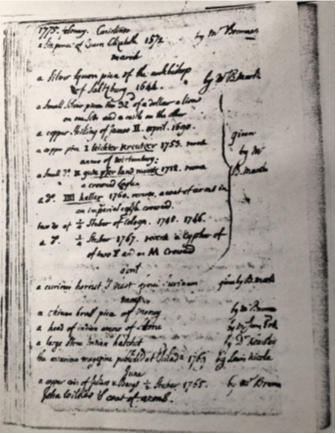
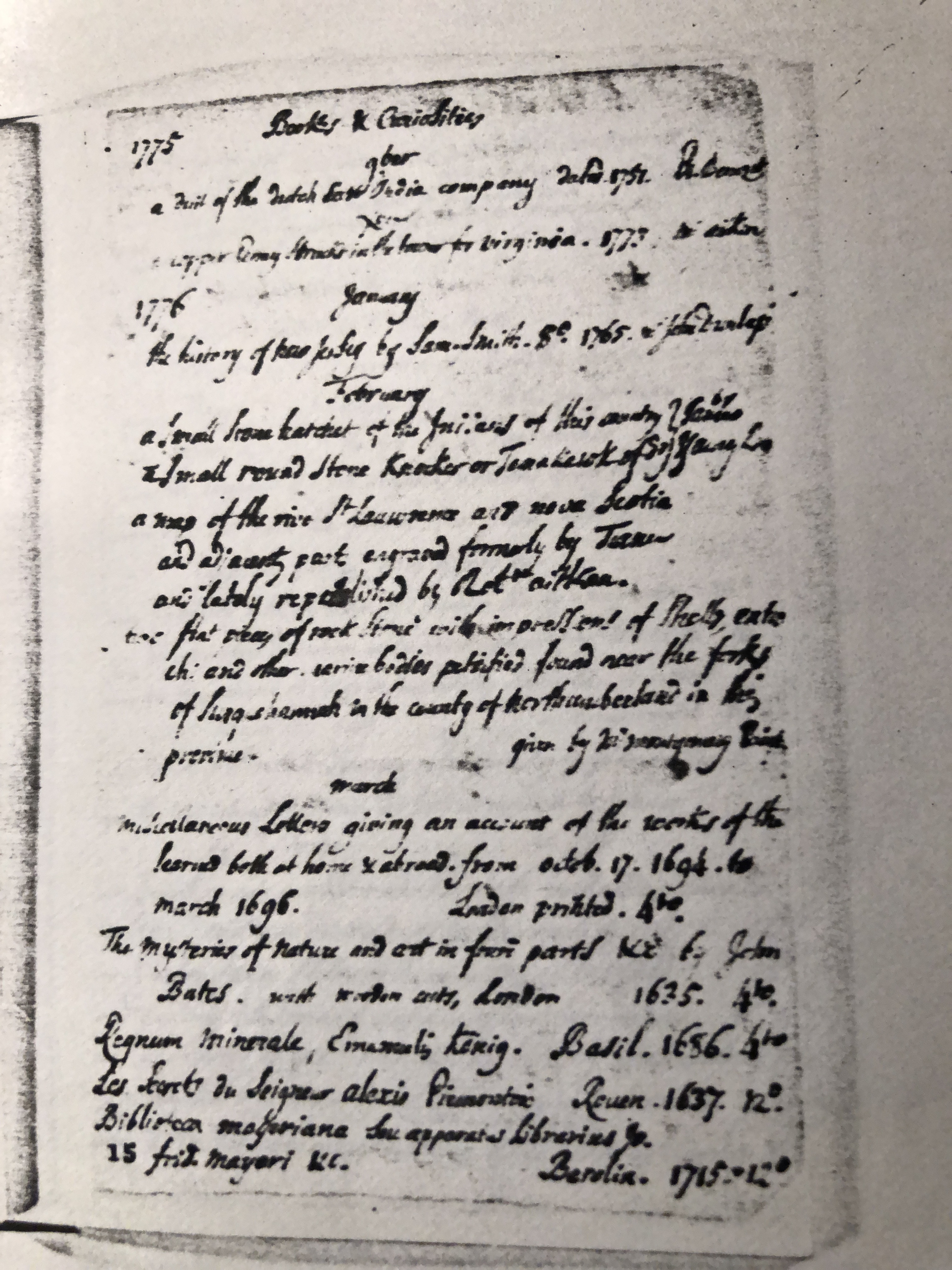
Among Du Simitière’s papers at the Library of Congress are several notebooks he kept from 1774 to 1783 comprising about 200 pages in which he recorded a great deal of information about his collections. Reproduced here are two representative pages that demonstrated the huge variety of what Du Simitière collected in just a few months of 1775-1776: coins, books, maps, an Indian hatchet, a hornet’s nest, and John Wilkes’s coat of arms, in all instances giving the names of the donors.
Du Simitière’s Roman Medals, n.d.
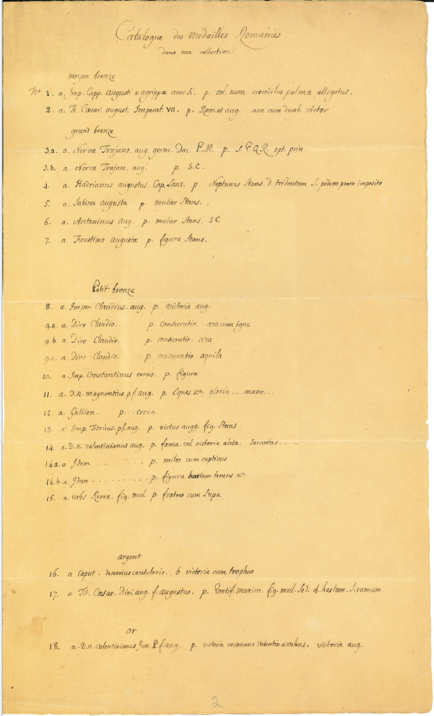
Among Du Simitière’s papers at the Library Company is a one-page document (Scraps, No. 2) listing his Roman medals.
Du Simitière’s Ancient and Modern Medals and Coins, n.d.
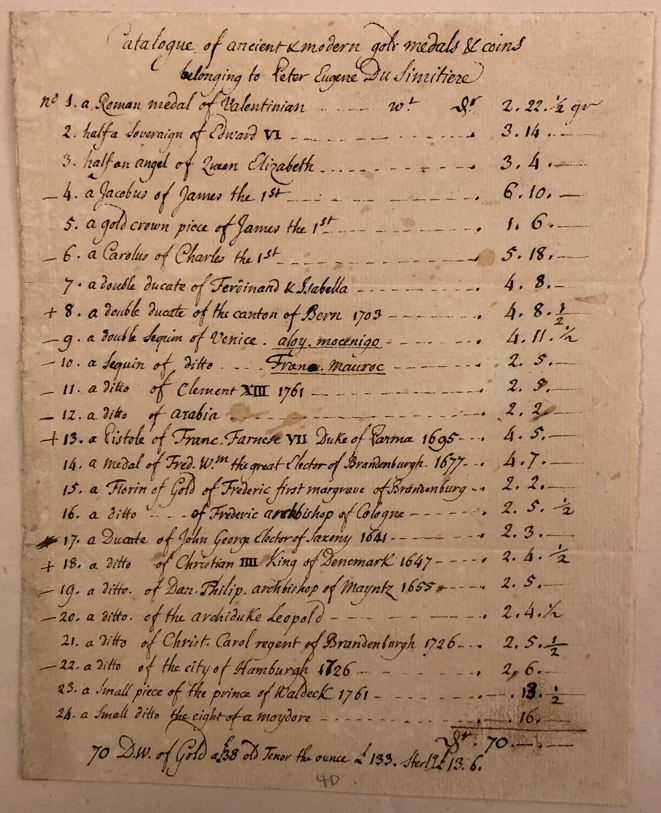
Among Du Simitière’s papers at the Library Company is a one-page document (Scraps, No. 40) listing his ancient and modern medals and coins.
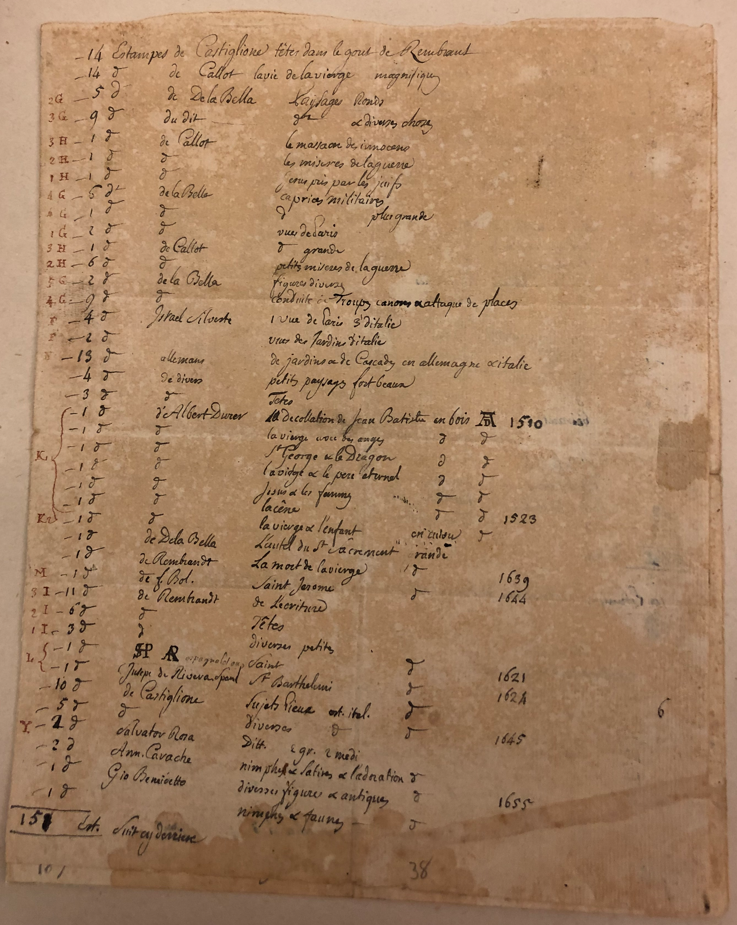
Du Simitière’s Engravings, n.d.
Among Du Simitière’s papers at the Library Company is a four-page document (Scraps, No. 38; first page shown here) listing his engravings.
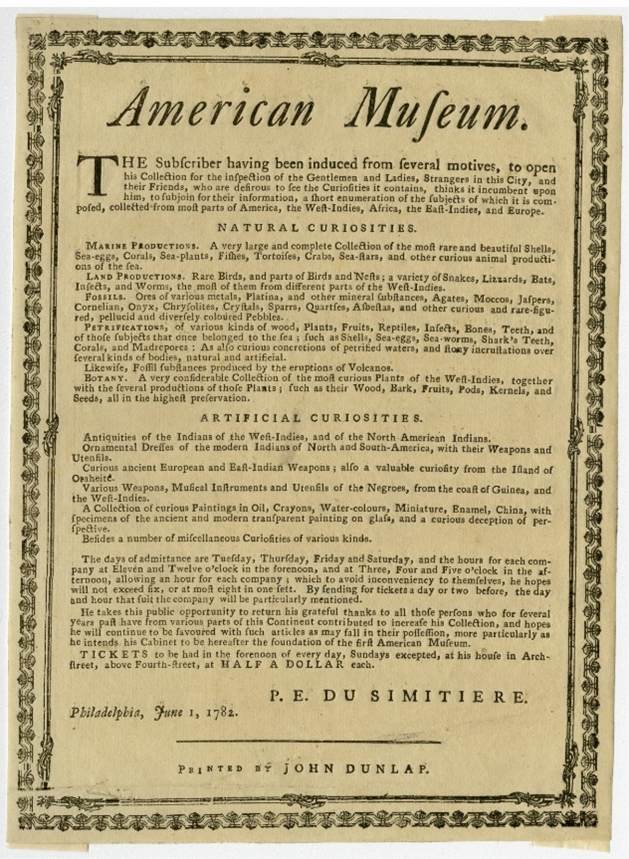
The Broadside Announcing the Opening of Du Simitière’s American Museum (Philadelphia: John Dunlap, 1782). Library Company of Philadelphia
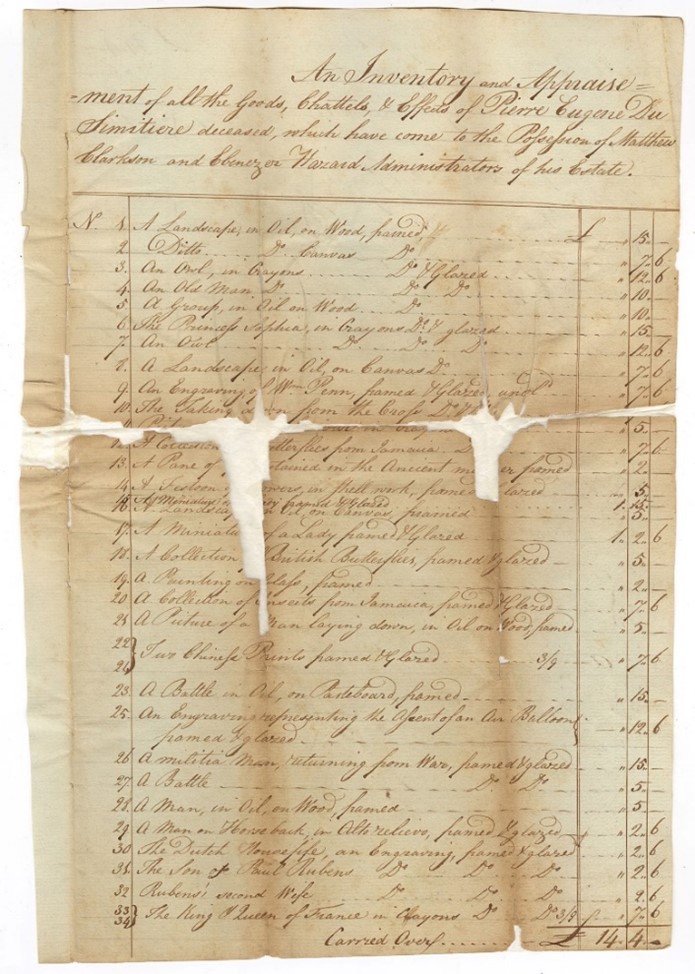
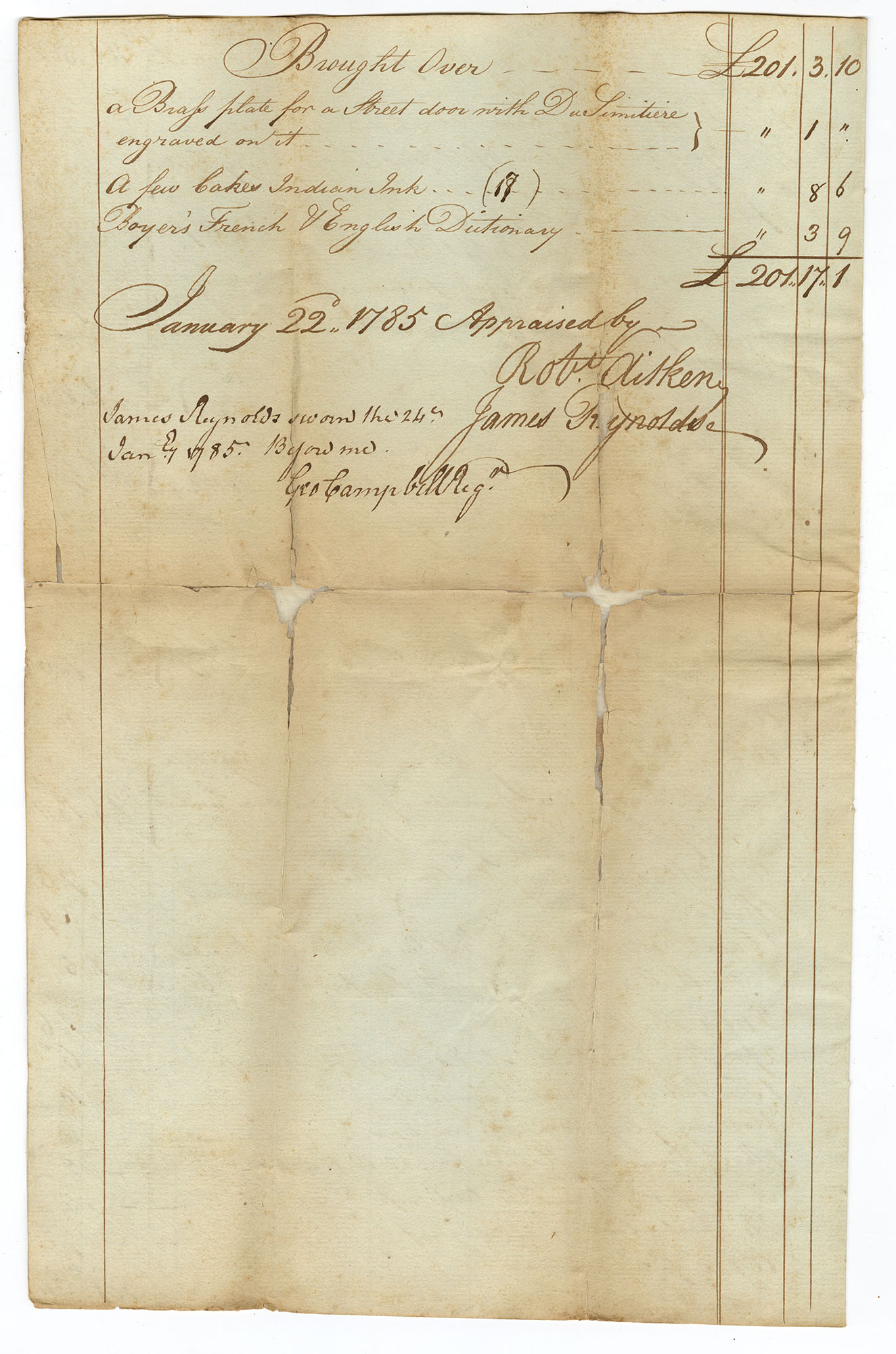
Du Simitière’s Estate Inventory (22 January 1785)
Du Simitière died in October 1784. Three months later his executors Matthew Clarkson and Ebenezer Hazard had his estate appraised by Philadelphia printer Robert Aitken and carver and gilder James Reynolds (both donors to his collection). The value of the estate was thought by Thomas Jefferson to be inadequate to satisfy Du Simitière’s debts. This fourteen-page document (first and last pages shown here), in the collections of the Library Company, records certain items not enumerated on the auction sale broadside or in other sources and provides appraised values of individual items.
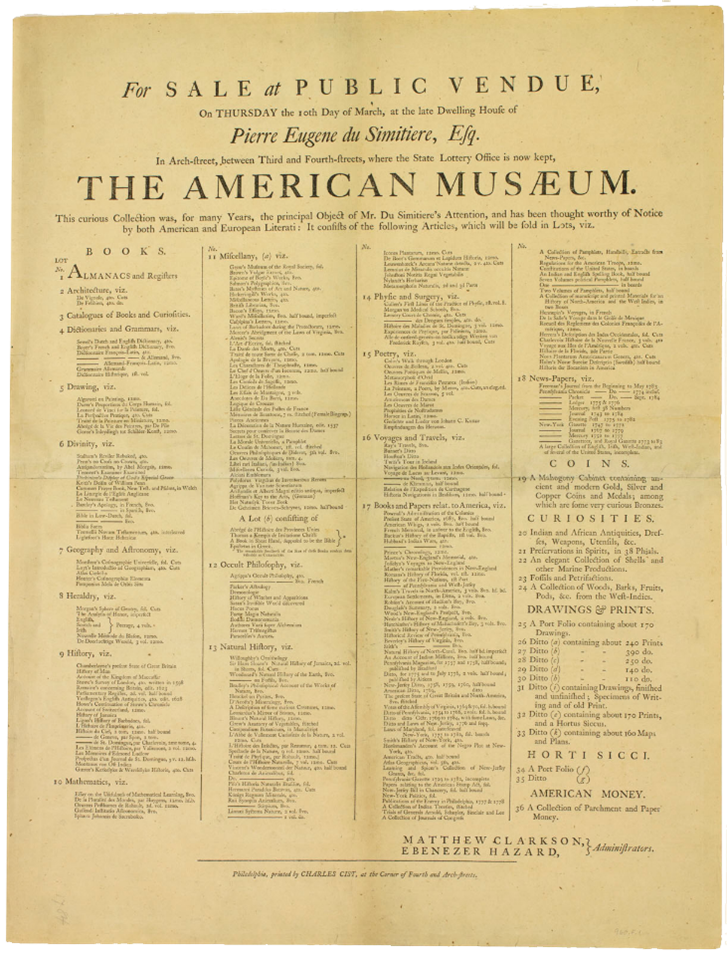
Broadside of Postmortem Sale of Du Simitière’s American Museum (Philadelphia: Charles Cist, 1785)
The Library Company holds a unique copy of this broadside, published by Du Simitière’s estate administrators, Matthew Clarkson and Ebenezer Hazard, that lists more than 200 book and newspaper titles and describes other elements of the museum, such as pamphlets, coins and medals, almost 1,500 prints, 160 maps, ethnographic materials, herbaria, shells, and fossils.
For the books, consulting the Library Company’s online catalog, WorldCat, and ESTC (The English Short Title Catalogue) enabled us to construct fuller bibliographical descriptions with reasonable certainty. These usually could be confirmed by locating listings in A Catalogue of the Books Belonging to the Library Company of Philadelphia: To Which is Prefixed a Short Account of the Institution, with the Charter, Laws, and Regulations (Philadelphia: Zachariah Poulson, 1789) (Evans 22066; accessible at https://archive.org/details/catalogueofbooks01libr), where an accession number can be searched as a keyword within the text of the catalog.
Du Simitière’s Newspapers, Pamphlets, and Broadsides
Newspapers and pamphlets formerly owned by Du Simitière are listed in this accession record and in Descriptive Catalogue of the Du Simitière Papers in the Library Company of Philadelphia (Philadelphia, 1940). The Library Company’s copy of this WPA guide is annotated with the pamphlets’ accession numbers. Item-by-item they also appear in the Library Company’s shelf-list file, which includes the many items that were sold as duplicates as well as those still on the shelves.
The newspapers were matched to records in the Library Company’s online catalog.
The broadsides formerly bound together in folio volumes presented the greatest challenge. After identifying items with provenance information linking them to Du Simitière (he signed many things, in his distinctive handwriting), the “root” accession number (such as 394.F, 395.F, and 396.F) became key to locating the other items formerly in the same volume.