Object Status:
Unlocated
Accession Date:
By 1796
Primary Source Reference:
A Scientific and Descriptive Catalogue of Peale's Museum (Philadelphia, 1796), p. 23
Additional Source Text:
"Was found at Cape May, near the mouth of the Delaware." Also listed there was another specimen, with longer forefeet and a shorter body, that Peale surmised may have been a different variety or a different sex, "found in the Delaware, fifteen or twenty miles above Philadlphia."
In his Natural History Lecture No. 3 (1799), Academy of Natural Sciences of Drexel University, Peale wrote: "This Seal was caught at Petty’s Island, a short distance above the City of Philadelphia. It was carried about our streets as a show, and probably was sick before it came into my hands, since I could not keep it living more than one week. Its size bespeak it [to] be a young one.
"This [other specimen] which is larger was caught at Cape May, is a full grown one, such as are found on our Northeastern Coast. It is seldom that they are seen so far south as the Capes of Delaware."
In his "Walk through the Phil[adelphi]a Museum" (1805-1806), pp. 16-17, Peale wrote: "From which it is said originated the fable of the Mermaid -- It is sometimes called Sea-dog, its head being of that shape & having long canine teeth, tho’ with short Ears. They are very numerous on the faulkland Islands -- so much so that Ships have been sent there for the sole purpose of getting their Skins. They are found along the North East & N west coasts of North America -- some have been taken in the Delaware.
"Its spacious Scull denotes it an Animal of great Sagasity. Buffon says, 'the sensations of the Seal are as perfect, and its sagasity as ready, as those of any other Quadruped: both the one & the other are strongly marked by its docility, its social qualities, its great attention towards its young, and by its voice, which is more expressive, and more modulated than in other Animals -- It endures both heat and cold, and feeds indifferently on Grass, fish, or flesh; it can equally live on Ice, land, or in water.' Yet it cannot stay long under water being obliged to come to the surface to breathe."
Specimen Type:
Live (presumably eventually taxidermied/preserved)
Peale's Common Name:
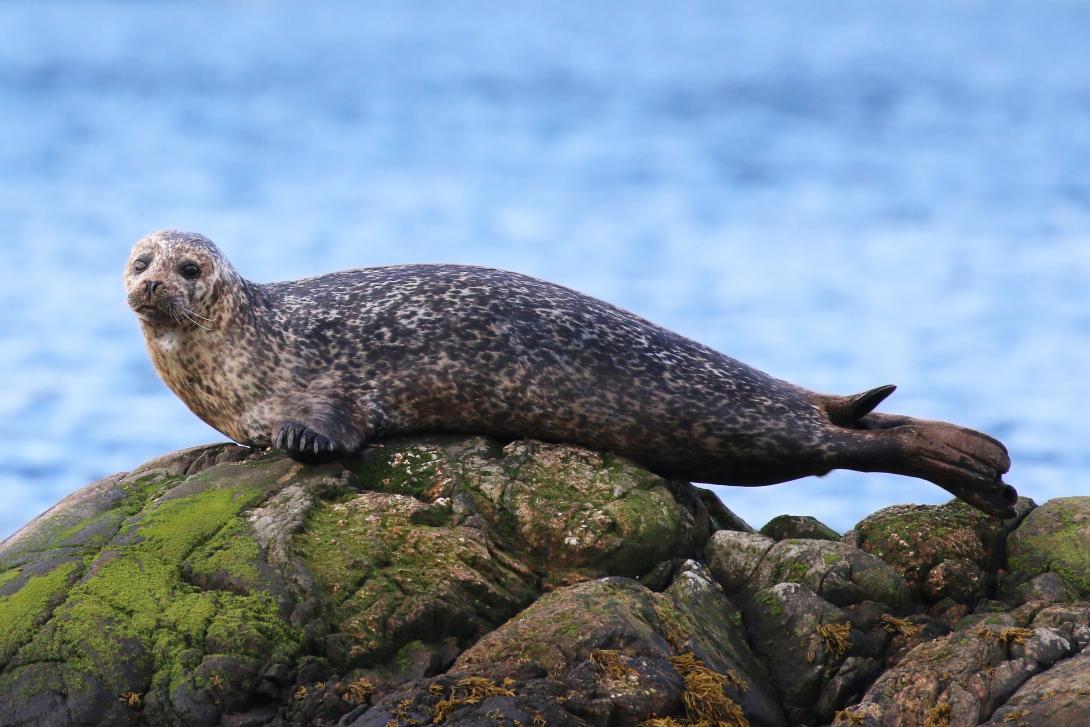
Seal
Peale's Scientific Name:
Phoca Vitulina
Current Common Name:
Harbor seal
Current Scientific Name
Phoca vitulina