Object Status:
Extant
Accession Date:
By 1799
Primary Source Reference:
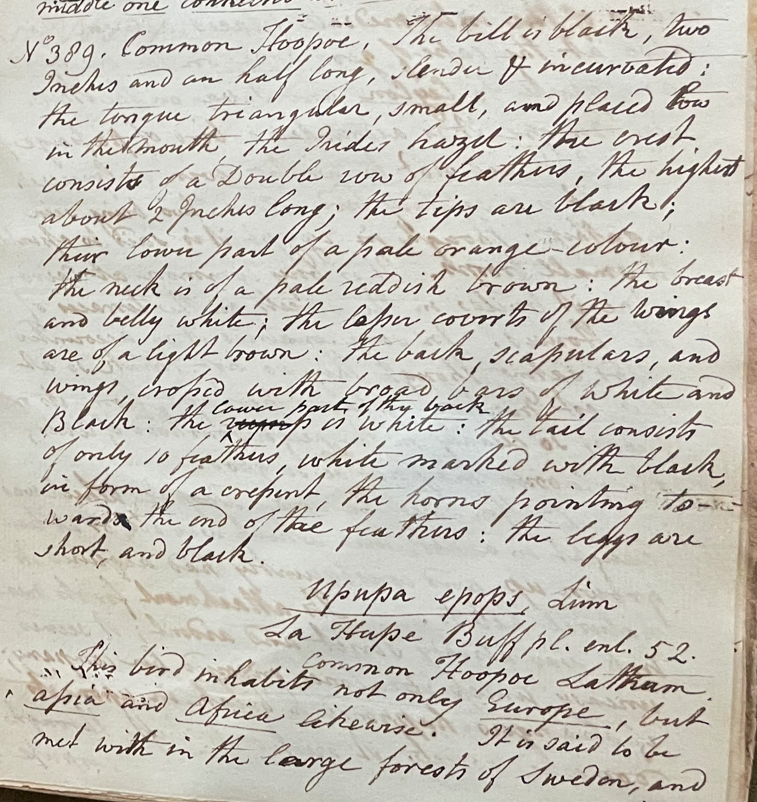
Charles Willson Peale, Lecture on Natural History 19. (ca. 1799). Academy of Natural Sciences of Drexel University Archives, coll. 40. / https://ansp.org/research/library/archives/0000-0099/coll0040/
Additional Source Text:
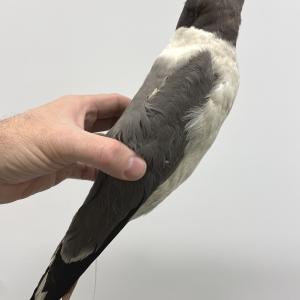
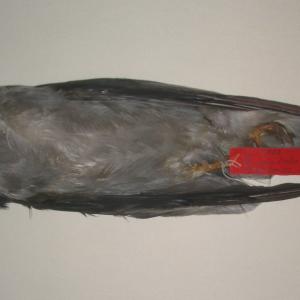
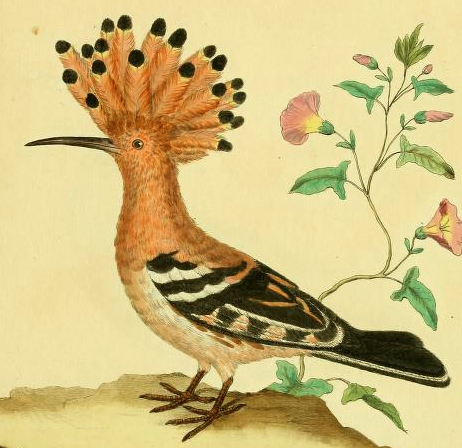
Charles Willson Peale (1741-1827) wrote, in his 19th Lecture (ca. 1799): "No. 389. Common Hoopoe. The bill is black, two Inches and a half long, slender and incurvated; the tongue triangular, small, and placed low in the mouth; the Irides hazel; the crest consists of a Double row of feathers, the highest about 2 Inches long; the tips are black; their lower part of a pale orange colour; the neck is of a pale reddish brown; the breast and belly white; the lesser coverts of the wings are of a light brown; the back, scapulars, and wings, crossed with broad bars of white and black; the rump lower part of the back is white; the tail consists of only 10 feathers, white marked with black, in form of a crescent, the horns pointing toward the end of the feathers; the legs are short, and black. Upupa epops Linn. La Hupe Buff. pl. enl. 52. Common Hoopoe Latham." (Academy of Natural Sciences of Drexel University Archives, coll. 40)
Peale continued: "This bird inhabits not only Europe, but Assia and Africa likewise. It is said to be met with in the large forests of Sweden and in Austria, but a Swedish gentleman informs me that the common […] and has been found as far north as the Orknies and Lapland, as well as in many of the intermediate places; also at the Cape of good hope on the one hand, and quite to Ceylon and Java on the other. In Europe it is accounted a bird of passage, and it is said not to winter even in Greece. It is a solitary bird seldom two being seen togather; though in Egypt it is said to assemble in small troops. It is very common at Cairo, where it builds in the streets, on the terraces of the Houses. In some countries it is accounted good eating, though they do not think so at the last mentioned place; perhaps, from its not feeding so cleanly in the neighborhood of Cities, the flavor may not be so good." (ANSP Archives, coll. 40)
"Buffon says, he saw a Hoopoe, which was caught in a net, and which was old, or at least grown up, and consequently had acquired its natural habits. Its attachment for its mistress was already strict and ardent; it seemed uneasy unless it alone enjoyed her company; if strangers happened to break in upon its domestic society, it erected its tuft, through surprise or disquietude, and fled to the top of the bed which was in the same room; sometimes it had the resolution to descend from its asylum, but then it flew directly to its mistress, who enjoyed exclusively all its regard, and affection. It had two very different kinds of noises; the one soft and tender, flowing from sentiment, and directed to its mistress; the other harsh and shrill, and expressing anger or fear. It was never confined in its cage, either by day or night, but ran about the House; and, though the windows were after open, it never shewed any desire of affecting its escape. At last, happening to be scared, it disappeared suddenly; it flew but a short distance, and not being able to find its way back again, it threw itself into a nun's cell, where the window had been left open; so necessary was human society become to its existance and comfort! It died in this retreat, where it could only be fed, and where its proper mode of treatment was unknown. Yet it lived three or four months in its first condition, its sole subsistence being a little bread and cheese. Another hoopoe was fed for eighteen months upon raw flesh; it was excessively fond of this, and hastened to eat it out of the hand; it rejected, on the contrary, what had been cooked. This predilection for raw flesh seems to indicate an analogy to the rapacious birds and those which live upon Insects." (ANSP Archives, coll. 40)
Peale continued: "The ordinary food of the Hoopoe is insects in general, and especially such as grovel on the surface either their whole life, or during a part of it; beetles, ants, worms, wild bees, and many kinds of catterpillars, &c. Hence this Bird haunts wet grounds, where its long and slender Bill can easily penetrate, and hence in Egypt, it follows the retreat of the Nile [River]; for, in proportion as the waters subside, the plains are left covered by a coat of slime, which being heated by a powerful Sun, quickly swarms with immence numbers of all kinds of Insects." (ANSP Archives, coll. 40)
Peale continued: "Accordingly, the migratory Hoopoes are very fat and delicious. I say the migratory Hoopoes, for there are others in the same country often seen on the date trees, in the neighborhood of Rosetta, which are never eaten; the same is the case with those which are very frequent in Grand Cairo, where they breed with full security on the House-tops. It is easy, indeed to conceive that Hoopoes, which live remote from man, in forsaken pains, are better food than such as haunt the streets or the environs of a large city; the former subsist upon the insects that lodge among clay and mud; the latter prowl among all sorts of filth, which about wherever vast numbers of men are collected; a circumstance which cannot fail to beget an aversion to the City Hoopoes and even communicate an offensive odour to their flesh. [A note in the margin indicates that much of this information was sourced from Latham]. There is a third intermediate class, which settling in our gardens, live upon Catterpillars and earth worms. It is universally agreed that the flesh of the Hoopoes, which feed so nastily, have fault bt that of tasting strongly of musk, which is perhaps the reason that cats, which are generally so fond of birds, will not touch them." A footnote at the bottom of the page reads: "Mr. Buffon extends much farther on the Hoopoe." (ANSP Archives, coll. 40)
Peale wrote, in "A Walk Through the Philad[elphi]a Museum" (1805–1806): "The beautiful crest of the common hoopoe (U. epops) distinguishes it in every country it visits, and it migrates through Europe, Assia & Africa. They are common in the meadows of Sweden, and they build their nests on the Terraces of the Houses of Cairo in Egypt. Buffon gives a pleasing account of the attachments of one of this species, and its fondness of music." (Historical Society of Pennsylvania, coll. 0481)
Specimen Type:
Dead/preserved
Current Common Name:
Eurasian Hoopoe
Current Scientific Name
Upupidae | Upupa epops