Object Status:
Unlocated
Accession Date:
By 12 October 1792
Primary Source Reference:
Charles Willson Peale, letter to Thomas Hall of Moorfields, London, dated 12 October 1792; Selected Papers, 2, part 1: 42.
Additional Source Text:
Charles Willson Peale (1741-1827) sent a "Wood or summer Drake" to Thomas Hall in London, on 12 October 1792 (Miller 1988: 42, Selected Papers, Vol. 2, part 1, Yale University Press).
Peale wrote in his 22nd Lecture (ca. 1799): "530. Summer Duck. The rich plumage of this beautiful Duck seems to be a studied attire, a gala suit, to which its elegant head-dress adds grace and lustre. a piece of beautiful rufous, speckled with little white dashes, covers the back, neck, and the breast, and is neatly intersected on the shoulders by a streak of white, accompanied by one of black; the wing is covered with feathers of a brown that melts into black with rich reflections of burnished steel; and those of the flanks are very delicately fringed and vermiculated with little blackish lines on a grey ground, and are prittily striped at the tips with black & white, of which the streaks are displayed alternately, and seem to vary according to the motion of the bird; the underside of the body is pearly white grey; a small white collar rises into a chin-[…] below the bill, and sends off a scallop below the Eye, on which another long streak of the same colour passes like a long eyelid; the upper side of the head is decorated with a superb tuft of long feathers, white, green, and violet, which fall back like hair, in bunches parted by smaller white bunches. The front and the cheeks dazzle with the lustre of bronze; the iris is red; the bill the same, with a black spot above, and the horny tip is of the same colour; the base is hemmed with a fluffy brim of yellow. Anas sponsa Linn. Beau Canard huppé de la Caroline. Buff. pl. enl. 980. Summer Duck Catebsy i. 97. Pennant No. 493. (Academy of Natural Sciences of Drexel University Archives, coll. 40)
Peale continued: "531. Female, head of a deep brown; crested, but not so much as the Drake; back deep brown; behind each eye a white spot; throat white; neck and breast reddish brown, with white sagittal spots; underparts of the body white. This most elegant species is found from New York to the Antilles. It passes the summer in the Jerseys and as far south as carolina, builds its nest in trees which grow near the water, especially in old Cypress. When the young are hatched, they are conveyed down on the backs of the old ones, to whom the ducklings adhere closely with their bills. The Mexicans call it the bird of various coloured head. It is there migratory." (ANSP Archives, coll. 40)
An undated scrap of paper tucked into Peale's 21st lecture manuscript contains a scribbled list of duck specimens, including: "Beautiful Summer D (sponsa)" (ANSP Archives, coll. 40).
Peale wrote, in "A Walk Through the Philad[elphi]a Museum" (1805–1806): "Among the most beautiful [ducks] ranks our Summer Duck (A. Sponsa). It is splendid without gaudy Colours. The female not so brilliant yet dressed with delicately tinted colours. They are the only Ducks we know who build their nests in Trees, chusing generally an Old Cypress that hangs over the water. When the young are hatched, they are conveyed down on the back of the Old ones, to whom the ducklings adhere closely with their bills. They pass the summer in the Jerseys and as far south as Carolina." (Historical Society of Pennsylvania, coll. 0481)
An undated list of 21 bird specimens in Peale's handwriting includes one "Summer Wood Duck" (American Philosophical Society Library, Mss.B.P31).
On 19 June 1809, "A Summer duck (preserved)" was donated by an unknown patron to the Philadelphia Museum, according to an entry in the Peale Museum Accessions Book (HSP, coll. 0481).
Alexander Wilson (1766-1813) described this species under the name "Summer Duck / Anas sponsa" in American Ornithology vol. 8, published posthumously (Pl. 70), where "Peale's Museum, No. 2872" was cited (Wilson 1814: 97). / https://www.biodiversitylibrary.org/item/175758#page/117/mode/1up (text) / https://www.biodiversitylibrary.org/item/175758#page/112/mode/1up (plate)
Notes:
After Peale's Museum closed, a portion of Peale's bird collection was purchased in 1850 by Moses Kimball (1809–95), who displayed it at his "Boston Museum". An advertisement in the Boston Transcript, printed 1 October 1850, stated that Kimball had acquired "One Half of the celebrated Peale's Philadelphia Museum". The other half of Peale's birds had been sold to the circus promoter P. T. Barnum (1810–91) and would be subsequently destroyed in a fire at his "American Museum" in New York City in July 1865. When the Boston Museum closed, Kimball's Peale remnants passed temporarily to the Boston Society of Natural History, who disposed of them to Charles J. Maynard (1845-1929), a local taxidermist. The specimens were stored in a barn in Massachusetts for several years, then eventually were deposited at the Museum of Comparative Zoology (MCZ), Harvard University. By the time the collection was catalogued by Walter Faxon (1848-1920) at MCZ, in 1914, in virtually every case the original mounts and labels had been disassociated from the specimens, and an untold number were lost.
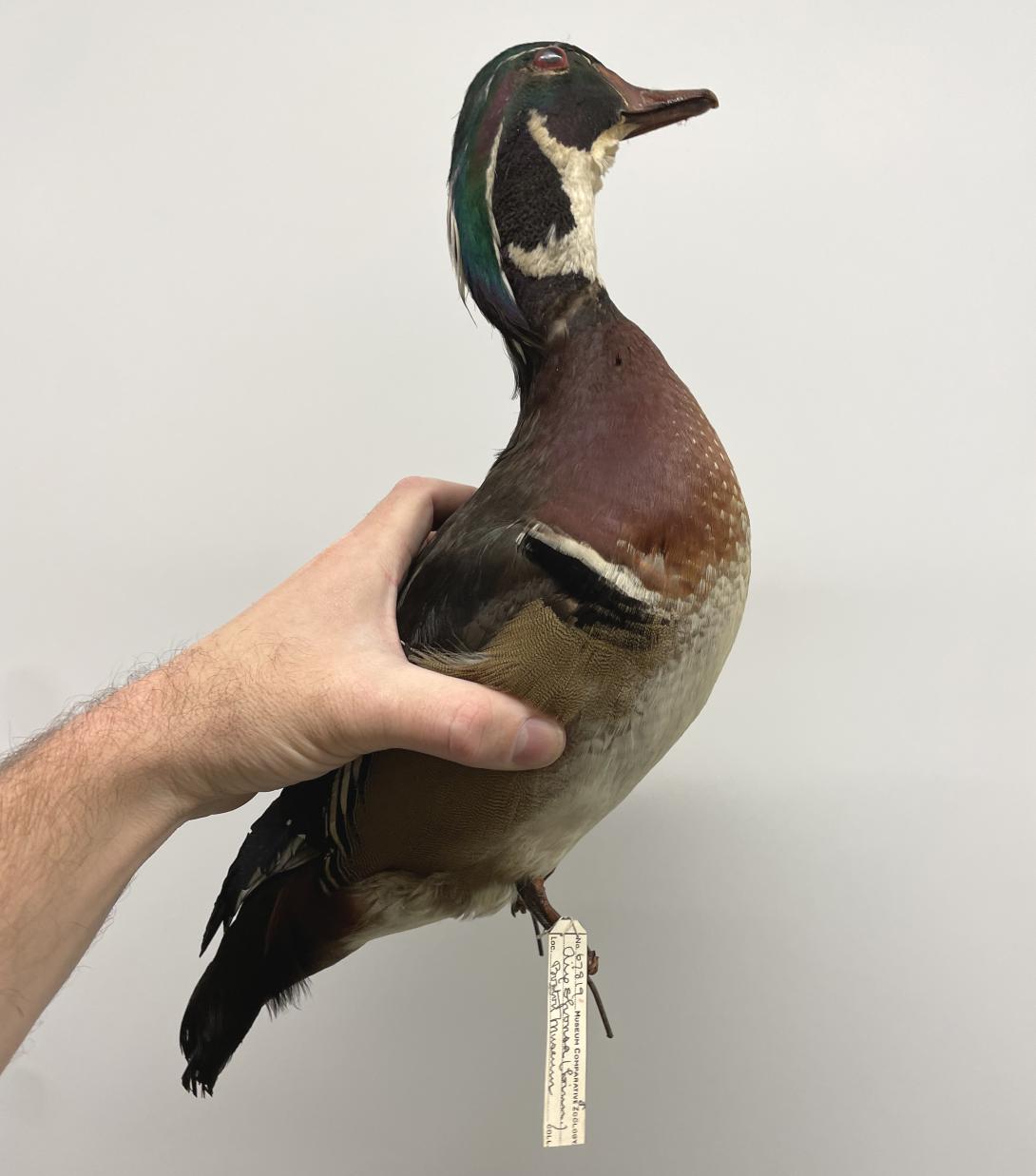
Walter Faxon, "Relics of Peale's Museum," Bulletin of the Museum of Comparative Zoology, 59, no. 3 (July 1915): 129, speculated that MCZ 67819 (shown here), a data-deficient specimen from the Boston Museum collection, was “probably the original of Wilson’s figure." / https://www.biodiversitylibrary.org/page/6339801#page/179/mode/1up
This species was common enough that Peale was using duplicate specimens for exchanges with foreign naturalists. Therefore, although MCZ 67819 may have been from Peale's collection, it is unlikely that Wilson used it as a model for his drawing. Wilson (1810: viii, American Ornithology, vol. 2) previously stated that "no drawings have been, or will be made for this work, from any stuffed subjects, where living specimens of the same can be procured; yet the former serve a very important purpose; they enable the author to ascertain the real existence and residence of such subjects" / https://www.biodiversitylibrary.org/item/175511#page/14/mode/1up
Wilson deposited many specimens at Peale's Museum, after completing his drawings, but the combined evidence from American Ornithology and the Peale Museum Accessions Book (Historical Society of Pennsylvania, coll. 0481) suggests that he deposited probably fewer than 100 skins total (and possibly as few as 40-50), whereas many authors have assumed that all the "Peale numbers" cited in Wilson's work were those of his own specimens (e.g., "he contributed 279 specimens to the collection", Edward H. Burtt, Jr., and William E. Davis, Jr., 2013, Alexander Wilson: The Scot Who Founded American Ornithology, Belknap Press, p. 310). This assumption appears to be based on a misunderstanding — Wilson was citing the numbers to give credit to Peale, to acknowledge his contributions, not to stake a claim to his own discoveries. If Burtt & Davis (2013) were correct, the "Catalogue of Duplicate Specimens" (APS Library, Mss.B.P31) would be full of Wilson's specimen deposits—but this is not the case. To the editor's (MRH) knowledge, there is no evidence that Wilson deposited a Wood Duck at Peale's Museum.
Specimen Type:
Dead/preserved
Current Common Name:
Wood Duck
Current Scientific Name
Anatidae | Aix sponsa
Repository:
Museum of Comparative Zoology, Harvard University (MCZ 67819)
![Titian Ramsay Peale, 1820, "Engineer Cant[onment]."](/sites/default/files/2026-04/woodduck.jpg)