Object Status:
Extant
Accession Date:
By 1799
Primary Source Reference:
Charles Willson Peale, Lecture on Natural History 21. (ca. 1799). Academy of Natural Sciences of Drexel University Archives, coll. 40. / https://ansp.org/research/library/archives/0000-0099/coll0040/
Additional Source Text:
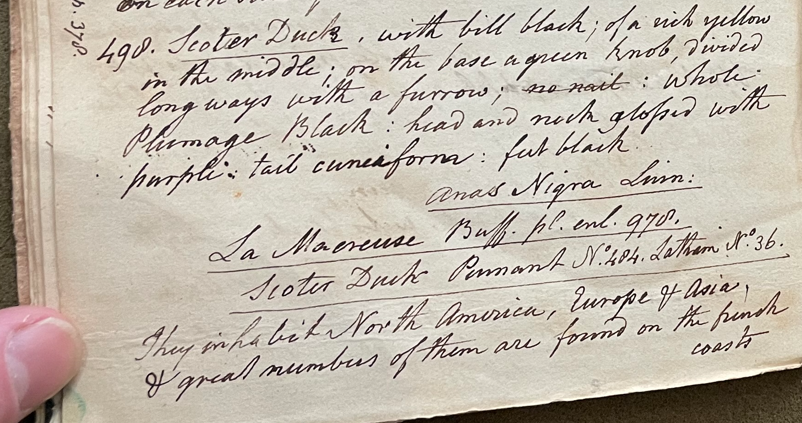
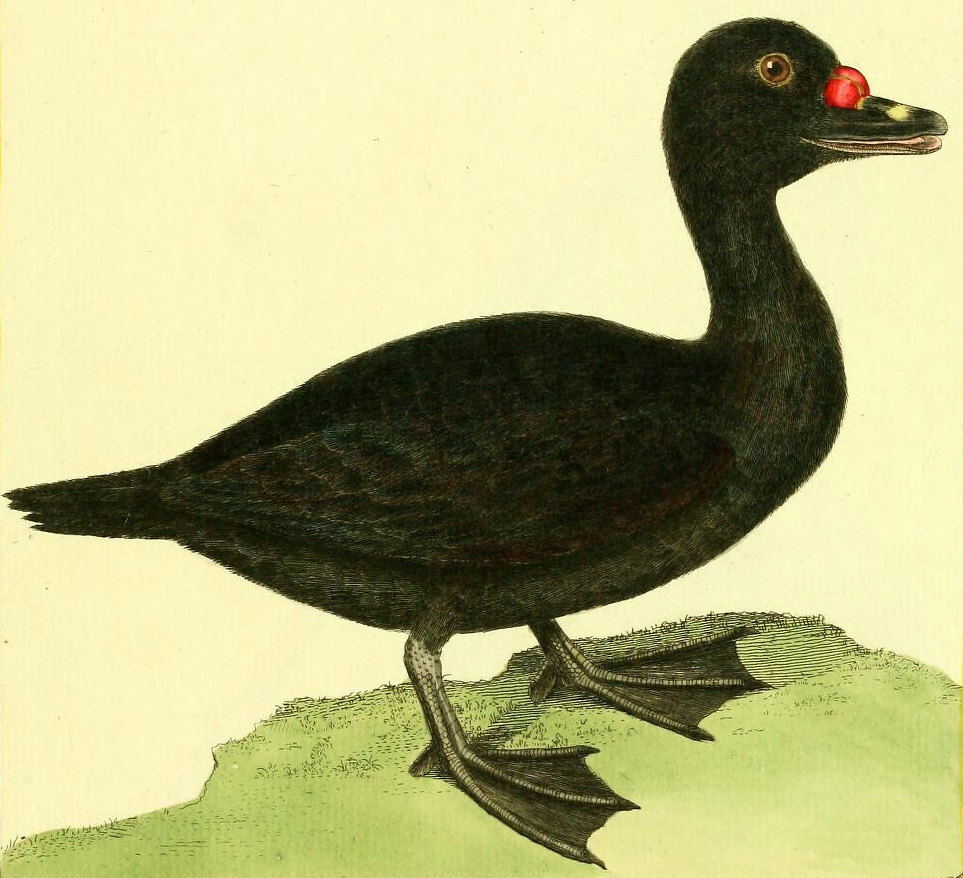
Charles Willson Peale (1741-1827) wrote, in his 21st Lecture (ca. 1799): "498. Scoter Duck. with bill black; of a rich yellow in the middle; on the base a green knob, divided longways with a furrow; whole plumage black; head and neck glossed with purple; tail cuneiform; feet black. Anas nigra Linn. La Macreuse Buff. pl. enl. 978. Scoter Duck. Pennant No. 484. Latham No. 36. They inhabit North America, Europe & Asia, & great numbers of them are found on the French coasts." (Academy of Natural Sciences of Drexel University Archives, coll. 40)
Peale continued: "Their chief food is a glossy bivalve shell, near an inch long, called by the French, vaimeaux; these they are perpetually diving after frequently to the debth of some fathoms; this affords an usual method of catching them by placing nets under water, in places where the shells are most numerous; and by this means thirty or 40 Dozen of them have been taken in one tide. The flesh tastes fishy to an extreme, and, from this cause, is allowed by the Roman Catholicks to be eaten on fast-days, and in Lent; and indeed, Mr. Latham says, must be a sufficient mortification." An undated scrap of paper tucked into Peale's 21st lecture manuscript contains a scribbled list of duck specimens, including: "Scoter duck (nigra) from Sweden" (ANSP Archives, coll. 40).
Peale wrote, in "A Walk Through the Philad[elphi]a Museum" (1805–1806): "The Scoter Duck (a. Nigra) and common wigeon (a. Penelope) came from Sweden, they differ from the American Scoter (and American Wigeon called the bald pate)." (Historical Society of Pennsylvania, coll. 0481).
Alexander Wilson (1766-1813) described this species under the name "Scoter Duck / Anas nigra" in American Ornithology vol. 8, published posthumously (Pl. 72), where "Peale's Museum, No. 2658" was cited (Wilson 1814: 135). Wilson evidently used Peale's specimen from Sweden as the model for his description, and combined it with anecdotal information about the American species, which is now recognized as a distinct species (M. americana). Due to an apparent typographical error, this species and "Velvet Duck / Anas fusca" (White-winged Scoter, M. deglandi) in the same volume (Wilson 1814: 137) bear the same Peale Museum number (2658). / https://www.biodiversitylibrary.org/item/175758#page/159/mode/1up (text) / https://www.biodiversitylibrary.org/item/175758#page/154/mode/1up (plate)
Notes:
A letter from Rev. Nicholas Collin (1746-1831) to Charles W. Peale, dated 2 June 1793, confirms that “Mr. Gustavus Von Carlson (President of one of the supreme courts of Justice) has charged himself with the exchange of Birds. This eminent ornithologist owns a precious Cabinet of Birds, containing more than 800 species; & has by testamentary disposition generously bequeathed the whole to the said [Swedish] Academy of Sciences. You will therefore be pleased to send in future the birds directly to him. He has already in return, forwarded several of the most valuable Swedish Birds…” (Miller 1988: 49, Selected Papers, Vol. 2, part 1, Yale University Press).
Specimen Type:
Dead/preserved
Current Common Name:
Common Scoter
Current Scientific Name
Anatidae | Melanitta nigra
Category:
Collection: