Object Status:
Extant
Accession Date:
By 1799
Primary Source Reference:
Charles Willson Peale, Lecture on Natural History 22. (ca. 1799). Academy of Natural Sciences of Drexel University Archives, coll. 40. / https://ansp.org/research/library/archives/0000-0099/coll0040/
Additional Source Text:
Charles Willson Peale (1741-1827) wrote, in his 22nd Lecture (ca. 1799): "506. Hook-billed Duck. these Ducks are supposed by Latham to be a variety of the mallard, in a domesticated state. the Bill is long and hooked. the colours of this specimen are much lighter than the mallard, a variety in common among domesticated fowls. They are keep [sic] in Scotland and England as curiosities, and it is said so much the breed is encouraged in Germany as almost to exclude the common Duck." (Academy of Natural Sciences of Drexel University Archives, coll. 40)
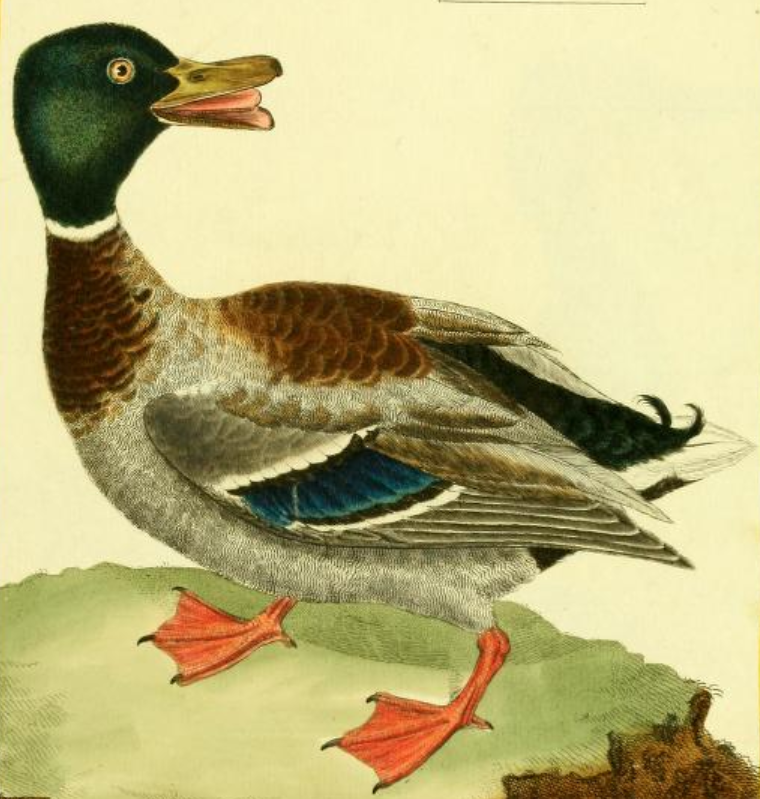
Peale continued: "507. a variety, having the crest on the back part of the head larger, and the whole plumage white. Anas adunca Linn. Hook-billed Duck Latham No. 43. 508. Domesticated Duck of the Mallard kind. It was sent to me from England as a very great curiosity, having no webs between the toes. It is a variety that may very easily be made with a pr. of scissors. Anas domestica Linn. 509. Mallard. Duck with a bill of a yellowish green; Head and neck of a shining changeable green; on the front of the lower part of the neck is a cimicircle of white; breast of a purplish red; lower-part of the body and belly, grey, crossed with speckled lines of black; speculum purple; four middle feathers of the tail curled upwards; legs saffron coloured. Anas Boschas Linn. Canard Savage Buff. pl. enl. 776. 777. Mallard Latham 43. Pennant 494."
Peale continued: "510. Femalle. It inhabits North American from Hudson's Bay to Carolina, is frequent in Greenland, and continuous there the whole summer. Arrives in Hudson's Bay in May; retires in October. Is common in all latitudes of the Russian empire; and was observed by Steller in the Aleutian Islands. In Sweden retires in winter to the shores of Shonan; but in severe seasons passes over to Denmark and Germany, possibly to England. Wild Ducks are most plenty more numerous in Lincolnshire than other parts of Engd. where great numbers are taken by decoys, in the neighbourhood of Wainfleet, thirty one thousand two hundred have been taken in one season. I think it might be well worth the trouble and expence to fix decoys after the methods practiced abroad, in some parts of the United States where I have seen the waters covered with them during the whole winter season, and the price which such game fetch in our markets would amply reward the undertakers. The methods of constructing such decoys may be seen in Willoughby's Ornithology p. 372–373."
An undated scrap of paper tucked into Peale's 21st lecture manuscript contains a scribbled list of duck specimens, including: "Hook-billed D (adunca)" (ANSP Archives, coll. 40).
Alexander Wilson (1766-1813) described this species under the name "The Mallard / Anas boschas" in American Ornithology vol. 8, published posthumously (Pl. 70), where "Peale's Museum, No. 2864" was cited (Wilson 1814: 112). / https://www.biodiversitylibrary.org/item/175758#page/132/mode/1up (text) / https://www.biodiversitylibrary.org/item/175758#page/112/mode/1up (plate)
Specimen Type:
Dead/preserved
Current Common Name:
Mallard
Current Scientific Name
Anatidae | Anas platyrhynchos