Object Status:
Extant
Accession Date:
By 1799
Primary Source Reference:
Charles Willson Peale, Lecture on Natural History 22. (ca. 1799). Academy of Natural Sciences of Drexel University Archives, coll. 40. / https://ansp.org/research/library/archives/0000-0099/coll0040/
Additional Source Text:
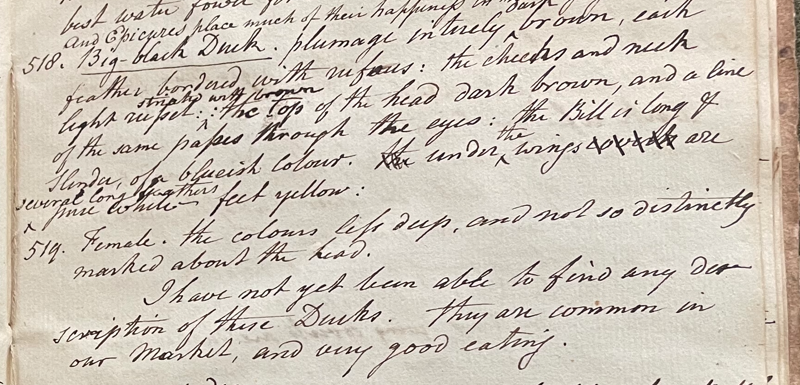
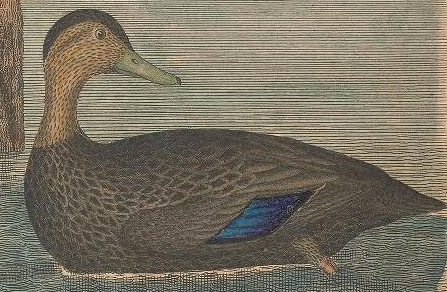
Charles Willson Peale (1741-1827) wrote, in his 22nd Lecture (ca. 1799): "518. Big-black Duck. plumage intirely brown, each feather bordered with rufous; the cheeks and neck light russet, striped with brown; the top of the heard dark brown, and a line of the same passes through the eyes; the Bill is long & slender, of a blueish colour. under the wings are several long feathers […] white; feet yellow. 517. Female. the colours less deep, and not so distinctly marked about the head. I have not yet been able to find any description of these Ducks. they are common in our Market, and very good eating." (Academy of Natural Sciences of Drexel University Archives, coll. 40)
An undated scrap of paper tucked into Peale's 21st lecture manuscript contains a scribbled list of duck specimens, including: "American Black Duck very large". (Academy of Natural Sciences of Drexel University Archives, coll. 40)
Alexander Wilson (1766-1813) described this species under the name "Dusky Duck / Anas obscura" in American Ornithology vol. 8, published posthumously (Pl. 72), where "Peale's Museum, No. 2880" was cited (Wilson 1814: 141). / https://www.biodiversitylibrary.org/item/175758#page/165/mode/1up (text) / https://www.biodiversitylibrary.org/item/175758#page/154/mode/1up (plate)
On 9 January 1822, a notice in Poulson's American Daily Advertiser mentioned Dr. Richard Harlan's (1796-1843) donation of a "Trachea of the Black Duck."
Specimen Type:
Dead/preserved
Current Common Name:
American Black Duck
Current Scientific Name
Anatidae | Anas rubripes