Object Status:
Unlocated
Accession Date:
By 1799
Primary Source Reference:
Charles Willson Peale, Lecture on Natural History 23. (ca. 1799). Academy of Natural Sciences of Drexel University Archives, coll. 40. / https://ansp.org/research/library/archives/0000-0099/coll0040/
Additional Source Text:
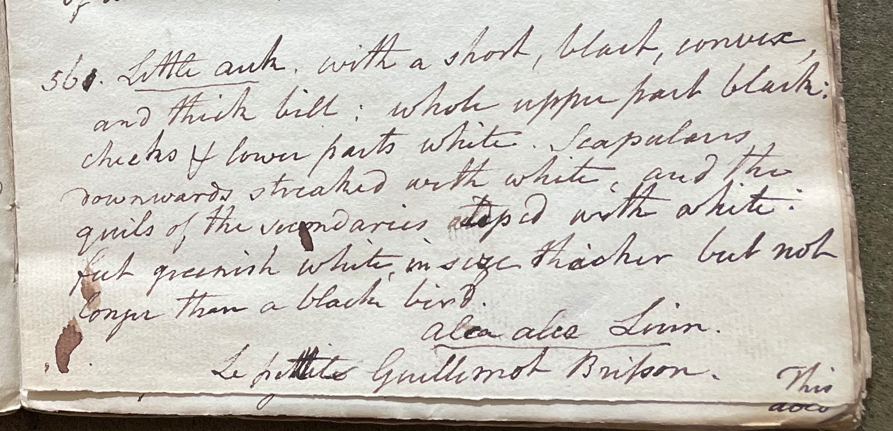
Charles Willson Peale (1741-1827) wrote, in his 23rd Lecture (ca. 1799): "561. Little Auk. with a short, black, convex and thick bill; whole upper part black; cheeks & lower parts white; scapulars downwards streaked with white, and the quills of the secondaries [striped] with white; feet greenish white, in size thicker but not longer than a black bird. Alca alle Linn. Le Petit Guillemot Brisson. This is the body, preserved to shew how much it is capable of being extended, or puffed up in a bellows form—which however all birds have a little but none that I have observed so striking, from which circumstance, probably they have got the name of Puffin." (Academy of Natural Sciences of Drexel University Archives, coll. 40)
Alexander Wilson (1766-1813) described this species under the name "Little Auk / Alca alle" in American Ornithology vol. 9, published posthumously (Pl. 74), where "Peale Museum, No. 2978" was cited (Wilson 1814: 94). / https://www.biodiversitylibrary.org/item/175518#page/102/mode/1up (text) / https://www.biodiversitylibrary.org/item/175518#page/85/mode/1up (plate)
Notes:
According to George Ord (1781-1866), in Wilson (1814: 94, American Ornithology, vol. 9), “The specimen from which the figure in [Wilson’s] plate was taken, was killed at Great Egg-harbor in the month of December, in 1811, and was sent to Mr. Wilson as a great curiosity.” That specimen, which was apparently not deposited in Peale’s Museum, had a white spot behind the eye, but no spot below the eye. Whereas, in a footnote, Ord noted that “In Peale’s Museum there is an excellent specimen of this species, which has likewise a smaller spot below each eye.” / https://www.biodiversitylibrary.org/item/175518#page/102/mode/1up
After Peale's Museum closed, a portion of Peale's bird collection was purchased in 1850 by Moses Kimball (1809–95), who displayed it at his "Boston Museum". An advertisement in the Boston Transcript, printed 1 October 1850, stated that Kimball had acquired "One Half of the celebrated Peale's Philadelphia Museum". The other half of Peale's birds had been sold to the circus promoter P. T. Barnum (1810–91) and would be subsequently destroyed in a fire at his "American Museum" in New York City in July 1865. When the Boston Museum closed, Kimball's Peale remnants passed temporarily to the Boston Society of Natural History, who disposed of them to Charles J. Maynard (1845-1929), a local taxidermist. The specimens were stored in a barn in Massachusetts for several years, then eventually were deposited at the Museum of Comparative Zoology (MCZ), Harvard University. By the time the collection was catalogued by Walter Faxon (1848-1920) at MCZ, in 1914, in virtually every case the original mounts and labels had been disassociated from the specimens, and an untold number were lost.
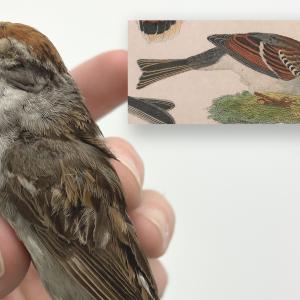
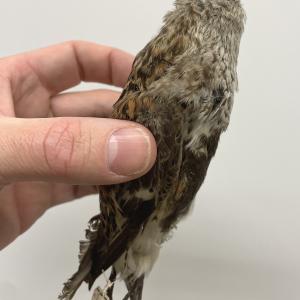
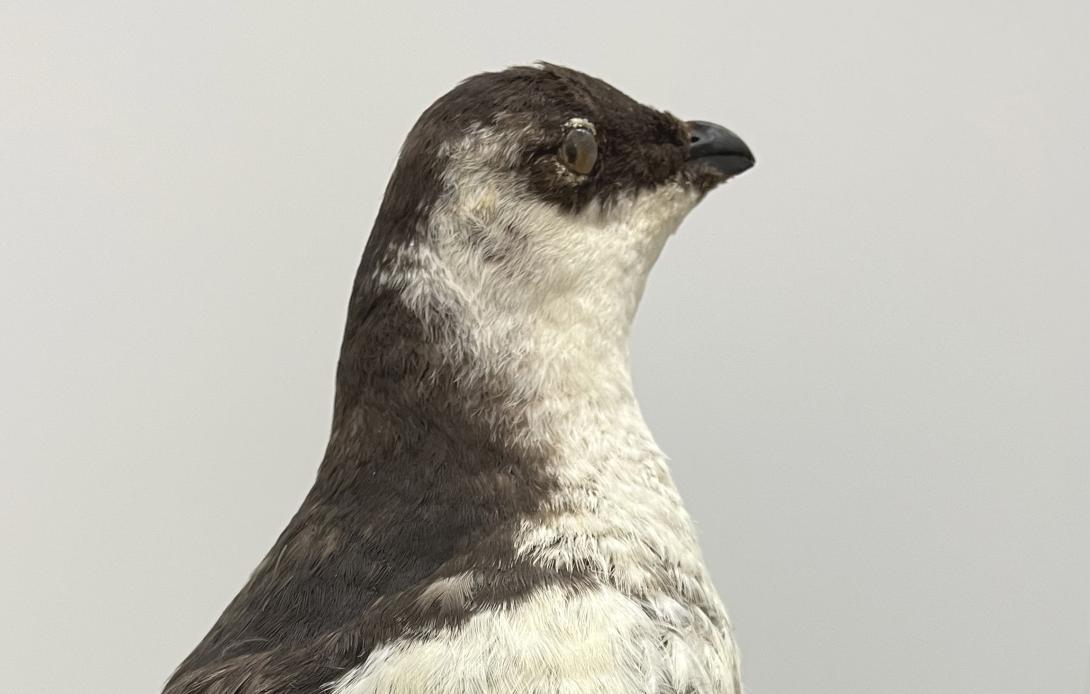
Walter Faxon, "Relics of Peale's Museum," Bulletin of the Museum of Comparative Zoology, 59, no. 3 (July 1915) drew attention to MCZ 67811 (shown here), a specimen from the Boston Museum collection, with the same plumage aberration—white spots below, as well as above, the eyes."
Specimen Type:
Dead/preserved
Current Common Name:
Dovekie
Current Scientific Name
Alcidae | Alle alle
Repository:
Museum of Comparative Zoology, Harvard University (MCZ 67811)