Object Status:
Extant
Accession Date:
By 1799
Primary Source Reference:
Charles Willson Peale, Lecture on Natural History 19. (ca. 1799). Academy of Natural Sciences of Drexel University Archives, coll. 40. / https://ansp.org/research/library/archives/0000-0099/coll0040/
Additional Source Text:
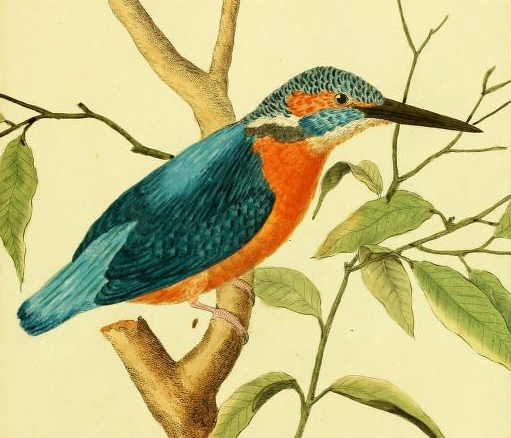
Charles Willson Peale (1741-1827) wrote, in his 19th Lecture (ca. 1799): "352. European Kingfisher. According to Latham this is the most beautiful of all the English birds. The length 7 Inches; the breadth 11 Inches and the weight 1 ¼ oz. The Bill is near 2 Inches long, and black; but the base of the upper mandible is yellow; the irides red; the top of the head, sides, and wing coverts, are of a dark green, masked with transverse spots of a brighter and very lucid blue, the green changing in some light into deep blue; the tail is also of a deep blue; but the middle of the back and tail coverts are wholly of the bright azure; at the base of the upper mandible is an orange spot at the upper corner of which is a small patch of white, and under that a black mark; behind the eye is a broad stripe of a rufous orange-colour, passing a little way on each side [of] the neck, and beneath this, a patch of white; the chin is white, with a tinge of rufous; and the rest of the under parts of the body rufous orange; the feet red." (Academy of Natural Sciences of Drexel University Archives, coll. 40)
Peale continued: "Latham says this bird is found not only in England but throughout Europe, Assia, and Africa; as specimens, precisely the same, have been received from both China, Bengal, and Egypt; Balon also remarks his having met with it in Romania and Greece, where he says it remans the whole year, as in England; and indeed it bears the rigour of the colder climates so well, that among the Germans it has gained the name of Eiszvogel, or Ice bird. However this may be, Latham says, many of them perish to his knowledge by the sides of running water, without the least mark of violence about them." (ANSP Archives, coll. 40)
Peale continued: "The French call them Martin Fishers, because like the Martin it skims along the surface of the water. Buffon says, its ancient appelation Alcyon or Halcyon, is nobler. It was celebrated among the Greeks; the epithet Alcyonian was applied by them to the four days before and after the winter solstice, when the sky is serene, and the sea smooth and tranquil. Then the timorous navigators of antiquity ventured to lose sight of the shore, and to shape their course on the glassy surface of the main. [A footnote mentions that this information was sourced from Buffon.] This kind suspension of the horrors of the season, this happy interval of calm was granted the alcyon, to breed her young. Imagination amplified the simple beauties of nature by the addition of the marvelous; the nest of that bird was made to float on the placid face of the ocean; Aeolus bound up his wings; Alcyone, his plaintive solitary daughter, still called on the billows to restore her hapless Ceyx, whom Neptune had downed, &c. This mythological tale of the bird Alcyon is, like every other fable, only the emblem of its natural History." (ANSP Archives, coll. 40)
Peale continued: "This is a favorite bird with Buffon and he expatiates largely to prove it to be the identical Alcyon of the Ancients. Our time is too precious to follow him, and I will only add his description: "It is the handsomest bird in our climates; none in Europe can compare with the Kingfisher in the elegance, the richness, and the luxuriance of colours; it has all the shades of the rain Bow, the brilliancy of enamel, and the glossy softness of silk; all the middle of the back, with the upper surface of the tail, is light blue and brilliant, which in the sun has the play of sapphire and the lustre of Tarquois stone; green is mixed on the wings with blue, and most of the feathers are terminated and dotted with tints of beryl; the head and the upper side of the neck are dotted in the same manner, with lighter pecks on an azure ground. [G…] compares the glowing yellow-red which colours the breast, to the red glare of a burning coal." (ANSP Archives, coll. 40)
Peale continued: "[No.] 353. I have placed this [specimen] here on a supposition that it may be the female as the colours are not quite so brilliant as the other. I find authors are silent about the difference of sexes. Alcedo ispida Linn. Le martin-pêcheur Buff. pl. enl. 77." (ANSP Archives, coll. 40)
Peale wrote, in "A Walk Through the Philad[elphi]a Museum" (1805–1806): "Our American belted kingfisher (A. alcyon) makes no contemptible figure even with European Kingfisher (A. Ispida) so much the favorite of Buffon and Latham." In the same essay, he also wrote: "No. 2210. Common Kingfisher (A. Ispida) the only one found in England, in Assia & Africa." (Historical Society of Pennsylvania, coll. 0481)
A mounted specimen of "Alcedo ispida (European K.)" from France was listed in "A Catalogue of Duplicate Specimens...", May 1822. [unpublished] American Philosophical Society Library (Mss.B.P31).
Specimen Type:
Dead/preserved
Current Common Name:
Common Kingfisher
Current Scientific Name
Alcedinidae | Alcedo atthis