Object Status:
Unlocated
Accession Date:
By 1799
Primary Source Reference:
Charles Willson Peale, Lecture on Natural History 21. (ca. 1799). Academy of Natural Sciences of Drexel University Archives, coll. 40. / https://ansp.org/research/library/archives/0000-0099/coll0040/
Additional Source Text:
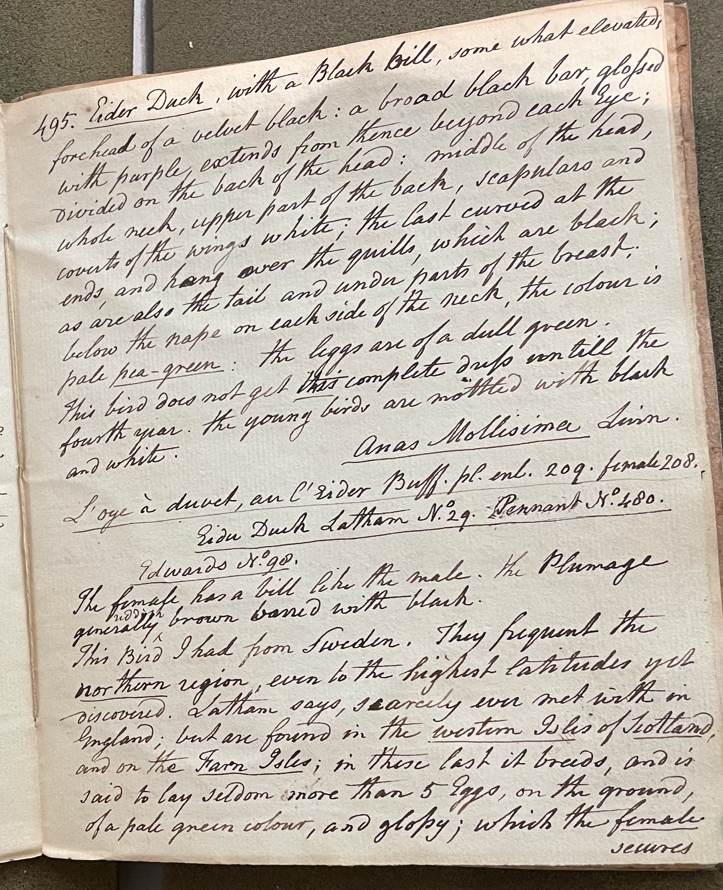
Charles Willson Peale (1741-1827) wrote, in his 21st Lecture (ca. 1799): "495. Eider Duck, with a Black Bill, somewhat elevated, forehead of a velvet black; a broad black bar, glossed with purple, extends from thence beyond each Eye; divided on the back of the head; middle of the head, whole neck, upper part of the back; scapulars and coverts of the wings white; the last curved at the ends, and hang over the quills, which are black; as are also the tail and under parts of the breast; below the nape on each side of the neck, the colour is pale pea-green; the leggs are of a dull green. This bird does not get this complete dress untill the fourth year. the young birds are mottled with black and white. Anas Mollisima Linn. L'oye à duvet, au l'Eider Buff. pl. enl. 209. Female 208. Eider Duck Latham No. 29. Pennant No. 480. Edwards No. 98. The female has a bill like the male. the Plumage generally reddish brown barred with black. This Bird I had from Sweden." (Academy of Natural Sciences of Drexel University Archives, coll. 40)
Peale continued: "They frequent the northern region, even to the highest tatitudes yet discovered. Latham says, scarcely ever met with in England; but are found in the western Isles of Scotland, and on the Farn Isles; in these last it breeds, and is said to lay seldom more than 5 Eggs, on the ground, of a pale green colour, and glossy; which the female secures from cold in a bed of fine down, plucked from her breast. This down is of the lightest and warmest nature of any thing yet known; the natives, who know the value, take care to plunder the nests, taking away both the down and Eggs; when the Duck lays again, furnishing a second parcel of down, her last stock; for if a third theft be committed she will wholly desert the place. The quantity of down said to found in one nest more than filled the crown of a hat, yet weighted no more than ¾ of an ounce." (ANSP Archives, coll. 40)
Peale continued: "[Three] pounds of this down may be compressed into a space scarce bigger than one's fist; yet is after wards so dilatable as to fill a quilt five feet square. That found in the nests is most valued, and termed live down; it is infinitely more elastic than that plucked from the dead bird, which is little esteemed in Iceland. The best is sold at 45 fish pr D, when cleansed, and at 16 when not cleansed. There is generally exported every year, on the company's account 1500 or 2000 pounds, of both sorts, exclusive of what is privately exported by foreigners. In 1750, the Iceland Company sold as much in quantity of the article as amounted to 3745 banco-dollars, besides what was sent directly to Gluckstadt." A footnote mentions the information was sourced from Latham. (ANSP Archives, coll. 40)
Peale continued: "Latham also says, that this bird is found as far south as New York; and breeds on the desert Isles of new England; but most commonly every where to the north; are said to be constant to the same breeding-places, and that a pair has been observed to occupy the same nest for 20 years togather. Their food is shells, for which they dive to great [depths]. They take their young on their backs instantly to sea, then dive, to shake them off and teach them to shift for themselves. The Greenlanders kill them with darts; pursue them in their little boats what their course (when they dive by the air bubbles; and strile them when they rise wearied. The flesh is valued as a food. The skin of this bird is of great value as a garment placed next the Skin. [A footnote mentions the information was sourced from Pennant.]" (ANSP Archives, coll. 40) An undated scrap of paper tucked into Peale's 21st lecture manuscript contains a scribbled list of duck specimens, including: "Eider D. – its valuable down, &c." (ANSP Archives, coll. 40) Peale wrote, in "A Walk Through the Philad[elphi]a Museum" (1805–1806): "How valuable is the Eider Duck (a. Mollissima) their flesh are valued as a food, but its down is infinitely more valuable, it is said that 3 pounds (?) of this down may be compressed into a space scarce bigger than one's fist; yet is afterwards so dilatable as to fill a quilt five feet square. They frequent the highest latitude & breed in Iceland were the down is taken from their nests. They also are found as far south as New York" (Historical Society of Pennsylvania, coll. 0481). Alexander Wilson (1766-1813) described this species under the name "Eider Duck / Anas mollissima" in American Ornithology vol. 8, published posthumously (Pl. 71). He described the male and female in separate accounts, citing "Peale's Museum, No. 2706" (male) and "Peale's Museum, No. 2707" (female), respectively (Wilson 1814: 122, 125). / https://www.biodiversitylibrary.org/item/175758#page/144/mode/1up (male text) / https://www.biodiversitylibrary.org/item/175758#page/147/mode/1up (female text) / https://www.biodiversitylibrary.org/item/175758#page/141/mode/1up (plate)Notes:
A letter from Rev. Nicholas Collin (1746-1831) to Charles W. Peale, dated 2 June 1793, confirms that “Mr. Gustavus Von Carlson (President of one of the supreme courts of Justice) has charged himself with the exchange of Birds. This eminent ornithologist owns a precious Cabinet of Birds, containing more than 800 species; & has by testamentary disposition generously bequeathed the whole to the said [Swedish] Academy of Sciences. You will therefore be pleased to send in future the birds directly to him. He has already in return, forwarded several of the most valuable Swedish Birds…” (Miller 1988: 49, Selected Papers, Vol. 2, part 1, Yale University Press).
After Peale's Museum closed, a portion of Peale's bird collection was purchased in 1850 by Moses Kimball (1809–95), who displayed it at his "Boston Museum". An advertisement in the Boston Transcript, printed 1 October 1850, stated that Kimball had acquired "One Half of the celebrated Peale's Philadelphia Museum". The other half of Peale's birds had been sold to the circus promoter P. T. Barnum (1810–91) and would be subsequently destroyed in a fire at his "American Museum" in New York City in July 1865. When the Boston Museum closed, Kimball's Peale remnants passed temporarily to the Boston Society of Natural History, who disposed of them to Charles J. Maynard (1845-1929), a local taxidermist. The specimens were stored in a barn in Massachusetts for several years, then eventually were deposited at the Museum of Comparative Zoology (MCZ), Harvard University. By the time the collection was catalogued by Walter Faxon (1848-1920) at MCZ, in 1914, in virtually every case the original mounts and labels had been disassociated from the specimens, and an untold number were lost.
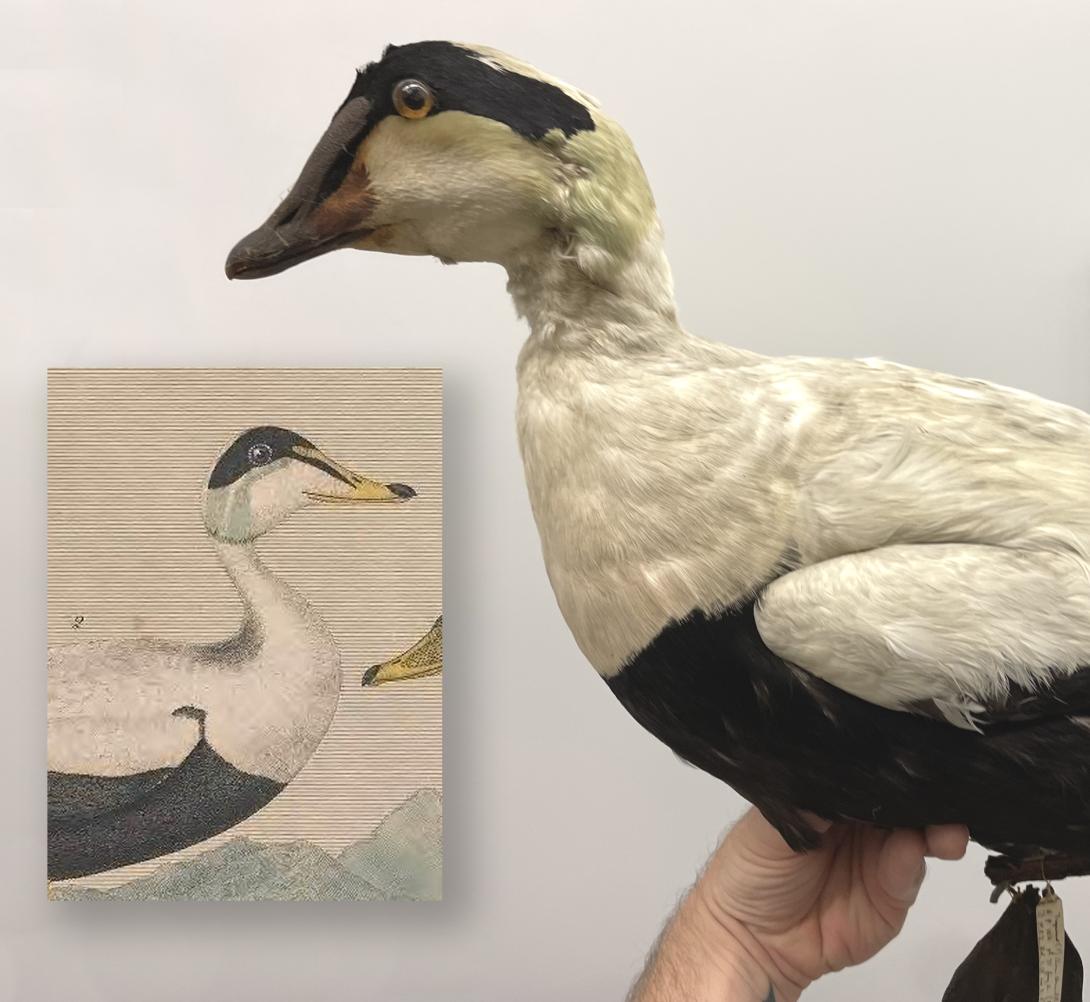
Walter Faxon, "Relics of Peale's Museum," Bulletin of the Museum of Comparative Zoology, 59, no. 3 (July 1915): 129, speculated that MCZ 67820, a data-deficient specimen from the Boston Museum collection (shown here), is "Perhaps the original of Wilson's figure." / https://www.biodiversitylibrary.org/page/6339801#page/179/mode/1up
Wilson (1814: 122) did not state whether he collected this species in the United States, or whether his drawings were made from American specimens. Peale's specimen was from Sweden. That Wilson did not mention any American specimen in his account, and only briefly commented that the species was "occasionally seen in winter as far south as the capes of Delaware", implies that he relied on Peale's European specimens for his descriptions and illustration. Wilson (1810: viii, American Ornithology, vol. 2) had previously stated that "no drawings have been, or will be made for this work, from any stuffed subjects, where living specimens of the same can be procured; yet the former serve a very important purpose; they enable the author to ascertain the real existence and residence of such subjects" / https://www.biodiversitylibrary.org/item/175511#page/14/mode/1up
Specimen Type:
Dead/preserved
Current Common Name:
Common Eider
Current Scientific Name
Anatidae | Somateria mollissima
Repository:
Museum of Comparative Zoology, Harvard University (MCZ 67820)
Category:
Collection: