Object Status:
Extant
Accession Date:
By 1799
Primary Source Reference:
Charles Willson Peale, Lecture on Natural History 13. (ca. 1799). Academy of Natural Sciences of Drexel University Archives, coll. 40. / https://ansp.org/research/library/archives/0000-0099/coll0040/
Additional Source Text:
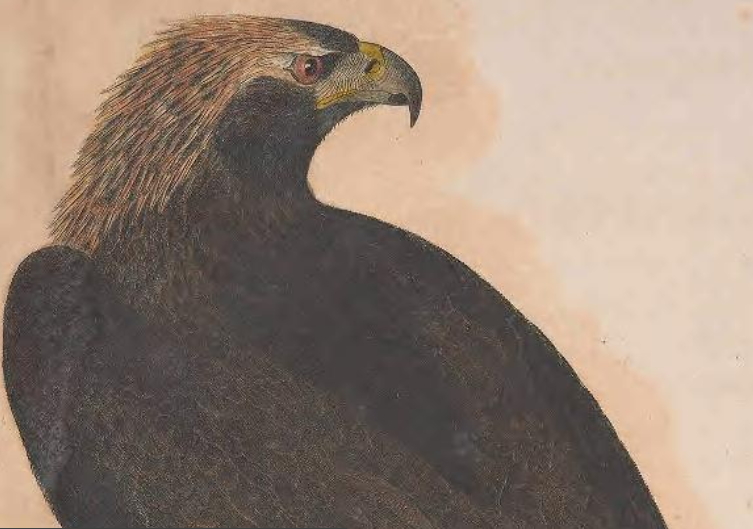
Charles Willson Peale (1741-1827) wrote, in his 13th Lecture (ca. 1799): "No. 15. This Bird, I had alive many years. It seemed more fierce than the White-head Eagle, and equally voracious with its prey of flesh. Fish it never eat. Tryals was made with those parts of Sturgeon which were bloody and most like flesh, and, however hungry it might be, yet it always refused it. Its cry very much resembled that of a Hawk; not the piercing harsh note of the [Bald] Eagle. The straight part of the bill is not so long as the [Bald] Eagle's. It is generally like the Hawk's bill, forming a more regular curve when seen in profile. The claws are long and sharp like Hawks, and not so thick and strong as those of the White head Eagle. Although it is not so large as the Golden Eagle of Europe, F. chrysaetos of Linnaeus, yet it considerably resembles the coloured plate of Buffon with his and Latham's description of that bird." (Academy of Natural Sciences of Drexel University Archives, coll. 40)
Peale continued: "I don't know what was the weight of this Eagle, but the length of it is about 3 feet, measuring from the end of the beak to the tip of the tail. It resembles it in the russet colour of the feathers on the top of its head and neck, dark brown body, wings and tail. On the inside of tail near the middle are [three] white bars; the feet is also covered to the toes with short light tawney colloured feathers, and the only difference, this [specimen] has not the chacolate coloured quil [primary] feathers with white shafts, as Latham describes, for the quils of this are all of a dark brown colour. Eagles are remarkable for their longevity and for their power of sustaining a long abstinence from food. Mr. Keyster relates, that an Eagle died at Vienna after a confinement of 104 years. This preeminent length of days probably gave occasion to saying of the Psalmists, 'Thy youth is renewed like the Eagles'." (ANSP Archives, coll. 40)
Peale continued: "One of this species, was in the possession of Owen Holland, Esqr., of Conway, [Ireland for] 9 years. It lived with the gentleman, who made him a present of it, [for] 32 years; but what age it was when the latter received it from Ireland is unknown. The same bird also furnishes us with a proof of the truth of the other remark; having once, "through the neglect of servants, endured hunger for 21 days without any sustenance what ever…." Could they be maintained without so much expense, it might be worth the experiment to make a trial of the longevity of my White-head Eagles. The instance I have quoted of Mr. Holland's Eagle, proves that servants will neglect them." Therefore, for such tryal, a permanant provision to ensure the cost of expence, as well as the necessary care of feeding. I have maintained for 15 years, and generally it has cost me a 5 penny bit [per] day—feeding it with sheeps' plucks, but I have always had other birds to partake of the same food. Therefore a considerable deduction should be made out of that expence. The amount of [real] cost to me has certainly been upwards of 300 dolrs for that period of time …" (ANSP Archives, coll. 40)
Peale continued: "No. 16. White-tailed Eagle. This Eagle, as well as the last [Golden Eagle] was found in the vicinity of Philadelphia. Every character of these agree, except the tail of this is white and the colour of the Body is rather of a darker hue. Edwards [1743, Pl. 1] has given a plate of an Eagle found at Hudson's bay [i.e., an immature Golden Eagle], which resembles it considerably, but that [illustration] has triangular white spots on the breast and transverse bars of a dark and a lighter colour on the covert feathers of the wings, which is not the case with the bird before us. Buffon has given a Coloured plate of the ring tailed Eagle, which he calls the common Eagle. It very much resembles this [specimen]. It has not the white spots which Edwards speaks off [sic], and [Buffon] also says, 'It occurs in France, Savoy, Switzerland, Germany, Poland, Scotland, and even in North America, at Hudson's Bay.' There is another material difference between this [specimen] and the Eagle described by Edwards, who says 'the tail is of Equal length with the wings.' Here the wings do not reach more than half the length of the tail." (ANSP Archives, coll. 40)
Alexander Wilson (1766-1813) described an immature bird under the name "Ring-tail Eagle / Falco fulvus" in American Ornithology vol. 7 (Pl. 55), where "Peale's Museum, No. 84" was cited (Wilson 1813: 13). / https://www.biodiversitylibrary.org/item/175507#page/19/mode/1up (text) / https://www.biodiversitylibrary.org/item/175507#page/8/mode/1up (plate)
Wilson (1813: 14) also noted that "the tail feathers of this bird are highly valued by the various tribes of American Indians for ornamenting their calumets, or Pipes of Peace. Several of these pipes which were brought from the remote regions of Louisiana by captain Lewis, are now deposited in Mr. Peale's Museum, each of which has a number of the tail feathers of this bird attached to it."
Notes:
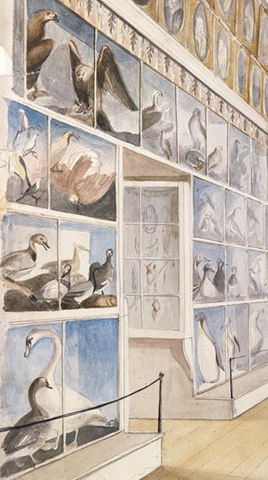
Two brown eagle specimens are visible in the Peales' watercolor painting of the Long Room interior at the Pennsylvania State House, executed ca. 1820, in the case to the upper left of the doorway (Detroit Institute of Arts, 57.262), shown here.
Specimen Type:
Live (later taxidermied)
Current Common Name:
Golden Eagle
Current Scientific Name
Accipitridae | Aquila chrysaetos