Object Status:
Unlocated
Accession Date:
By 1799
Primary Source Reference:
Charles Willson Peale, Lecture on Natural History 13. (ca. 1799). Academy of Natural Sciences of Drexel University Archives, coll. 40. / https://ansp.org/research/library/archives/0000-0099/coll0040/
Additional Source Text:
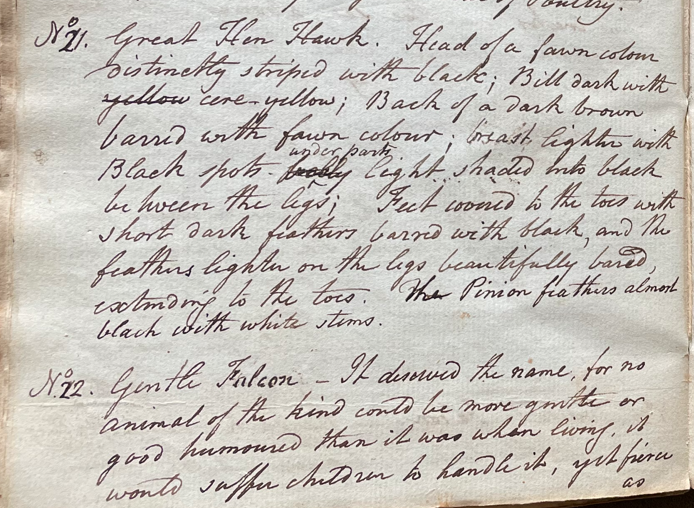
Charles Willson Peale (1741-1827) described three specimens of this species in his 13th Lecture (ca. 1799), two immature individuals and a dark morph adult. Peale wrote: "No. 21. Great Hen Hawk. Head of a fawn colour distinctly striped with black; Bill dark with yellow cere; Back of a dark brown barred with fawn colour; breast lighter with Black spots; under parts light, shaded into blak between the legs; Feet covered to the toes with short dark feathers barred with black, and the feathers lighten on the legs beautifully [barred], extending to the toes. The Pinion [primary] feathers almost black with white stems." (Academy of Natural Sciences of Drexel University Archives, coll. 40)
Peale continued: "No. 22. Gentle Falcon. It deserved the name, for no animal of the kind could be more gentle or good humoured than it was when living. It would suffer children to handle it, yet fierce as possible against dogs. This docile disposition would have rendered this a desireable, valuable bird in times of Falconry, when a person of Rank seldom went out without his Hawk on his hand, such great use was made of them for the chase. The Bill brown with yellow cere; Head sallow white striped with brown; the body Brown, the feathers edged with light russet. The tail white, the lower part a dark brown on the upper side; the lower part of the body a dark russet, from under which came white leg feathers extending nearly to the toes. [A cut-off footnote reads: "[The wings] extending to the end of the tail"]. It is a species of Chicken Hawk belonging to Pennsylvania. Br. Zool. No. 50? Pennant Arctic Z. vol. II. p. [203]? Latham. I. p. 64. Falco gentilis Linn. ? No. 13." (ANSP Archives, coll. 40)
Peale continued: "No. 24. Black Falcon, or Hawk. Hazle Eye with projecting brows. The feathers on the out-side generally of a dark brown, some stripes of pure white on the breast & underparts; the upper parts of the tail feathers mottled with a grey white and the ends finish in reddish brown; feet of flesh colour half-covered with short feathers; the leg feathers full and nearly reach the toes. A rare and hansome bird of Pennsylvania. Edwards has described a bird found at Hudson's Bay much like it, but with spots on the coverts of the wings which is not in the bird before us. [Edwards] t. 53. F. cinereus Linn."(ANSP Archives, coll. 40)
In "A Walk Through the Philad[elphi]a Museum" (1805–1806), Peale included "Black falcon" in a list of other raptors, without providing any further description (Historical Society of Pennsylvania, coll. 0481).
Alexander Wilson (1766-1813) described this species under the name "Rough-legged Falcon / Falco lagopus" in American Ornithology vol. 4 (Pl. 33), where "Peale's Museum, No. 116" was cited (Wilson 1811: 59). The model for his plate was reportedly collected "in the meadows below this city [Philadelphia], between the rivers Delaware and Schuylkill, where they spend their time watching along the dry banks like cats; or sailing low and slowly over the surface of the ditches." / https://www.biodiversitylibrary.org/item/175531#page/75/mode/1up (text) / https://www.biodiversitylibrary.org/item/175531#page/74/mode/1up (plate)
Wilson deposited "two skins of the Black Hawk" on 16 January 1812, according to the Peale Museum Accessions Book, p. 59 (Historical Society of Pennsylvania, coll. 0481).
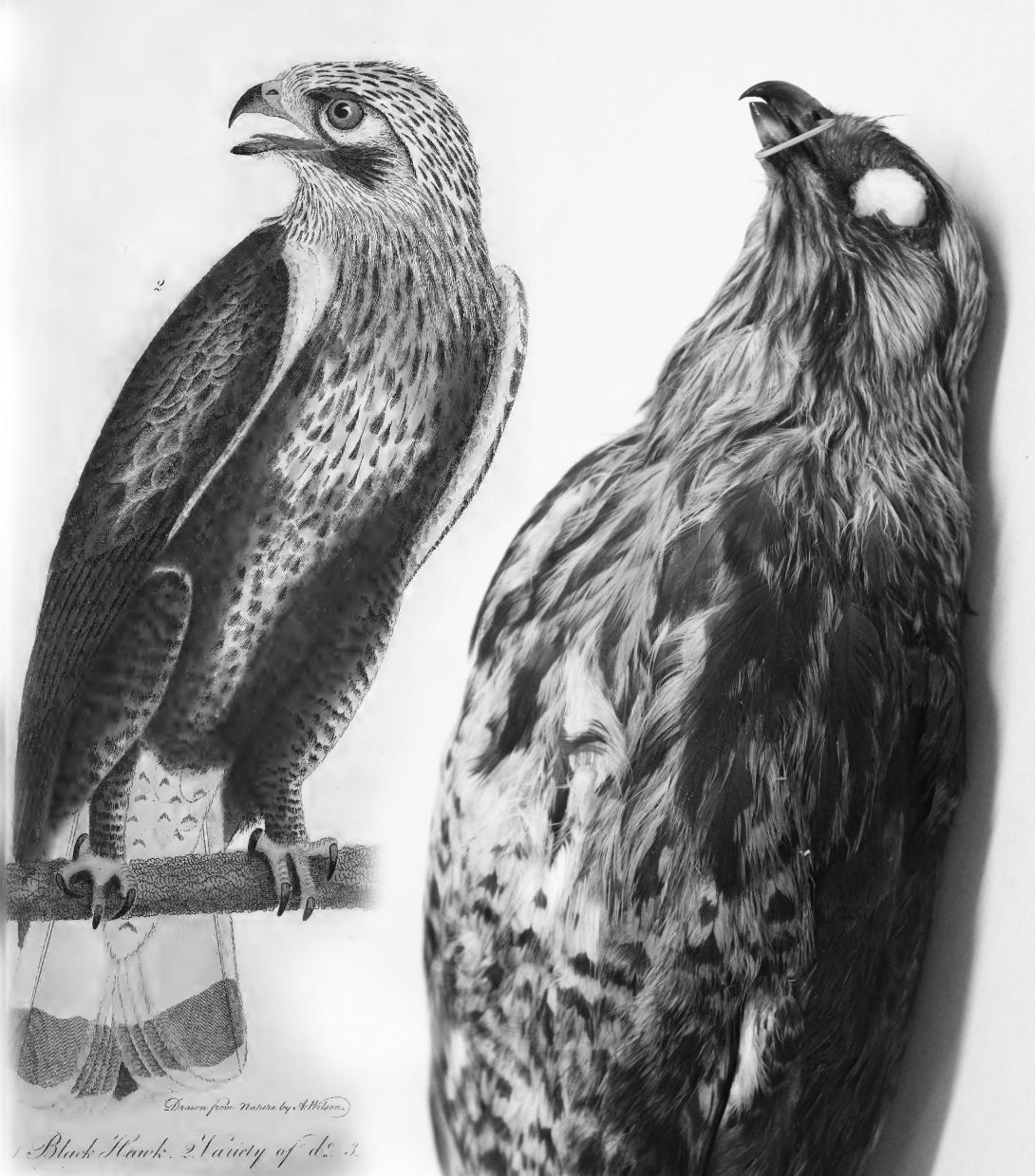
Wilson described these specimens under the name "Black Hawk / Falco niger" in American Ornithology vol. 6 (Pl. 53). One specimen was adult, and he cited "Peale's Museum, No. 404" (Wilson 1812: 82). / https://www.biodiversitylibrary.org/item/175484#page/108/mode/1up (text) / The other specimen was immature. Wilson called it a "Variety" and cited "Peale's Museum, No. 405" (Wilson 1812: 84). / https://www.biodiversitylibrary.org/item/175484#page/112/mode/1up (text) / The immature specimen (shown here) is extant in the Academy of Natural Sciences of Drexel University (ANSP 1563).
Titan R. Peale (1799-1885) deposited "2 Species of Hawks" on 23 March 1821, after returning from the Long Expedition, as recorded in the Peale Museum Accessions Book (Historical Society of Pennsylvania, coll. 0481). A colored drawing made by Titian at "Engineer Cant." in February 1820, is extant in the American Philosophical Society Library / https://diglib.amphilsoc.org/islandora/object/birds-no-1-engineer-cant-…
Notes:
The editor (MRH) rediscovered Wilson’s specimen of the “variety of the Black Hawk” (ANSP 1563) in 2019, at the Academy of Natural Sciences of Drexel University (shown here), with a wooden pedestal attached to its leg, presumably the original mount from Peale’s Museum. For more details, see Matthew R. Halley, 2020, "Rediscovery of a lost type specimen of Alexander Wilson", Wilson Journal of Ornithology 132: 206-213. / https://doi.org/10.1676/1559-4491-132.1.206
Specimen Type:
Dead/preserved
Current Common Name:
Rough-legged Hawk
Current Scientific Name
Accipitridae | Buteo lagopus
Repository:
Academy of Natural Sciences of Drexel University (ANSP 1563)