Object Status:
Extant
Accession Date:
By 1799
Primary Source Reference:
Charles Willson Peale, Lecture on Natural History 22. (ca. 1799). Academy of Natural Sciences of Drexel University Archives, coll. 40. / https://ansp.org/research/library/archives/0000-0099/coll0040/
Additional Source Text:
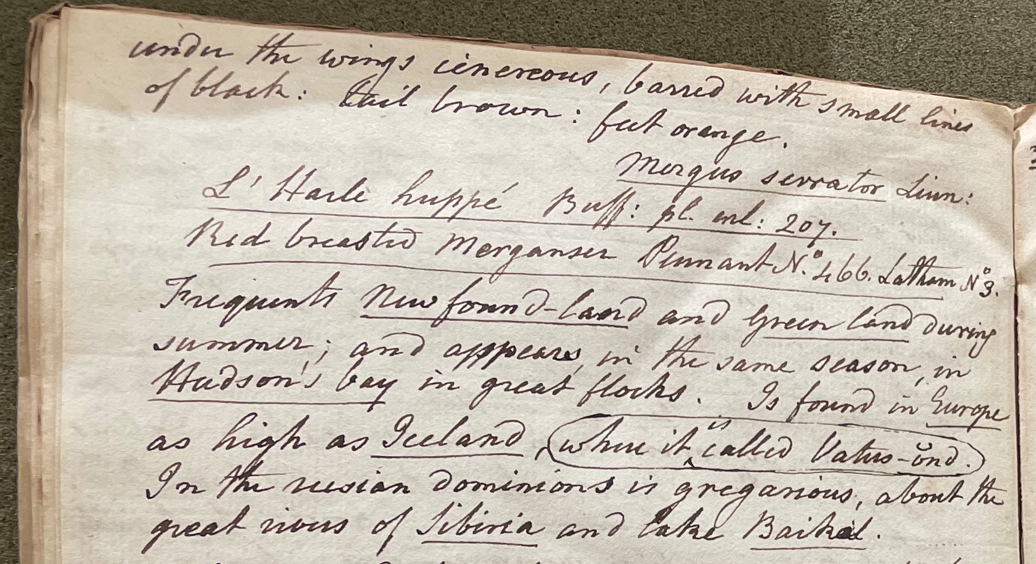
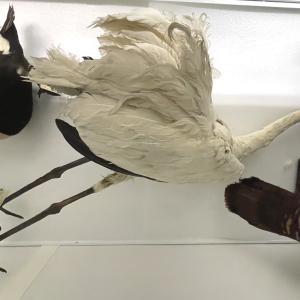
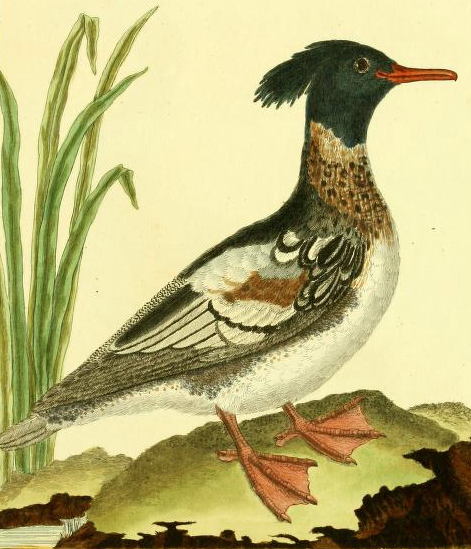
Charles Willson Peale (1741-1827) wrote, in his 22nd Lecture (ca. 1799): "Red-breasted Merganser. it is considerably less, than the Goosander [Common Merganser, Mergus merganser], and a very rare bird here. it is the only one I have seen. It was killed in the Schulkill [i.e., Schuylkill River]. The bill of an orange red. the Head and upper part of the neck of a Mallard green rather darker. long pendant crest of feathers much like hair; neck white with a black line running down the back part. the breast mottled with ferruginous spotted with black; upper part of the back black; exterior scapulars black; interior white; coverts of the wings black and white; primaries dusky; lower part of the back, and sides under the wings cinereous, barred with small lines of black; tail brown; feet orange." (Academy of Natural Sciences of Drexel University Archives, coll. 40)
Peale continued: "Mergus serrator Linn. L'Harle huppé Buff. pl. enl. 207. Red breasted Merganser Pennant No. 466. Latham No. 3. Frequents Newfound-land and green land during summer; and appears in the same season in Hudson's bay in great flocks. Is found in Europe as high as Iceland, where it is called Vatus-ŏnd. In the rusian dominions is gregarious, about the great views of Sibiria and lake Baikal." (ANSP Archives, coll. 40)
Peale also described a female specimen, which, having never seen it in America, he presumed was a different species: "553. Mergus Castor. it is considerably like the female of Goosander, but much smaller. the head & neck is of a russet brown, lighter in the front part of the neck; a few crested feathers chiefly on the hinder part of the head; a light [line] passes from the upper mandible to the Eyes. Back brown; under part of the body white; wing quills dark, barred with white. Mergus Castor Linn. I received this from Sweden. They are said to be common in Germany; and at times to be found as low as Egypt." (ANSP Archives, coll. 40)
Peale wrote, in "A Walk Through the Philad[elphi]a Museum" (1805–1806): "Comparing the Red-breasted Merganser (M. Serrator) of Europe with this found in the [Schuylkill river], no difference appears between them." He also wrote, "We don't know any Mergansers of this Country like this diver (M. Castor) of Sweden." (Historical Society of Pennsylvania, coll. 0481)
On 15 August 1806, a donation of "Red breasted Merganser" from Thomas Hall in England was entered into the Peale Museum Accessions Book, p. 17 (HSP, coll. 0481)
Alexander Wilson (1766-1813) described this species under the name "Red-breasted Merganser / Mergus serrator" in American Ornithology vol. 8, published posthumously (Pl. 69), where "Peale's Museum, No. 2936" was cited (Wilson 1814: 81). / https://www.biodiversitylibrary.org/item/175758#page/99/mode/1up (text) / https://www.biodiversitylibrary.org/item/175758#page/96/mode/1up (plate)
Notes:
A letter from Rev. Nicholas Collin (1746-1831) to Charles W. Peale, dated 2 June 1793, confirms that “Mr. Gustavus Von Carlson (President of one of the supreme courts of Justice) has charged himself with the exchange of Birds. This eminent ornithologist owns a precious Cabinet of Birds, containing more than 800 species; & has by testamentary disposition generously bequeathed the whole to the said [Swedish] Academy of Sciences. You will therefore be pleased to send in future the birds directly to him. He has already in return, forwarded several of the most valuable Swedish Birds…” (Miller 1988: 49, Selected Papers, Vol. 2, part 1, Yale University Press).
Thomas Hall (ca.1746-1813) was a natural history dealer and showman in London who, like Peale, assembled a collection of exotic taxidermy and natural oddities in his home, which he displayed to paying customers. Hall’s museum was known by the names “Curiosity House” and “Finsbury Museum”, and he distributed tokens advertising himself as “The first artist in Europe for preserving Birds, Beasts &c.” Today, many of these tokens are preserved in the British Museum. / https://www.britishmuseum.org/collection/term/BIOG145361
Peale proposed a specimen exchange with Hall, in a letter dated 28 April 1792: “I therefore make you the proposal of sending you all the Variety of this Country, for an Equal number of European [species] … which shall be preserved in the best manner (of which I now feel myself fully equal to) and sent and that I may be prepared for such an exchange I am now using every means in my power to Collect and preserve the Birds of the present season … I have not time to give you any description of such as I suppose are peculiar to this part of America, and I find that every year I discover some kinds that I had not known before, and from what I have read, I find that those who have attempted the Natural History of this Country [were] generally deficent of inteligence [sic].” (Miller 1988: 31–32, Selected Papers, Vol. 2, part 1, Yale University Press).
Peale announced in June 1792 that he was “busily employed in preserving the Birds of our Country [the United States] in order to furnish [himself] with such a number of duplicates as [would enable him] to make an extensive exchange” with Hall, and with institutions in Sweden and Holland (Miller 1988: 37). During his travels in London, Rubens Peale (1784-1865) wrote to his father on 1 June 1803: “I wish you to inform me in the next [letter] how you stand with Hall, recolleckting that I have had from him a considerable number of subjects in return from what I let him have.” (Miller 1988: 529)
The final specimen deposit from Hall was recorded in the Peale Museum Accessions Book on 17 August 1806 (Historical Society of Pennsylvania, coll. 0481).
"
Specimen Type:
Dead/preserved
Current Common Name:
Red-breasted Merganser
Current Scientific Name
Anatidae | Mergus serrator
Category:
Collection: