Object Status:
Extant
Accession Date:
By 1793
Primary Source Reference:
Charles Willson Peale, letter to Thomas Hall of Moorfields, London, dated 1793; Selected Papers, 2, part 1: 46.
Additional Source Text:
Charles Willson Peale (1741-1827) sent an"Indian hen" to Thomas Hall in London, in early 1793, in exchange for European specimens (Miller 1988: 46, Selected Papers, Vol. 2, part 1, Yale University Press).
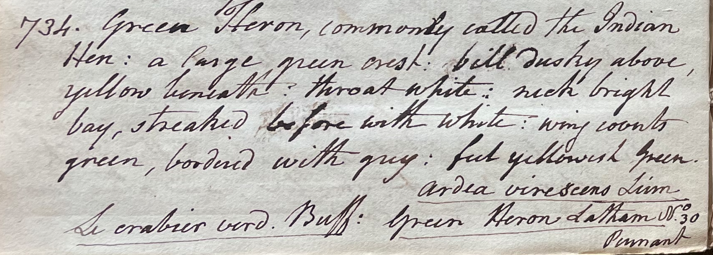
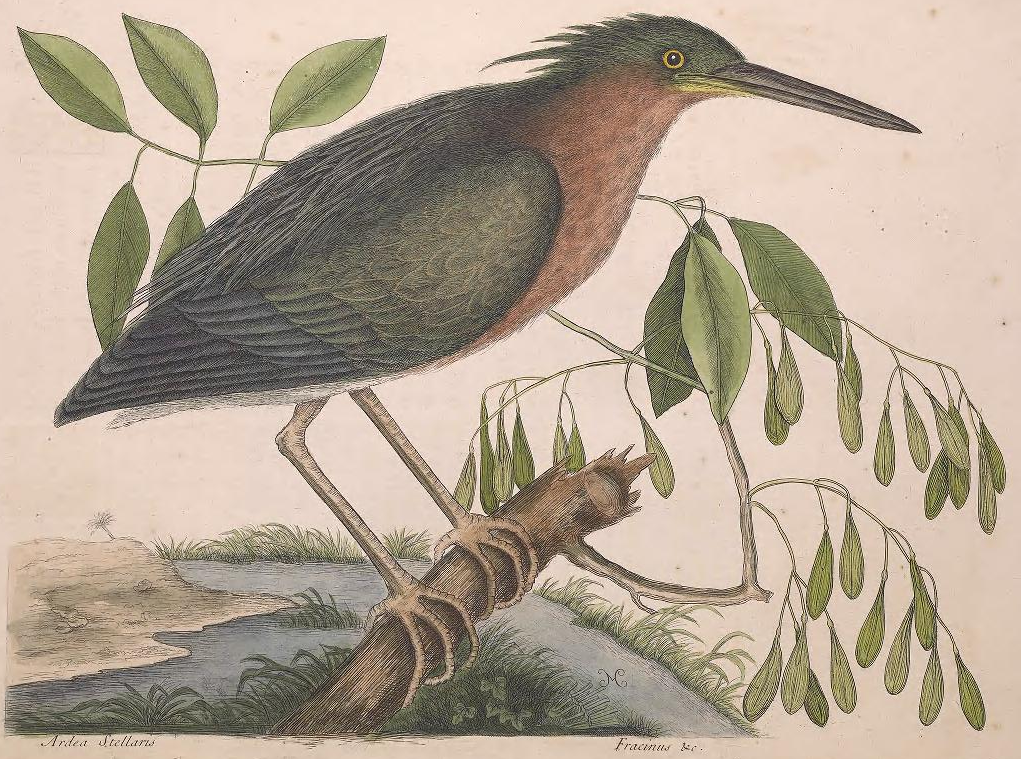
Charles Willson Peale (1741-1827) wrote, in his 25th Lecture (ca. 1799): "No. 734. Green Heron, commonly called the Indian Hen; a large green crest; bill dusky above, yellow beneath; throat white; neck bright bay, streaked before with white; wing coverts green, bordered with grey; feet yellowish green. Ardea virescens Linn. Le crabier verd. Buff. Green Heron Latham No. 30 Pennant No. 349. Small Bittern. Catesby i. pl. 80. It inhabits from New York to South Carolina. Usually sits, with its neck contracted on trees hanging over rivers; feeds on small fish, frogs and crabs of smaller kind. From the last thefrench call several of these Herons crabiers. 735. Female, very little difference in the plumage." (Academy of Natural Sciences of Drexel University Archives, coll. 40)
A slip of loose paper tucked into Peale's 36th lecture contains a list of waterbirds with the following entry: "Green Heron (A. virescens)." (ANSP Archives, coll. 40)
Alexander Wilson (1766-1813) described this species under the name "Green Heron / Ardea virescens" in American Ornithology vol. 7 (Pl. 61), where "Peale's Museum, No. 3797" was cited (Wilson 1813: 97). / https://www.biodiversitylibrary.org/item/175507#page/115/mode/1up (text) / https://www.biodiversitylibrary.org/item/175507#page/114/mode/1up (plate)
Specimen Type:
Dead/preserved
Current Common Name:
Green Heron
Current Scientific Name
Ardeidae | Butorides virescens