Object Status:
Extant
Accession Date:
By 1799
Primary Source Reference:
Charles Willson Peale, Lecture on Natural History 29. (ca. 1799). Academy of Natural Sciences of Drexel University Archives, coll. 40. / https://ansp.org/research/library/archives/0000-0099/coll0040/
Additional Source Text:
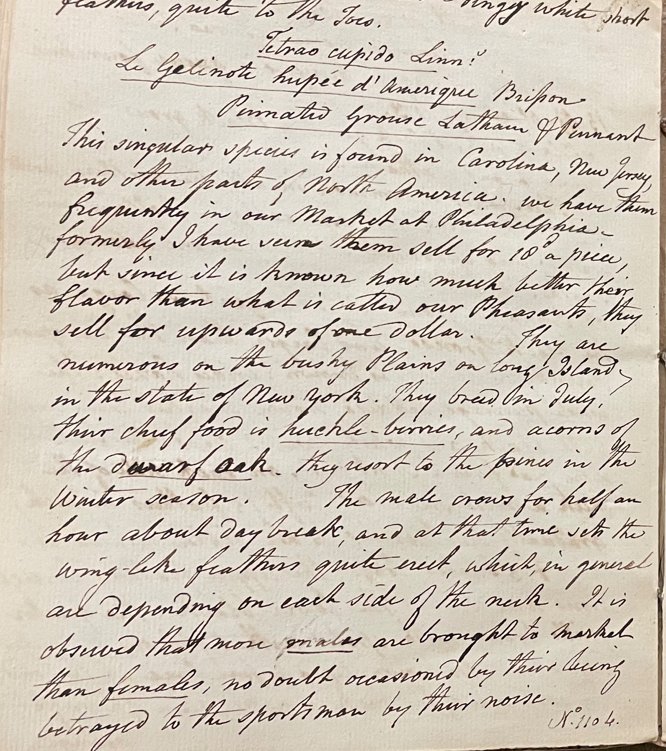
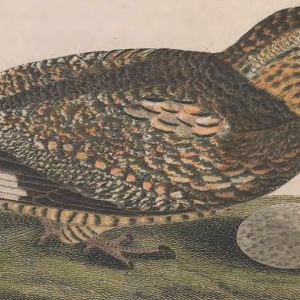
Charles Willson Peale (1741-1827) wrote, in his 29th Lecture (ca. 1799): "No. 1103. Pinnated Grous. It is not quite so large as the Black Grouse, and larger than the European Partridge. The bill is brown; irides hazel; the whole plumage reddish brown, marked transversely with back and white waved lines; the feathers of the head form a short crest, on each side of the neck a most singular tuft (5 feathers in each) gradually lengthening to the fifth, which is about 3 inches long; the upper feathers ferruginous and white; the lower black; the greater quills brown [spotted] with light on the outer edge; tail also brown tiped [with] a fine line at the end; on each side of the neck, a naked skin of a bright orange colour; feet covered with dingy white short feathers, quite to the toes. Tetrao cupido Linn. Le Gelinote hupee d'Amerique Brisson. Pinnated Grouse Latham & Pennant. This singular species is found in Carolina, New Jersey, and other parts of North America. We have them frequently in our market at Philadelphia. Formerly I have seen them sell for 18d a piece, but since it is known how much better their flavor than what is called our Pheasants, they sell for upwards of one dollar." (Academy of Natural Sciences of Drexel University Archives, coll. 40)
Peale continued: "They are numerous on the bushy plains of Long Island, in the state of New York. They breed in July. Their chief food is huckle-berries, and acorns of the dwarf oak. They resort to the pines in the winter season. The male crows for half an hour about daybreak, and at that time sets the wing-like feathers quite erect, which in general are depending on each side of the neck. It is observed that more males are brought to market than females, no doubt occasioned by their being betrayed to sportsmen by their noise. No. 1104. Female, is smaller than the male, less bright in colour, and wants the wing feathers on the neck. This specimen [has] not quite got its groath … No. 1107. Chickens of the Heath Cock which I got at Cape May in the month of May (1799). The hen had with her, according to the account I received from the man who gave them, more than one Doz. young ones." (ANSP Archives, coll. 40)
Alexander Wilson (1766-1813) described this species under the name "Pinnated Grous / Tetrao cupido" in American Ornithology vol. 3 (Pl. 27), where "Peale's Museum, No. 4700, male—[and] 4701, female" were cited (Wilson 1811: 104). / https://www.biodiversitylibrary.org/item/175516#page/124/mode/1up (text) / https://www.biodiversitylibrary.org/item/175516#page/125/mode/1up (plate)
Titian Ramsay Peale (1799-1885) deposited "2 Prairie Hens" on 23 March 1821, after returning from the Long Expedition, as recorded in the Peale Museum Accessions Book, p. 112 (Historical Society of Pennsylvania, coll. 0481). Two undated pencil sketches of this species are preserved in Titian's portfolio at the American Philosophical Society (Mss.B.P.31.15d), but whether they are from the Long Expedition, or later drawings of the Heath Hen, is not known.
An unmounted specimen of "Tetrao cupido (Pinnated Grous)" from Missouri was listed in "A Catalogue of Duplicate Specimens...", May 1822. [unpublished] American Philosophical Society Library (Mss.B.P31).
Notes:
Most of the specimens in Peale's account (except for those acquired by the Long Expedition) were of the now-extinct eastern subspecies, known by the name of "Heath Hen" (Tympanuchus cupido cupido). Peale's lecture account (ca. 1799) contains the only record of this extinct subspecies in Cape May County, New Jersey; and it is a breeding record: "Chickens of the Heath Cock which I got at Cape May in the month of May (1799). The hen had with her, according to the account I received from the man who gave them, more than one Doz. young ones." Witmer Stone (1866-1939) was evidently unaware of the extent of Peale's collection when preparing his classic work, Bird studies at Old Cape May, Philadelphia: Delaware Valley Ornithological Club). In his first volume, Stone (1937: 881) wrote: "It never occured in Cape May County so far as we know [although it] may have done so in earlier times." Here, for simplicity, we state that Titian R. Peale (1799-1885) deposited the Long Expedition specimens at Peale's Museum. However, it should be noted that the specimens did not belong to Titian, and were not his to give away. Officially, they were the property of the United States government, and as such were formally deposited by Major Stephen Harriman Long (1784-1864), who led the government-sponsored expedition. The Peale Museum Accessions Book, pp. 112-113 (Historical Society of Pennsylvania, coll. 0481) contains an "Invoice of Zoological Specimens and Drawings prepared by Titian Peale, Assistant Naturalist for the Exploring Expedition, and deposited in the Philadelphia Museum by Majr. S. H. Long, Maj. U.S. Engr. pursuant to instructions of the Secretary of War." At the conclusion of the invoice, "Rubens Peale [1784-1865], manager" signed the following statement: "Received, Philadelphia Museum, March 23d. 1821. of Majr. S. H. Long, the several articles, specified in the above Invoice, as a deposit for safe keeping, preservation and Exhibition; and I hereby promise, as agent for the Institution to hold the said articles subject to the orders of the War Department, thru the said Maj. Long." (HSP, coll. 0481)
Specimen Type:
Dead/preserved
Current Common Name:
Greater Prairie Chicken
Current Scientific Name
Phasianidae | Tympanuchus cupido