Object Status:
Extant
Accession Date:
By 1799
Primary Source Reference:
Charles Willson Peale, Lecture on Natural History 16. (ca. 1799). Academy of Natural Sciences of Drexel University Archives, coll. 40. / https://ansp.org/research/library/archives/0000-0099/coll0040/
Additional Source Text:
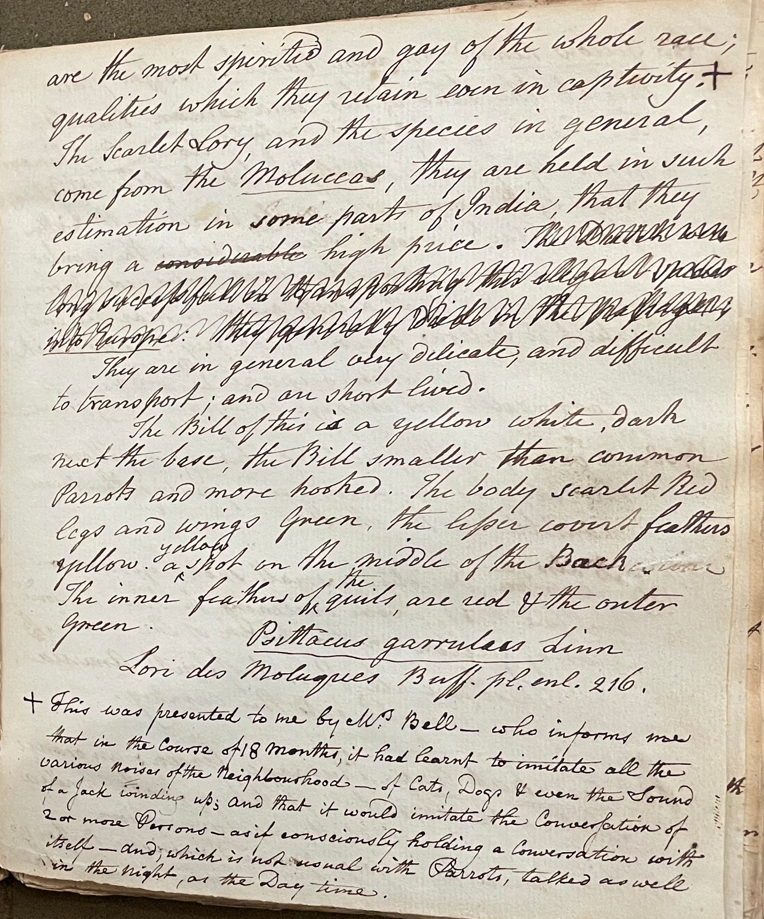
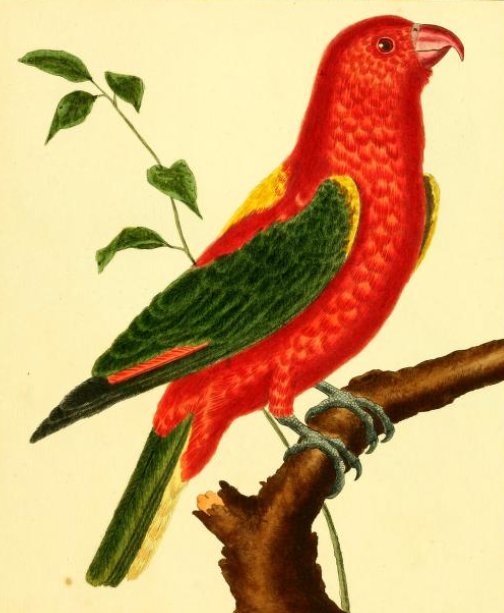
Charles Willson Peale (1741-1827) wrote, in his 16th Lecture (ca. 1799): "No. 136. Scarlet Lory. The name of Lory has been given to a family of the Parrots, from their frequently repeating that word. The little tribe is but little distinguished from the rest, except in colour, which is red, more or less deeply shaded. They are the most spirited and gay of the whole race; qualities which they retain even in captivity. This [specimen] was presented to me by Mrs. Bell, who informs me that in the course of 18 months, it had learnt to imitate all the various noises of the neighbourhood – of cats, dogs & even the sound of a jack winding up, and that it would imitate the conversation of 2 or more persons, as if consciously holding a conversation with itself, and, which is not usual with Parrots, talked as well in the night, as the Day time. The Scarlet Lory, and the species in general, come from the Moluccas. They are held in such estimation in some parts of India, that they bring a high price. They are in general very delicate, and difficult to transport; and are short lived. The bill of this is a yellow white, dark near the base; the bill smaller than common Parrots and more hooked. The body [is] scarlet red; legs and wings green, the lesser covert feathers yellow; a yellow spot on the middle of the back. The inner feathers of the quils are red & the outer green. Psittacus garrulus Linn. Lori des Moluques Buff. pl. enl. 216. (Academy of Natural Sciences of Drexel University Archives, coll. 40)
Peale wrote, in "A Walk Through the Philad[elphi]a Museum" (1805–1806): "what is related of the Scarlet Lory is still more singular, for it immitates the conversations of two or more persons, and what is not usial [sic] with birds, talks as well by night as in the day time. This, and many others of [those] here displayed dressed in such a rich variety of Colours comes from the Islands in the South Seas." (Historical Society of Pennsylvania, coll. 0481)
Specimen Type:
Dead/preserved
Current Common Name:
Red Lory
Current Scientific Name
Psittaculidae | Eos bornea