Object Status:
Extant
Accession Date:
By 1799
Primary Source Reference:
Charles Willson Peale, Lecture on Natural History 26. (ca. 1799). Academy of Natural Sciences of Drexel University Archives, coll. 40. / https://ansp.org/research/library/archives/0000-0099/coll0040/
Additional Source Text:
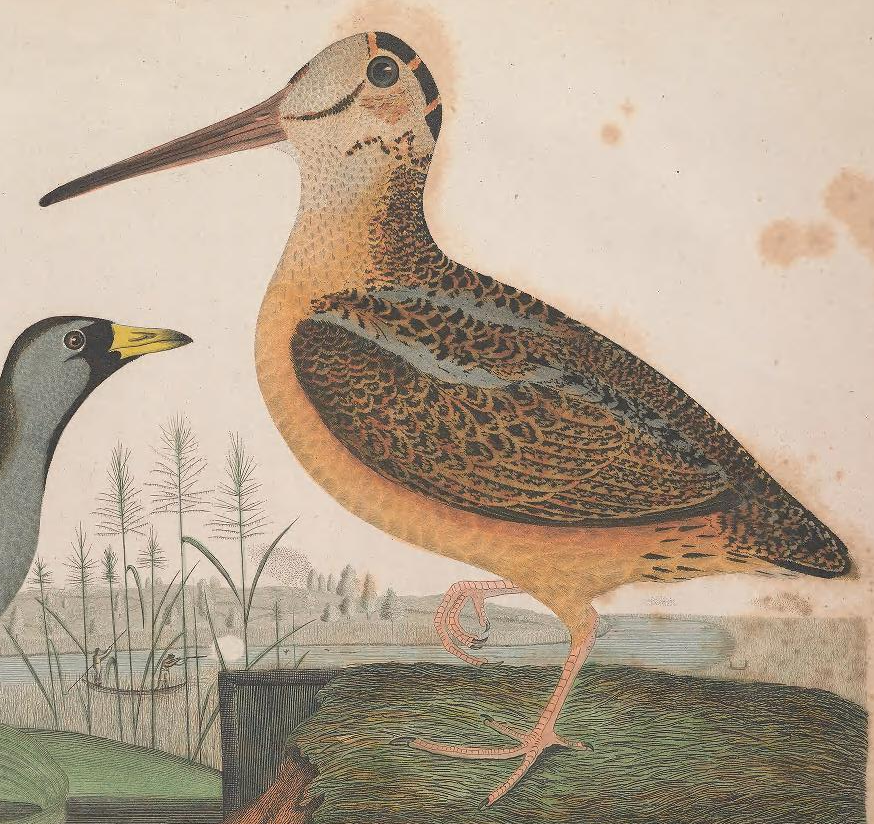
Charles Willson Peale (1741-1827) wrote, in his 26th Lecture (ca. 1799): "832. Is the American Woodcock; it is not only smaller than that I have just described [i.e., Eurasian Woodcock, Scolopax rusticola], but the plumage is very different; the under part of the body is not barred, but is wholly of a russet white. The upper parts of this bird is brown barred with white and black. It is not so dark nor has it the reddish hue of the other. The wings do not reach to the end of the tail as is the case in the other. The character of the Eyes, which are placed high up and back from the bill, correspond, and the bills also are much alike." (Academy of Natural Sciences of Drexel University Archives, coll. 40)
Peale continued: "This also is known to be a desirous bird for the table, even without the necessary […] entrail sauce. Lawson prefers them in point of delicacy to the European kind. I am creditably informed that we possess one much larger, and of some difference of plumage; it is found on the upland grounds. They are not common. Here is one that has a great deal more of the russet colour, it may be a little bigger but not much; perhaps is the male. The European Woodcock lays 4 or 5 Eggs, and it is said this kind only two. They are birds which fly but little in the middle of day, their flights are short and chiefly in evening or morning. On which account. They are game which sportsmen require Dogs to drive up, as they feed in meadows covered with grass, or low shrubbery." (ANSP Archives, coll. 40)
Peale wrote, in "A Walk Through the Philad[elphi]a Museum" (1805–1806): "The English Woodcock and the American are here placed together, and plainly shew they are different species by their plumage as well as by their size. It is said of the American Woodcock that while the hen is sitting, the male in the evening often flies up perpendicularly to a great height, and returns strait down to the same spot, and from the moment of its descent begins an agreable kind of whistle, and continues it till it alights on the ground, after staying a little time, repeats the same for several times together, and this even after dark." (Historical Society of Pennsylvania, coll. 0481)
Alexander Wilson (1766-1813) described this species under the name "Woodcock / Scolopax minor" in American Ornithology vol. 6 (1812: 40, Pl. 48), but did not cite Peale's Museum. / https://www.biodiversitylibrary.org/item/175484#page/58/mode/1up (text) / https://www.biodiversitylibrary.org/item/175484#page/44/mode/1up (plate)
An unmounted specimen of "Scolopax minor (Woodcock)" was listed in "A Catalogue of Duplicate Specimens...", May 1822. [unpublished] American Philosophical Society Library (Mss.B.P31).
Specimen Type:
Dead/preserved
Current Common Name:
American Woodcock
Current Scientific Name
Scolopacidae | Scolopax minor