Object Status:
Unlocated
Accession Date:
By 1799
Primary Source Reference:
Charles Willson Peale, Lecture on Natural History 21. (ca. 1799). Academy of Natural Sciences of Drexel University Archives, coll. 40. / https://ansp.org/research/library/archives/0000-0099/coll0040/
Additional Source Text:
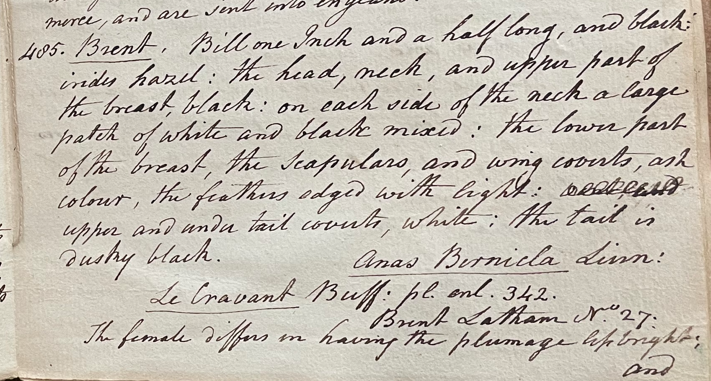
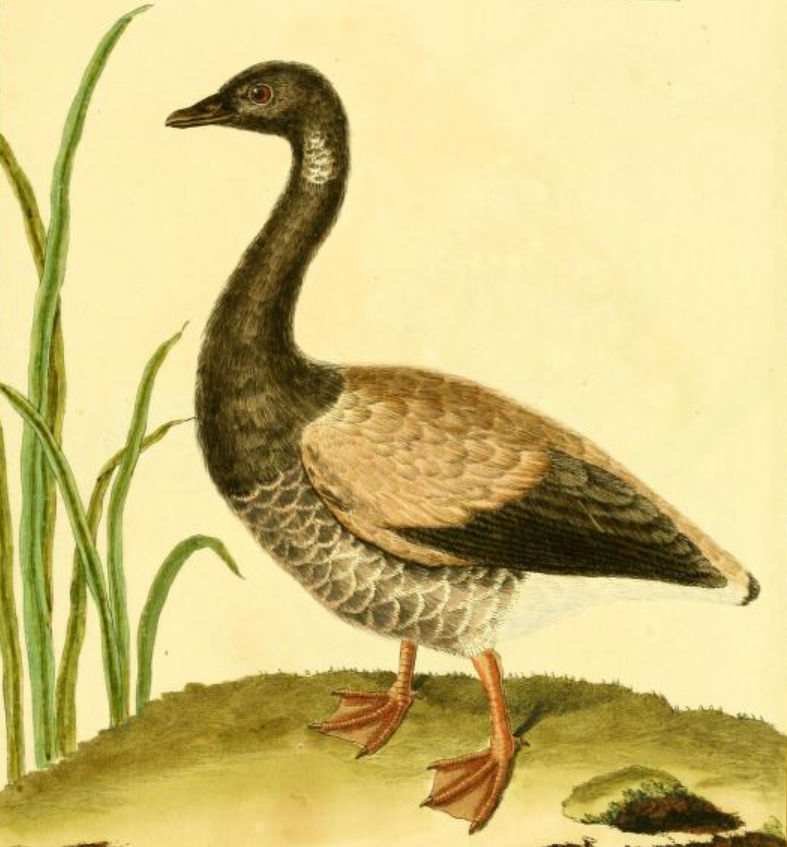
Charles Willson Peale (1741-1827) wrote, in his 21st Lecture (ca. 1799): "485. Brent. Bill one Inch and a half long, and black; irides hazel; the head, neck, and upper part of the breast, black; on each side of the neck a large patch of white and black mixed; the lower part of the breast, the scapulars, and wing coverts, ash colour, the feathers edged with light; upper and under tail coverts, white; the tail is dusky black. Anas bernicla Linn. Le Cravant. Buff. pl. enl. 342. Brent Latham No. 27. The female differs on having the plumage less bright, and in young birds the white on the sides of the neck is small, or wholy deficient." (Academy of Natural Sciences of Drexel University Archives, coll. 40)
Peale continued: "They inhabit North America, Assia & Europe; are found on the coasts of England, Ireland, and Holland in the winter season; and in some seasons have resrted to the coasts of Picardy in France, in such prodigious flocks as to prove a pest to the Inhabitants, as especially happened in the winter of the year 1740, when these birds destroyed all the Corn near the Sea-coasts, by tearing it up by the roots; a general war was for this reason declared against them, and carried on in earnest; by knocking them on the head with clubs; but their numbers were so prodigious that this availed but little; nor were the Inhabitants releved from this scourge till the North wind, which brought them, ceased to blow, and they took leave. [A footnote mentions that this information was sourced from Buffon's "Hist. des Ois."]. They are indifferent eating, being very fishy." (ANSP Archives, coll. 40)
An undated scrap of paper tucked into Peale's 21st lecture manuscript contains a scribbled list of duck specimens and the following passage: "The Brandt Brent (Ber...) it is also said to belong to Assia & Europe and was so numerous in the year 1740 that they made great destruction in their field of grain and could not be..." (ANSP Archives, coll. 40).
Alexander Wilson (1766-1813) described this species under the name "The Brant / Anas bernicla" in American Ornithology vol. 8, published posthumously (Pl. 72), where "Peale's Museum, No. 2704" was cited (Wilson 1814: 131). / https://www.biodiversitylibrary.org/item/175758#page/155/mode/1up (text) / https://www.biodiversitylibrary.org/item/175758#page/154/mode/1up (plate)
Notes:
After Peale's Museum closed, a portion of Peale's bird collection was purchased in 1850 by Moses Kimball (1809–95), who displayed it at his "Boston Museum". An advertisement in the Boston Transcript, printed 1 October 1850, stated that Kimball had acquired "One Half of the celebrated Peale's Philadelphia Museum". The other half of Peale's birds had been sold to the circus promoter P. T. Barnum (1810–91) and would be subsequently destroyed in a fire at his "American Museum" in New York City in July 1865. When the Boston Museum closed, Kimball's Peale remnants passed temporarily to the Boston Society of Natural History, who disposed of them to Charles J. Maynard (1845-1929), a local taxidermist. The specimens were stored in a barn in Massachusetts for several years, then eventually were deposited at the Museum of Comparative Zoology (MCZ), Harvard University. By the time the collection was catalogued by Walter Faxon (1848-1920) at MCZ, in 1914, in virtually every case the original mounts and labels had been disassociated from the specimens, and an untold number were lost.
Walter Faxon, "Relics of Peale's Museum," Bulletin of the Museum of Comparative Zoology, 59, no. 3 (July 1915): 130, speculated that MCZ 67824, a data-deficient specimen from the Boston Museum collection, is “Probably the specimen figured by Wilson." Faxon's claim may be true, but Peale had this species in his collection by 1799, with little room (or interest) to display duplicates. / https://www.biodiversitylibrary.org/page/6339801#page/186/mode/1up
Wilson (1810: viii, American Ornithology, vol. 2) wrote: "no drawings have been, or will be made for this work, from any stuffed subjects, where living specimens of the same can be procured; yet the former serve a very important purpose; they enable the author to ascertain the real existence and residence of such subjects" / https://www.biodiversitylibrary.org/item/175511#page/14/mode/1up
Wilson deposited many specimens at Peale's Museum, after completing his drawings, but the combined evidence from American Ornithology and the Peale Museum Accessions Book (Historical Society of Pennsylvania, coll. 0481) suggests that he deposited probably fewer than 100 skins total (and possibly as few as 40-50), whereas many authors have assumed that all the "Peale numbers" cited in Wilson's work were those of his own specimens (e.g., "he contributed 279 specimens to the collection", Edward H. Burtt, Jr., and William E. Davis, Jr., 2013, Alexander Wilson: The Scot Who Founded American Ornithology, Belknap Press, p. 310). This assumption appears to be based on a misunderstanding — Wilson was citing the numbers to give credit to Peale, to acknowledge his contributions, not to stake a claim to his own discoveries. If Burtt & Davis (2013) were correct, the "Catalogue of Duplicate Specimens" (APS Library, Mss.B.P31) would be full of Wilson's specimen deposits—but this is not the case. No duplicate of Brant Goose is listed. To the editor's (MRH) knowledge, there is no evidence that Wilson deposited a Brant Goose at Peale's Museum.
Specimen Type:
Dead/preserved
Current Common Name:
Brant Goose
Current Scientific Name
Anatidae | Branta bernicla
Repository:
Museum of Comparative Zoology, Harvard University (MCZ 67824)