Object Status:
Extant
Accession Date:
By 12 October 1792
Primary Source Reference:
Charles Willson Peale, letter to Thomas Hall of Moorfields, London, dated 12 October 1792; Selected Papers, 2, part 1: 42.
Additional Source Text:
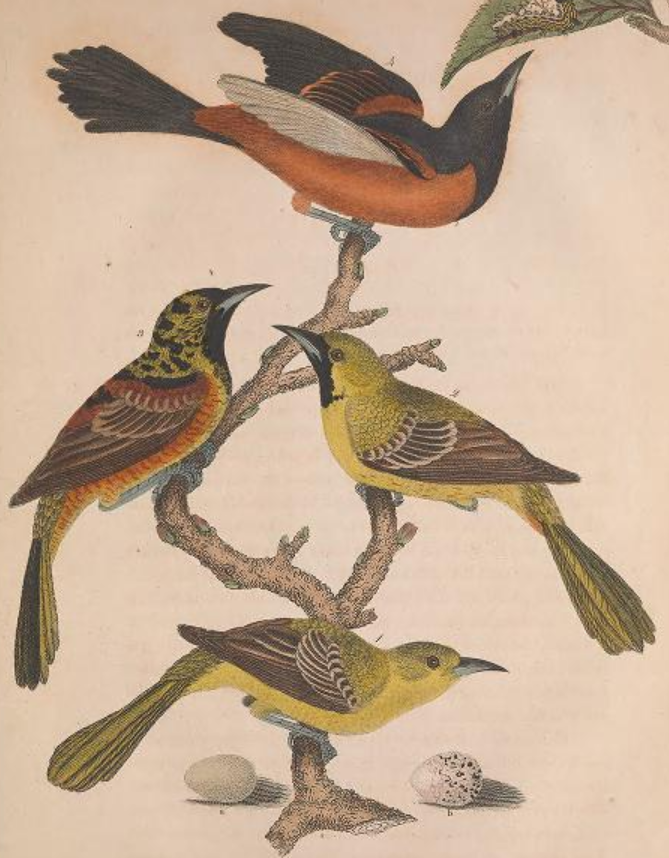
Charles Willson Peale (1741-1827) sent a "Chocolate colloured bird with black head Tail and striped wings" (i.e., an adult male Orchard Oriole) to Thomas Hall, a correspondent in London, on 12 October 1792 (Miller 1988: 42, Selected Papers, Vol. 2, Part 2, Yale University Press).
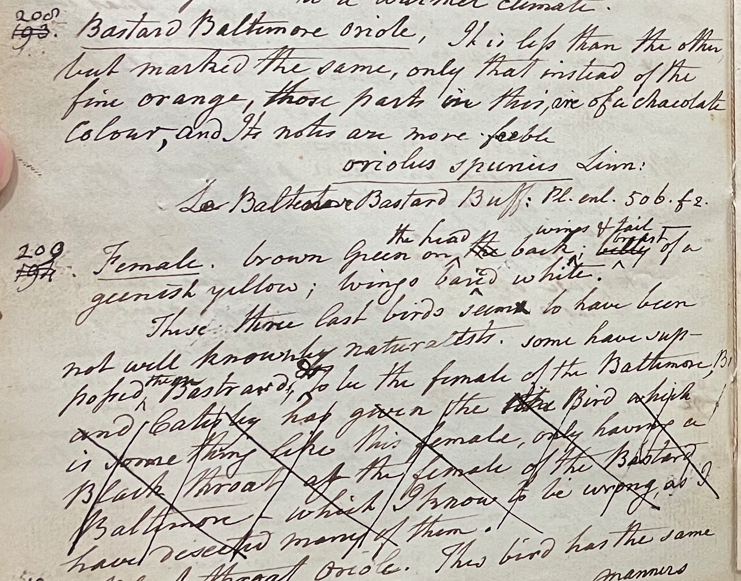
Peale wrote, in his 17th Lecture (ca. 1799): "No. 193. 208. Bastard Baltimore Oriole. It is less than the other but marked the same, only that instead of the fine orange, those parts in this, are of a chocolate colour, and its notes are more feeble. Oriolus spurius Linn. Le Baltimore bastard Buff. pl. enl. 506. f. 2. 194. 209. Female. brown green on the head & back, wings & tail; breast of a general yellow; wings barred white. These three last birds seem to have been not well known to naturalists. Some have supposed the Bastard to be the female of the Baltimore. [Buffon] and Catesby have given the bird which is something like the female, only having a Black throat, as the female of the Bastard Baltimore, which I know to be wrong as I have dissected many of them." (Academy of Natural Sciences of Drexel University Archives, coll. 40)
Peale continued: "195. 210. Black throat Oriole. This bird has the same manners as the last described, and they are often found together. I know it to be a male (tho' Catesby has discribed it as the Female of the Baltimore Bird). Let the amateurs of Natural history observe these Birds in the seasons when they pair, that they may satisfy themselves that all the authors of Natural History have been misinformed respecting them." (ANSP Archives, coll. 40)
Peale wrote, in "A Walk Through the Philad[elphi]a Museum" (1805–1806): "Before we leave this genus, it is deserving of Notice that authors have been under the mistake of making the black throat, the female of the Bastard Baltimore (oriolus Spurius). Here we see the proper female to each of them." (Historical Society of Pennsylvania, coll. 0481)
Alexander Wilson (1766-1813) described this species under the name "Orchard Oriole / Oriolus mutatus" in American Ornithology vol. 1 (Pl. 4), where "Peale's Museum No. 1508.—Bastard Baltimore" was cited as the primary reference (Wilson 1808: 23). / https://www.biodiversitylibrary.org/item/175530#page/37/mode/1up (text) / https://www.biodiversitylibrary.org/item/175530#page/83/mode/1up (plate)
Twelve mounted specimens of "Oriolus spurius (Orchard Oriole)" were listed in "A Catalogue of Duplicate Specimens...", May 1822. [unpublished] American Philosophical Society Library (Mss.B.P31).
Notes:
After a long discussion about the differences between the Orchard and Baltimore Orioles, Wilson (1808: 71) wrote: “I may add, that Mr. Charles W. Peale, proprietor of the Museum in Philadelphia, who, as a practical naturalist, stands deservedly first in the first rank of American connoisseurs; and who has done more for the promotion of that sublime science than all our speculative theorists together, has expressed to me his perfect conviction of the changes which these birds pass thro; having himself examined them both in spring and towards the latter part of summer, and having at the present time in his possession thirty or forty individuals of this species, in almost every gradation of change.” Wilson also mentioned that Peale had raised multiple individuals “from the nest."
Specimen Type:
Live (later taxidermied)
Current Common Name:
Orchard Oriole
Current Scientific Name
Icteridae | Icterus spurius