Object Status:
Extant
Accession Date:
By 1799
Primary Source Reference:
Charles Willson Peale, Lecture on Natural History 21. (ca. 1799). Academy of Natural Sciences of Drexel University Archives, coll. 40. / https://ansp.org/research/library/archives/0000-0099/coll0040/
Additional Source Text:
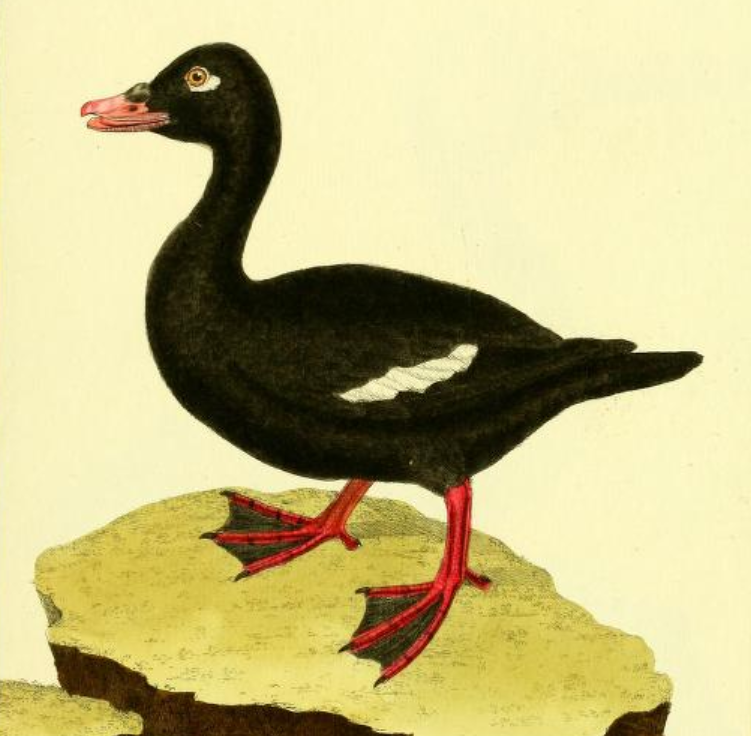
Charles Willson Peale (1741-1827) wrote, in his 21st Lecture (ca. 1799): "493. Female of the Channel Duck. This duck I find in Maryland; they keep a considerable distance from the shore, and from my researches as yet I have not found it described. The general plumage, is a russet brown; on each cheek a large oval white spot, a little back and below the eyes; the wings barred with white; the Bill is short and high, therefore belonging to the goose family. The male is very black and has only white on the wings, very difficult to be shot." (Academy of Natural Sciences of Drexel University Archives, coll. 40)
In the same lecture, Peale described the male under a different name: "499. Velvet Duck. I have only the head of this duck, which I found in our Market. The feathers were taken from the body. Latham says it is a little larger than the Mallard. The bill rises into a knob at the base, behind the nostrils it is black; the rest of the bill yellow, with the nail at the end red; the edges all round, black; the plumage in general is black; inclined to brown on the under part of the body; under each Eye-lid a white mark, passing in a streak behind the Eye; and across the middle of the wing a band of white; the leggs are red; claws black. Anas fusca linn. La grande Macreuse Buff. pl. enl. 956. Velvet Duck Latham No. 37. Pennant 482. Frequents the seas about New York. Is very common in the great lakes and rivers of the north and east of Sibiria, and on the shores. Extends to Kamtschatka. Is less common in Russia. Lays from 8 to 10 white Eggs. Notwithstanding they are Ducks which at all times frequent the sea, yet, in the laying season, go far inland, and make their nests; as soon as that task is over, the males fly away; but as soon as the young can fly, they are rejoined by their mates; followed by the brood." (ANSP Archives, coll. 40)
Peale wrote, in "A Walk Through the Philad[elphi]a Museum" (1805–1806): "The Muscovy, the Golden Eye, and the Channel Duck fills this Case" (Historical Society of Pennsylvania, coll. 0481).
Alexander Wilson (1766-1813) described this species under the name "Velvet Duck / Anas fusca" in American Ornithology vol. 8 (1814, Pl. 72), where he cited "Peale's Museum, No. 2658, Female". Due to an apparent typographical error, this species and "Scoter Duck / Anas nigra" (Common Scoter, M. nigra) were given the same Peale Museum number (2658) by Wilson (1814: 135). / https://www.biodiversitylibrary.org/item/175758#page/159/mode/1up (text) / https://www.biodiversitylibrary.org/item/175758#page/154/mode/1up (plate)
Notes:
Except for a period of three years (1767-70) when he studied abroad in England, Peale lived in Maryland until the age of 34 years, where “Channel Duck” was a colloquial name for White-winged Scoter; see Waldo L. McAtee, 1927, "Local names of migratory game birds", U.S. Department of Agriculture Miscellaneous Circular 13. / https://www.biodiversitylibrary.org/item/131846#page/33/mode/1up
Specimen Type:
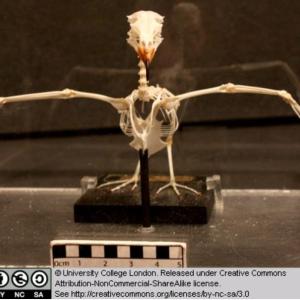
Dead/preserved
Current Common Name:
White-winged Scoter
Current Scientific Name
Anatidae | Melanitta deglandi