Object Status:
Unlocated
Accession Date:
By 1799
Primary Source Reference:
Charles Willson Peale, Lecture on Natural History 21. (ca. 1799). Academy of Natural Sciences of Drexel University Archives, coll. 40. / https://ansp.org/research/library/archives/0000-0099/coll0040/
Additional Source Text:
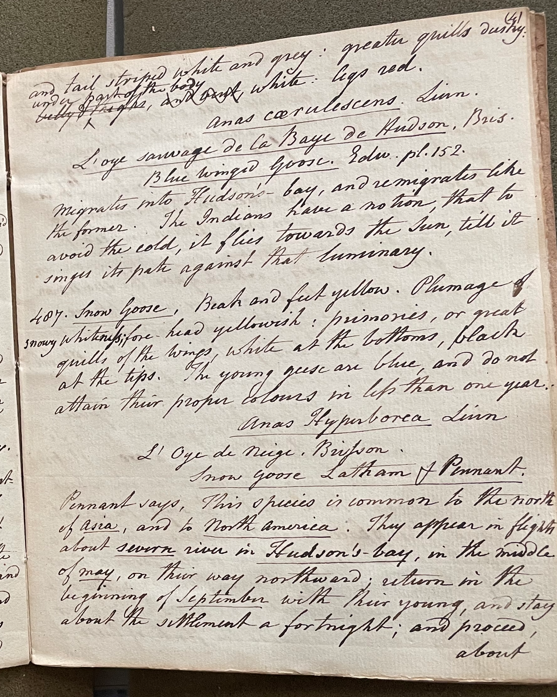
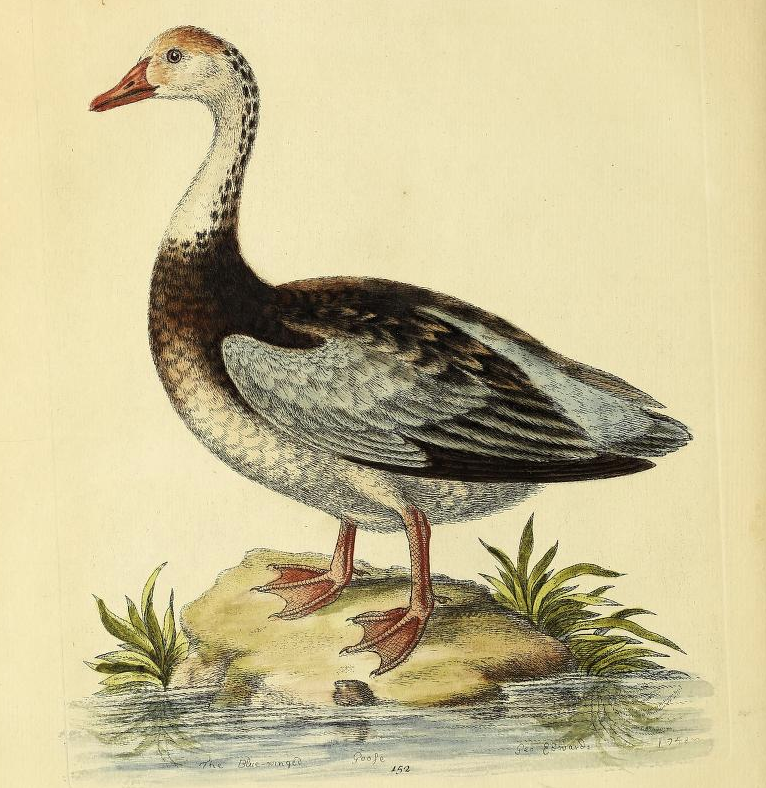
Charles Willson Peale (1741-1827) wrote, in his 21st Lecture (ca. 1799): "486. Blue winged Goose, commonly called with us Brent-Goose. Bill is red; irides deep chocolate; crown of the head yellowish, appearing as if singed; the rest of the head and neck white; the lower part of the neck, all round the breast, sides, under the wings, and back, dark brown, palest on the breast; wing and tail coverts pale blueish ash-colour; scapulars and tail striped white and grey; greater quils dusky; under parts of the body white; legs red. Anas caerulescens Linn. L'oye sauvage de la Baye de Hudson. Bris. Blue winged Goose. Edw. pl. 152. Migrates into Hudson's-bay, and remigrates like the former [i.e., Brant Goose, Branta bernicla]. The Indians have a notion, that to avoid the cold, it flies towards the Sun, till it singes its pate against that luminary." (Academy of Natural Sciences of Drexel University Archives, coll. 40)
Then, Peale described the typical plumage of the species, and its geographic distribution: "487. Snow Goose. Beak and feet yellow. Plumage of snowy whiteness; fore-head yellowish; primaries, or great quills of the wings, white at the bottoms, black at the tips. The young geese are blue, and do not attain their proper colours in less than one year. Anas Hyperborea Linn. L'Oye de Neige. Brisson. Snow Goose Latham & Pennant. Pennant says, 'Tis species is common to the North of Asia, and to North America. They appear in flights about severn river in Hudson's-bay in the middle of May, on their way northward; return in the beginning of September with their young, and stay about the settlement a fortnight; and proceed, about the 10th of October, flying very high, southward to pass the winter. They come in flocks of thousands; quite cover the coutry; rise in clouds, and with an amazing noise. They visit Carolina in vast flocks; and feed on the rooths of sedge & grass, which they tear up like Hogs. It used to be a common practice in that country [Carolina] to burn a piece of a marsh, which inticed the geese to come there, as they could then more readily get at the roots; which gave the sportsman opportunity of killing as many as he pleased. In Hudson's Bay thousands are annually shot by the Indians for the use of the settlement; and are esteemed excellent meat." (ANSP Archives, coll. 40)
Peale continued: "Pennant is very lengthy on this goose; he is particular on their migrating into Sibiria - and makes them out to be a very stupid animal, describing the manner in which the Sibirians take them. He says, the Inhabitants first place, near the banks of the rivers, a great net, in a strait line, or else form a hovel of skins sewed together. This done, one of the company dresses himself in the skin of a reindeer, advances towards the flock of geese, and then turns back towards the net or the hovel; and his companions go behind the flock, and, making a noice, drive them forward. The simple birds mistake the man in white for their leader, and follow him within reach of the net, which is suddenly pulled down, and captivates the whole." (ANSP Archives, coll. 40)
Peale continued: "When he chooses to conduct them to the Hovel, they follow in the same manner; he [craps] in at a hole left for that purpose and out at another on the opposite side, which he closes up. The geese follow him through the first; and as soon as they are got in, he passes round, and secures everyone. In that frozen clime, they afford great substinance to the natives, and the feathers are an article of commerce. Each family will kill thousands in a season. These they pluck and gut, then fling them in heaps into holes dug for the purpose, and cover them with nothing more than the earth. This freezes, and forms over them an arch; and whenever the family has occasion to open one of these magazines, they find their provision sweet and good'." A footnote mentions that this information was sourced from Pennant's Arctic Zoology. (ANSP Archives, coll. 40)
An undated scrap of paper tucked into Peale's 21st lecture manuscript contains a scribbled list of duck specimens and the following passage: "here is the Blue winged Goose which the Indians says that to avoid the cold, it flies towards the sun & singes its pate. Also the white snow goose (hyperborea) which is said to be common to Assia as well as to America. Some curious accounts are given of the manner of taking catching them in Sibiria." (ANSP Archives, coll. 40)
Another slip of loose paper tucked into Peale's 36th lecture contains a list of waterbirds with the following entry: "Blue winged Goose & Snow Goose" (ANSP Archives, coll. 40).
Peale wrote, in "A Walk Through the [Philadelphia] Museum" (1805–1806): "Here is the Snow Goose (A. hyperborea) which the Indians say that to avoid the cold it flies towards the Sun & singes its pate against that luminary. said to be common to Assia as well as America. some curious accounts are given of the manner of catching them in Siberia. Blue Winged Goose (A. caerulescens) belongs only to America" (Historical Society of Pennsylvania, coll. 0481).
Alexander Wilson (1766-1813) described this species under the name "Snow Goose / Anas hyperborea" in American Ornithology vol. 8, published posthumously (Pl. 68), where "Peale's Museum, No. 2635" was cited (Wilson 1814: 76). He also depicted a blue morph ("young") individual (Pl. 69), for which "Peale's Museum, No. 2636" was cited (Wilson 1814: 89). / https://www.biodiversitylibrary.org/item/175758#page/92/mode/1up (text) / https://www.biodiversitylibrary.org/item/175758#page/83/mode/1up (plate) / https://www.biodiversitylibrary.org/item/175758#page/107/mode/1up (blue morph text) / https://www.biodiversitylibrary.org/item/175758#page/96/mode/1up (blue morph plate)
Titian Ramsay Peale (1799-1885) deposited a "Snow Goose" On 9 January 1822, according to a notice in Poulson's American Daily Advertiser.
Notes:
After Peale's Museum closed, a portion of Peale's bird collection was purchased in 1850 by Moses Kimball (1809–95), who displayed it at his "Boston Museum". An advertisement in the Boston Transcript, printed 1 October 1850, stated that Kimball had acquired "One Half of the celebrated Peale's Philadelphia Museum". The other half of Peale's birds had been sold to the circus promoter P. T. Barnum (1810–91) and would be subsequently destroyed in a fire at his "American Museum" in New York City in July 1865. When the Boston Museum closed, Kimball's Peale remnants passed temporarily to the Boston Society of Natural History, who disposed of them to Charles J. Maynard (1845-1929), a local taxidermist. The specimens were stored in a barn in Massachusetts for several years, then eventually were deposited at the Museum of Comparative Zoology (MCZ), Harvard University. By the time the collection was catalogued by Walter Faxon (1848-1920) at MCZ, in 1914, in virtually every case the original mounts and labels had been disassociated from the specimens, and an untold number were lost.
Walter Faxon, "Relics of Peale's Museum," Bulletin of the Museum of Comparative Zoology, 59, no. 3 (July 1915): 130, speculated that MCZ 67822, a data-deficient specimen from the Boston Museum collection, is the "Original of Wilson’s drawing, without much doubt." He also stated that MCZ 67832, another data-deficient specimen with the same provenance, is "the Original of Wilson's figure". / https://www.biodiversitylibrary.org/page/6339801#page/180/mode/1up
These claims are unlikely to be true for several reasons. Wilson (1810: viii, American Ornithology, vol. 2) had previously stated that "no drawings have been, or will be made for this work, from any stuffed subjects, where living specimens of the same can be procured; yet the former serve a very important purpose; they enable the author to ascertain the real existence and residence of such subjects" / https://www.biodiversitylibrary.org/item/175511#page/14/mode/1up
Wilson (1814: 77) wrote of the light morph bird: "The specimen from which the above figure and description were taken, was shot on the Delaware [River], below Philadelphia, on the fifteenth of February." And, Wilson's (1814: 90) description of the blue morph bird also makes clear that he collected (shot) and dissected it himself. Therefore, if MCZ 67822 and 67823 were those specimens, they must have been deposited by Wilson at Peale's Museum. Wilson did not state that he deposited any specimens, although some have interpreted the "Peale number" citations to be references to Wilson's own deposits (see below). / https://www.biodiversitylibrary.org/item/175758#page/93/mode/1up
Specimens of this large species were already mounted in Peale's Museum by 1799, and Peale had little space (or interest) to display duplicates. Wilson deposited many specimens at Peale's Museum, after completing his drawings, but the combined evidence from American Ornithology and the Peale Museum Accessions Book (Historical Society of Pennsylvania, coll. 0481) suggests that he deposited probably fewer than 100 skins total (and possibly as few as 40-50), whereas many authors have assumed that all the "Peale numbers" cited in Wilson's work were those of his own specimens (e.g., "he contributed 279 specimens to the collection", Edward H. Burtt, Jr., and William E. Davis, Jr., 2013, Alexander Wilson: The Scot Who Founded American Ornithology, Belknap Press, p. 310). This assumption appears to be based on a misunderstanding — Wilson was citing the numbers to give credit to Peale, to acknowledge his contributions, not to stake a claim to his own specimen deposits. If Burtt & Davis (2013) were correct, the "Catalogue of Duplicate Specimens" (APS Library, Mss.B.P31) would be full of Wilson's specimen deposits—but this is not the case. No duplicates of Snow Goose are listed. To the editor's (MRH) knowledge, there is no evidence that Wilson deposited a Snow Goose at Peale's Museum.
Faxon (1915) also overlooked a specimen donated by Titian R. Peale on 9 January 1822, according to a notice in Poulson's American Daily Advertiser.
Specimen Type:
Dead/preserved
Current Common Name:
Snow Goose
Current Scientific Name
Anatidae | Chen caerulescens
Repository:
Museum of Comparative Zoology, Harvard University (MCZ 67822 and 67823)