Object Status:
Extant
Accession Date:
By 1799
Primary Source Reference:
Charles Willson Peale, Lecture on Natural History 25. (ca. 1799). Academy of Natural Sciences of Drexel University Archives, coll. 40. / https://ansp.org/research/library/archives/0000-0099/coll0040/
Additional Source Text:
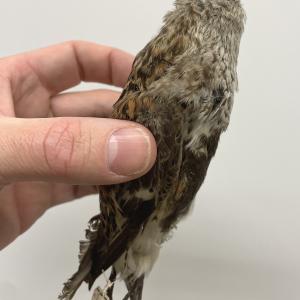
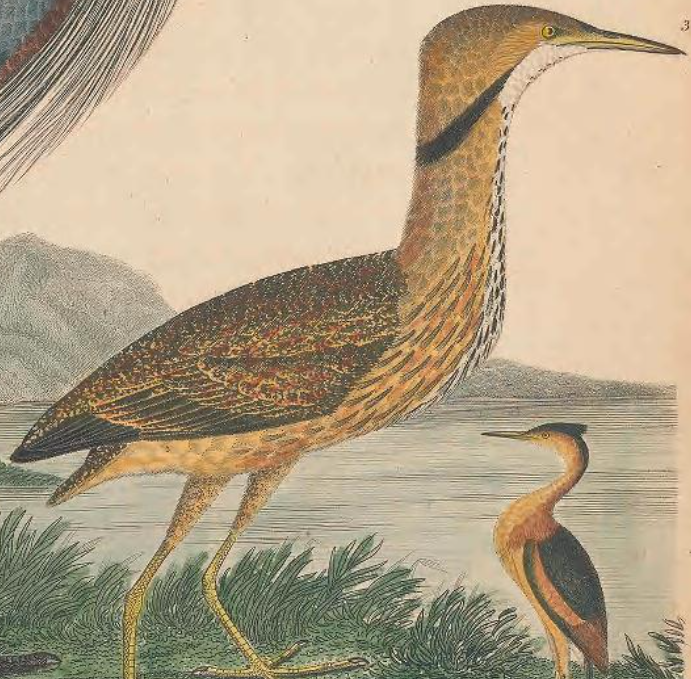
Charles Willson Peale (1741-1827) wrote, in his 25th Lecture (ca. 1799): "No. 741. Bittern. The upper part of the upper mandible dark; the under edge & under mandible white; the top of the [head] russet brown; throat white; on each side of the neck is a black band; the neck & breast is striped with russet white & black lines; the back and wing coverts are russet brown barred with dark brown; wing quills black; vent sallow white; legs yellowish green; irides yellow. a variety of Ardea stillaris Linn. Butor de la baye d'Hudson Buff. Vol. 7. pag. 430. Bitter from Hudsons Bay Edw. tab. 136." (Academy of Natural Sciences of Drexel University Archives, coll. 40)
Peale continued: "The appellation of Stary or Stillaris, given by the Ancients to the Bittern, is derived, according to Scagliger, from its evening flight when it soars aloft and seems to lose itself in the starry-vault; others assert that the name refers to the spots scattered on its plumage. This bird is common throughout the United States. Pennant says they it arrives in Hudsons Bay the latter end of May; lives among the swamps and willows; lays two Eggs. It is smaller than the European species and whatever authors may say, on comparing them both togather, we must pronounce them different species. They are esteemed very good eating." Peale also wrote: "744. In This American Bittern, I have dressed the neck feathers in the same form, as those of Europe, in order that the difference of the plumage may be seen more distinctly by a comparative view." (ANSP Archives, coll. 40)
Peale wrote, in "A Walk Through the Philad[elphi]a Museum" (1805–1806): "while speaking on Bitterns, step a little forward and we shall the European Bitterns (a. Stellaris) they are elegant birds with that wide spread of neck feathers. one of America is here mounted in the same manner. it is smaller and a different species." (Historical Society of Pennsylvania, coll. 0481)
In October 1811, the anonymous donation of "A female, Brown Bittern" was recorded in the Peale Museum Accessions Book (Historical Society of Pennsylvania, coll. 0481).
Alexander Wilson (1766-1813) described this species under the name "American Bittern / Ardea minor" in American Ornithology vol. 8, published posthumously (Pl. 65), where "Peale's Museum, No. 3727" was cited (Wilson 1814: 35). / https://www.biodiversitylibrary.org/item/175758#page/45/mode/1up (text) / https://www.biodiversitylibrary.org/item/175758#page/35/mode/1up (plate)
Specimen Type:
Dead/preserved
Current Common Name:
American Bittern
Current Scientific Name
Ardeidae | Botaurus lentiginosus