Object Status:
Extant
Accession Date:
6 August 1791
Primary Source Reference:
Charles Willson Peale, diary entry dated 5 August 1791. American Philosophical Society Library, Peale-Sellers Family Collection (Mss.B.P31).
Additional Source Text:
Charles Willson Peale (1741-1827) wrote in his diary on 5 August 1791: "I amuse myself [by] making a cage for a humming Bird, which had flown into the window. A [second] also came in and I put them togather, but whether they can agree so well as to live togather I have yet to prove." (American Philosophical Society Library, Peale-Sellers Collection, Mss.B.P31)
Peale published a Broadside in 1792 which read: "Last summer in my journey into Maryland, I caught a pair of humming birds, which I intended for such an essay; but my stay in that state was longer than I expected, and the cold weather commenced, and both of these birds I recovered twice from a lifeless appearance, by animal heat, into such animation as to feed freely; the cold weather increasing, and their falling again into stillness, I put them into cotton in a small box, and I have not found any putrid smell from them, in a variety of weather since." (Miller 1988: 17, Selected Papers, Vol. 2, part 1, Yale University Press)
On 12 October 1792, Peale sent a "Humming birds— nest" to Thomas Hall in London, in exchange for European specimens: "The Humming bird, makes his nest so like a knot of the Tree wherever they build, that it becomes exceedingly difficult to find them, and I have only one pr of Eggs in my Museum— or I should have sent some with the nest." (Miller 1988: 44)
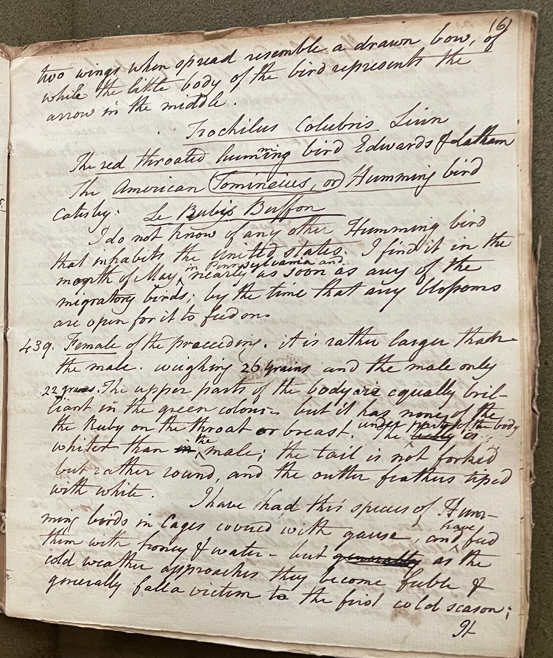
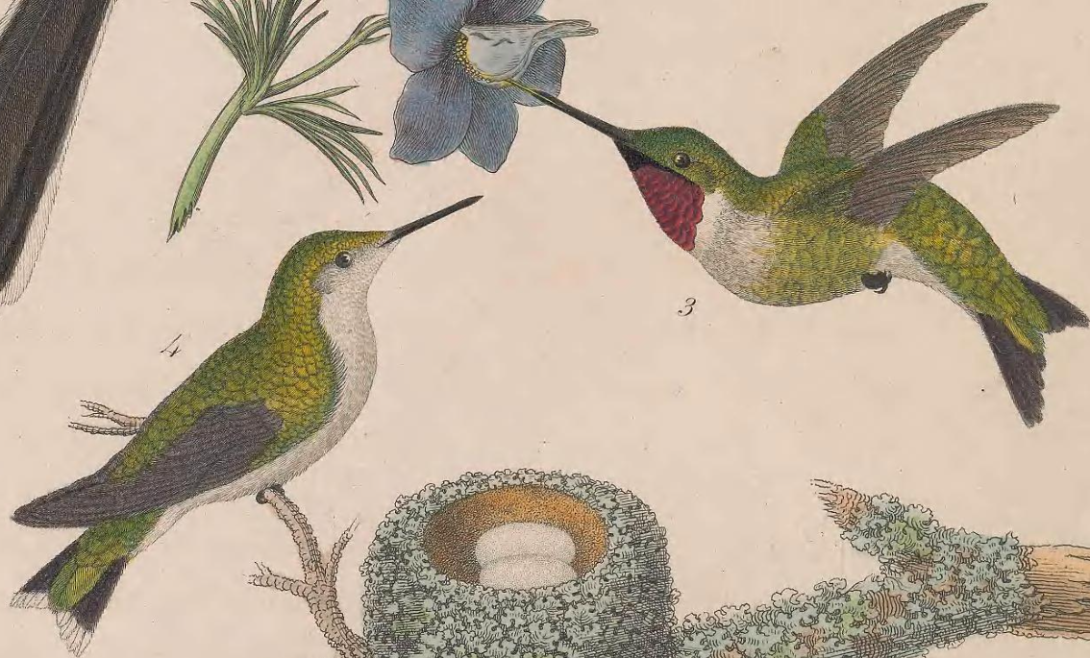
Peale wrote, in his 20th Lecture (ca. 1799): "438. Red throated Humming bird. Length 3 inches & 1/3; Bill ¾ of an inch. The male in green gold on the upper part, with a changeable copper gloss; the under parts grey; the throat, and fore part of the neck, of a ruby colour; in some light as bright as fire itself; viewed sideways appears mixed with gold; and beneath looks of a dull garnet colour; the two middle feathers of the tail are the same as the plumage on the upper part of the body; the others of a purplish brown; the tail a little forked. The wings are brown tinged with violet. The form of the wings in singular; Catesby compares it to the blade of a Turkish scimitar. The 4 or 5 outer quills are long, the next less so, and those next [to] the body extremely small; which, joined to another circumstance that the largest are curved outwards, make the two wings when spread resemble a drawn bow, of white; the little body of the bird represents the arrow in the middle.Trochilus colubris Linn." (Academy of Natural Sciences of Drexel University Archives, coll. 40)
Peale continued: "The red throated humming bird Edwards & Latham. The American […], or Humming bird. Catesby. Le Rubis Buffon. I do not know of any other Humming bird that inhabits the United States. I find it in the month of May in Pennsylvania, and nearly as soon as any of the migrating birds; by the time that any blossoms are open for it to feed on. 439. Female of the preceeding. It is rather larger than the male, weighing 26 grams and the male only 22 grams. The upper parts of the body are equally brilliant in the green colour, but it has none of the Ruby on the throat or breast; underparts of the body whiter than the male; the tail is not forked but rather round, and the outer feathers tipped with white." (ANSP Archives, coll. 40)
Peale continued: "I have had this species of Humming birds in cages covered with […], and have feed [sic] them with honey & water, but as the cold weather approaches they become feeble & generally fall a victim to the first cold season; it is generally believed that they only feed on the honey which they get in flowers. However, I have sufficient proof to believe that they also eat the smallest flies. By mere accident I found out this fact. A pair of young b irds were brought to me in the nest, without feathers on the wings, and only downy feathers on the body. Mrs. Peale took the charge of feeding them, by making a syrup of sugar & water, and dipping a piece of wire into the syrup put a drop to each […] frequently which nourished and supported them until they got fledged and could fly about the room, when they would feed out of the bottle as often as they wanted. They became so well acquainted with their mistress that they preferred sitting on her hand, head, or shoulders to any other place of rest. Having the liberty of flying, we very frequently saw them dart after the smallest gnats or flies, those that were not larger than a pin head, and also often saw them disappointed in catching those small particles of moth [dust] that are only distinguished in the sun shine, floating in the air. We made frequent amusement of taking them into the sun to see how very active they would be in seeking their small prey." (ANSP Archives, coll. 40)
Peale continued: "I had always believed that humming birds lived wholy on hony [sic] before I had this experience, and I find it as also the oppinion [sic] of most authors. One person Buffon says denies the fact: "Badier, who, finding in the esophagus some portions of insects, concludes that the bird lives on these, and not on the nectar of flowers." If Badier supposed they lived wholy on Insects, he will find too many opponents who have had ocular demonstration that their most common food, they obtain from the flowers sweat, but like many birds which feed principally on seeds, are known also to catch flies occasionally. With this species I am familiar, therefore I can more particularly speak of their manners. Small as they really are, (and we much suppose very defenceless), their bill being remarkably soft and tender, little than a sheath for its long tubular tongue; with it, the bird can neither act offensively nor defensively!" (ANSP Archives, coll. 40)
Peale continued: "But it has very sharp and long claws for its size; these are its most powerful weapons, with those it can pull out the feathers from each other in their terrible conflicts together. I have often seen them fight in the […] as well as in the cages where I have put several together. They are the most spirited bird I am acquainted with, for they will attack birds of 10 times their bulk. Whether it is their humming noise that frightens, or whether they, with their little talons, really do hurt the arger birds which they attack, I cannot say; but sparrows, Robbins, and even the King Bird fly from them. My friend Mr. Bartram, who pays very particular attention to natural History, and makes many interesting remarks, not only on the vegetable, but also on the feathered tribe – first related to me the manner of the humming birds fighting, and the singular and very curious submission of the vanquished; and afterwards their friendly association together. When a quarrel takes place between two Cocks, and they have sufficiently tryed their strength, and one is willing to submit. He lights on a dead limb of a tree; on a stump – or a tussock, when the place is open. The conquerer, then begins to make a sweep of 10 or twelve feet flying from side to side over the head of the vanquished bird – forming a curve – several feet above him, and at each time the conquerer passes over his head, the Conquered bows it down – every sweep the conquerer makes, he shorted the distance and approaches nearer to the other bird; who still each time makes his submission as the other passes over him. This passing and repassing is repeated several times until the sweep has become short and the conquerer has approached very near to the vanquished bird – who has not sufficiently humbled himself. They then fly away together and go to feeding on the same bush, or tree, as if they had no farther animosity against each other." (ANSP Archives, coll. 40)
Peale continued: "I have said they have great courage, if the greater bulk of a heart is necessary to anmate the spirits – the Humming bird possesses a greater proportion than any other animal – for its heart is remarkably large. The manner of construction in of their nests is also diserving [sic] your notice, it corresponds to the delicacy of their bodies; it is formed Buffon says with the soft cotton or silku down gathered from flowers, and has the consistency and feel of a thick smooth skin. The female performs the work, and the male collects the materials. She applies herself with ardour; selects, one by one, the fibres proper to form the texture of this kindly cradle for her progeny; she smooths the margin with her breast, the inside with her tail; she covers the outside with bets of the Bark of gum tree, which are stuck to shelter from the weather, and give solidarity to the fabrick; the whole is attached to a limb or sometimes between two small branches, and is so perfectly resembling the knot of a tree, as scarcely to be known from one. This nest [on display] contains two Eggs, which is generally the number they lay – the Eggs are very large for the size of the bird." (ANSP Archives, coll. 40)
Alexander Wilson (1766-1813) described this species under the name "Humming-bird / Trochilus colubris" in American Ornithology vol. 2 (Pl. 10) where "Peale's Museum No. 5288" was cited (Wilson 1810: 26) cited. He repeated Peale's anecdote about hand raising a brood of this species: "Mr. Charles Wilson [sic] Peale, proprietor of the Museum, tells me, that he had two young Humming-birds which he raised from the nest. They used to fly about the room; and would frequently perch on Mrs. Peale's shoulder to be fed. When the sun shone strongly into the chamber, he has observed them darting after the motes that floated in the light, as Flycatchers would after flies." / https://www.biodiversitylibrary.org/item/175511#page/32/mode/1up (text) / https://www.biodiversitylibrary.org/item/175511#page/8/mode/1up (plate)
Two mounted male specimens of "Trochilus colubris (A[merican] Humming Bird)" were listed in "A Catalogue of Duplicate Specimens...", May 1822. [unpublished] American Philosophical Society Library (Mss.B.P31).
Notes:
To my knowledge, Peale's diary entry is the oldest example of a "window strike" in ornithological literature. / https://en.wikipedia.org/wiki/Bird%E2%80%93window_collisions
Specimen Type:
Dead/preserved
Current Common Name:
Ruby-throated Hummingbird
Current Scientific Name
Trochilidae | Archilochus colubris