Object Status:
Extant
Accession Date:
By 1799
Primary Source Reference:
Charles Willson Peale, Lecture on Natural History 30. (ca. 1799). Academy of Natural Sciences of Drexel University Archives, coll. 40. / https://ansp.org/research/library/archives/0000-0099/coll0040/
Additional Source Text:
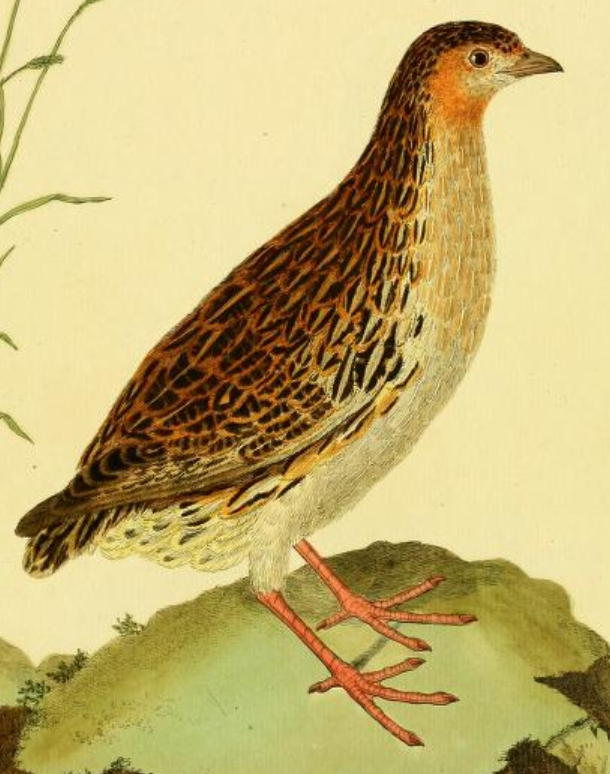
Charles Willson Peale (1741-1827) wrote, in his 30th Lecture (ca. 1799): "No. 1132. Common Quail. Length 7 ½ Inches. Bill dusky; the general colour is rufus, with striped yellow lines and spotted brown; a dingy white throat, with a brown line bordering it, diving the white from the rufus colours of the breast. This is a female. Tetrao coturnix Linn. La Caille. Buff. pl. enl. 170. This quail seems to spread entirely throughout the Old World, but does not inhabit the New; it is seen from the Cape of Good Hope quite to Iceland, and throughout Russia, Tartary, and China, and in short is mentioned by so many travelers, and in so many places, that we almost call it an Inhabitant of All. It is observed to shift quarters according to the season, coming northward in spring, and departing south in Autumn; and this in vast flocks, like other migratory birds. Twice in a year come in such quantities into Capri, that the Bishop of the Island draws the chief part of his [revenue] from them; hence [it] is called the Quail Bishop." (Academy of Natural Sciences of Drexel University Archives, coll. 40)
Peale continued: "But this does not stand alone; almost all the Islands in the Archipelago, on the opposite coasts, are at times covered with these birds, and some of them obtain a name from the circumstance. On the west coast of the Kingdom of Naples, within the span of 4 or 5 miles, an hundred thousand have been taken in a day, which have been sold for eight livres pr. hundred, to dealers who carry them for sale to Rome. Great quantities also sometimes alight in spring on the coasts of Provence, especially on the diocese of the Bishop of [Fregus], which is near the sea, and appear, at their first landing, so much fatigued that they are often taken by the hand." (ANSP Archives, coll. 40)
Peale continued: "These circumstances then leave no doubt of their being the same kind of birds which the divine hand of Providence thought right to direct in such quantities as to cover the camp of the murmuring Israelites. [A note mentions that he sourced this information from "Exod. XVI. 13."] In autumn, great quantities are frequently imported into England and France, for the table, which we have frequently seen on their passage to London by the stage coaches, about an hundred in a large square box, divided into five or six partitions, one above another, just high enough to admit of the quails standing uprght; these boxes have wires on the fore-part, and each partition with a little trough for food; and I have been told they may be conveyed thus to great distances without difficulty. How they agree so well together is at least doubtfull, since the Antients [sic] found them such quarrelsome birds, that when children fell out they applied a proverb, "as quarrelsome as quails in a cage." They breed in England, make their nest no better than partridges, or rather no nest at all, for a hollow place on the ground often serves them. These birds are easily drawn within reach of a net, by a call imitating the voice which is not unlike the words "whit, whit, whit"; other uses are made of them in China than for mere food; the one for fighting as we do game-cocks; another, for warming the hands in the winter season; but for this last purpose they use other sorts as well as this species." (ANSP Archives, coll. 40)
Peale wrote, in "A Walk Through the Philad[elphi]a Museum" (1805–1806): "The quail of Europe (T. coturnix) is considerably smaller than the American quail but the Chinese quail (T. Sinensis) is still smaller. Authors give accounts of immense quantities of them [T. coturnix] being taken on the west coast of the Kingdom of Naples – and the neighbouring Countries, which it is said leave no doubt of their being the same kind of Birds which the divine hand of providence directed in such quantities as to cover the Camp of the mourning Israelites (Exod: XVI.13.)". (Historical Society of Pennsylvania, coll. 0481)
An undated list of 21 bird specimens in Peale's handwriting includes an unidentified "Quail F[emale]" (American Philosophical Society Library, Mss.B.P31).
Specimen Type:
Dead/preserved
Current Common Name:
Common Quail
Current Scientific Name
Phasianidae | Coturnix coturnix