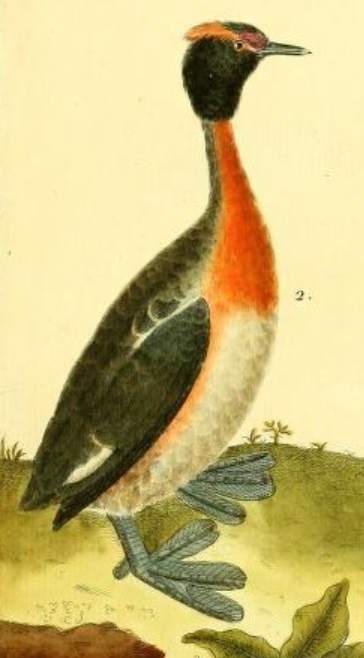
Object Status:
Extant
Accession Date:
By 1799
Primary Source Reference:
Charles Willson Peale, Lecture on Natural History 24. (ca. 1799). Academy of Natural Sciences of Drexel University Archives, coll. 40. / https://ansp.org/research/library/archives/0000-0099/coll0040/
Additional Source Text:
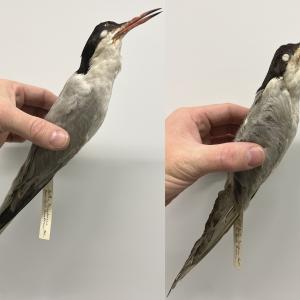
Charles Willson Peale (1741-1827) wrote, in his 24th Lecture (ca. 1799): "631. Horned Grebe. head very full of feathers, and of a mallard green colour; from each eye issues a long tuft of yellowish orange coloured feathers, almost meeting at the hind part of the head; beneath them is a large ruff of black feathers; fore part of the neck and breast of an orange red; the hind part and back dusky; coverts of the wings cenereous; primaries and tertials black; secondaries white; belly underpart of the body gloss and silvery; feet of a blue ash colour before; flesh colour behind. Colymbus cornutus Linn. Horned Grebe Latham No. 6. Pennant No. 417. Inhabits Hudson's bay; appears there in the fresh waters in June; lays its eggs among the aquatic plants. Retires towards the south in Autumn; is called by the natives, Tekeep. It appears in New York in that season, and continues there till spring, when it returns to the north & for its vast quikness in diving is called, in New York, the Water Witch." (Academy of Natural Sciences of Drexel University Archives, coll. 40)
Peale wrote, in "A Walk Through the Philad[elphi]a Museum" (1805–1806): "one found here is much Smaller called the Horned Grebe (C. Cornutus) it is a rare bird in our Waters, but is said it stays at New York all the Winter." (Historical Society of Pennsylvania, coll. 0481)
On 24 May 1821, a "Horned Greebe (dead)" donated by James Reddle, Jr., was entered in the Peale Museum Accessions Book, p. 112 (HSP, coll. 0481).
A mounted specimen of "Colymbus cornutus (Horned Grebe)" was listed in "A Catalogue of Duplicate Specimens...", May 1822. [unpublished] American Philosophical Society Library (Mss.B.P31).
Specimen Type:
Dead/preserved
Current Common Name:
Horned Grebe
Current Scientific Name
Podicipedidae | Podiceps auritus