Object Status:
Extant
Accession Date:
26 May 1791
Primary Source Reference:
Dunlap's American Daily Advertiser (Philadelphia), 26 May 1791
Additional Source Text:
On 26 May 1791, "A Scarlet Red Curlew" donated by Dr. Lavergern was announced in Dunlap's American Daily Advertiser (Philadelphia) and the General Advertiser (Philadelphia). The donation was also announced in the Independent Gazetteer (Philadelphia) on 28 May 1791, Osborne's New-Hampshire Spy on 8 Jun 1791, and the Maryland Gazette (Annapolis) on 9 June 1791.
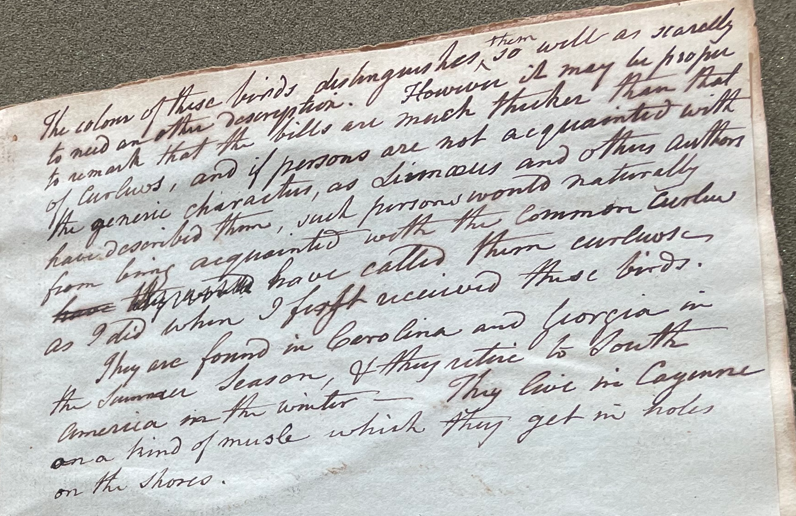
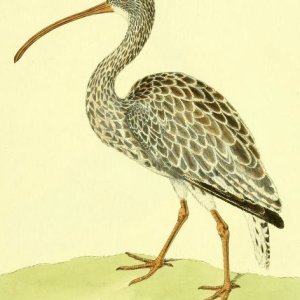
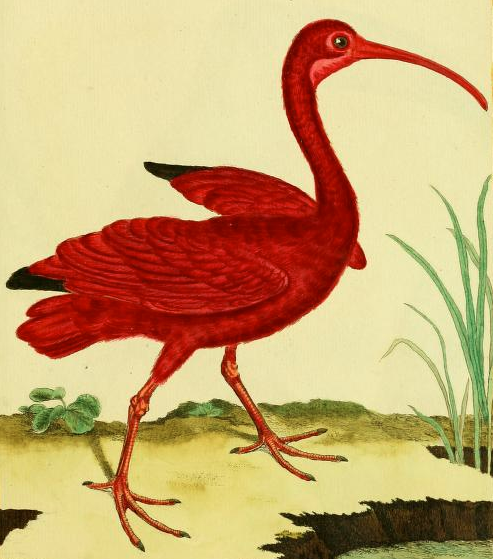
Charles Willson Peale (1741-1827) wrote, in his 25th Lecture (ca. 1799): "807 and 808. Scarlet Ibis. face, beak and feed are red; plumage of blood red colour, [which] the bird attains its 2d. year [a footnote reads: "except the tips of the wings, which are black"]; when young the wings only, are red. Tantalus ruber Linn. Curlis rouge du Brasil, Buff. pl. enl. 80. 81. Red Curlew Catesby tab. 84. The colour of these birds distinguishes them so well as scarcely to need an other description. However it may be proper to remark that the bills are much thicker than that of Curlews, and if persons are not acquainted with the generic characters, as Linnaeus and other authors have described them, such persons would naturally from being acquainted with the Common Curlew have called them curlews, as I did when I first received these birds. They are found in Carolina and Georgia in the Summer Season, & they retire to South America in the winter. They live in Cayenne on a kind of musle which they get in holes on the shores." (Academy of Natural Sciences of Drexel University Archives, coll. 40)
An undated list of 21 bird specimens in Peale's handwriting includes one "[Cerlew] Cayenne [illegible] (as received from Cayenne)" (American Philosophical Society Library, Mss.B.P31).
On 21 May 1805, a "A scarlet Ibis, living" donated by Bellvue Soisson was entered in the Peale Museum Accessions Book, p. 5 (Historical Society of Pennsylvania, coll. 0481).
Peale wrote, in "A Walk Through the Philad[elphi]a Museum" (1805–1806): "That beautiful red bird the Scarlet Ibis (T. ruber) is also found in the Georgia & South Carolina in the summer season it belongs to S. America. They are sometimes called the scarlet Curlew, by those who dont know that know that Curlews have bills quite slender at the Base, the distinction is obvious with a glance of the Eye." (Historical Society of Pennsylvania, coll. 0481)
A notice in the United States Gazette (Philadelphia) on 7 February 1806, announced the donation of "the scarlet ibis of South America."
Alexander Wilson (1766-1813) described this species under the name "Scarlet Ibis / Tantalus ruber" in American Ornithology vol. 8, published posthumously (Pl. 66), where "Peale's Museum, No. 3864" was cited (Wilson 1814: 41). / https://www.biodiversitylibrary.org/item/175758#page/53/mode/1up (text) / https://www.biodiversitylibrary.org/item/175758#page/50/mode/1up (plate)
Specimen Type:
Live (later taxidermied)
Current Common Name:
Scarlet Ibis
Current Scientific Name
Threskiornithidae | Eudocimus ruber