Object Status:
Extant
Accession Date:
By 1799
Primary Source Reference:
Charles Willson Peale, Lecture on Natural History 19. (ca. 1799). Academy of Natural Sciences of Drexel University Archives, coll. 40. / https://ansp.org/research/library/archives/0000-0099/coll0040/
Additional Source Text:
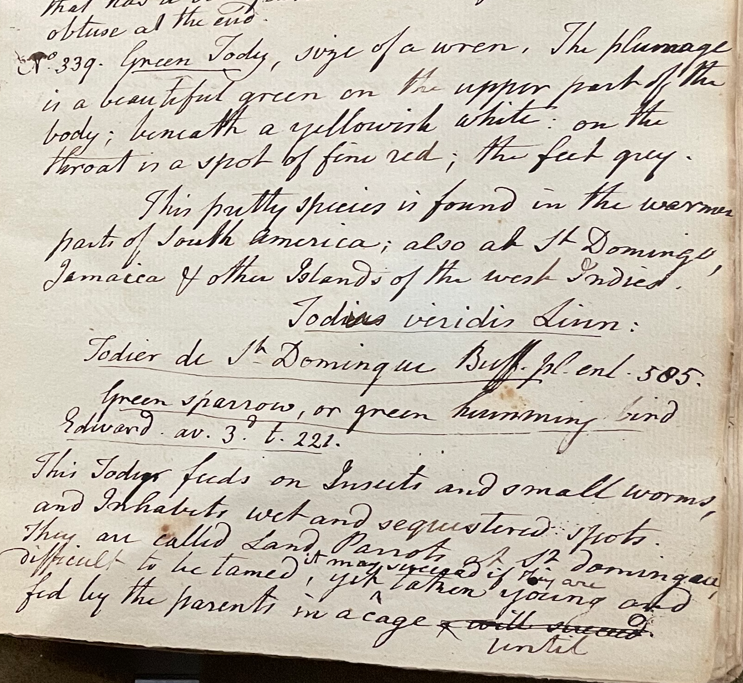
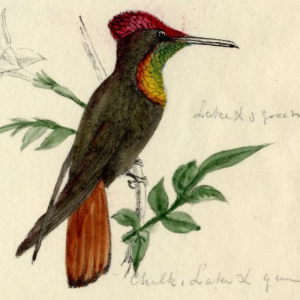
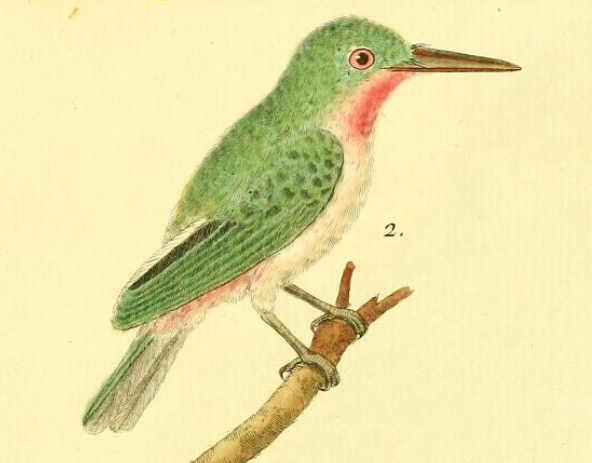
Charles Willson Peale (1741-1827) wrote, in his 19th Lecture (ca. 1799): "No. 339. Green Tody, size of a wren. The plumage is a beautiful green on the upper part of the body; beneath a yellowish white; on the throat is a spot of fine red; the feet grey. This pretty species is found in the warm part of South America; also at St. Domingo, Jamaica & other Islands of the west Indies. Todius viridis Linn. Todier de St. Dominique Buff. pl. enl. 585. Green sparrow, or green humming bird Edward. Av. 3d. t. 221. This Tody feeds on Insects and small worms, and Inhabits wet and sequestered spots. They are called Land Parrots of St. Dominque, difficult to be tamed yet it may succeed if they are taken young and fed by the parents in a cage until they can eat themselves; they have a strong attachment to their brood, and will not leave them as long as they hear them cry." A footnote inserted here mentions that this information was sourced from Buffon. (Academy of Natural Sciences of Drexel University Archives, coll. 40)
Peale wrote, in "A Walk Through the Philad[elphi]a Museum" (1805–1806): "The Genus Todus or Tody contain only a few species of birds all belonging to South America. They are said to be the only bird that has a bill flattened above & below and obtuse at the end. / The Tody feeds on Insects & small worms, inhabits wet and sequestered spots. They are called Land Parrots at St. Domingaux [Dominican Republic], difficult to be tamed, yet it may succeed if they are taken young and fed by the Parents in a cage until they can eat themselves; they have a strong attachment to their brood, and will not leave them as long as they hear them cry. / Green Tody (Todus viridis). Inhabits South America." (Historical Society of Pennsylvania, coll. 0481)
Notes:
Peale was incorrect: the genus Todus is restricted to the Caribbean islands. Based on his vague description, Peale’s specimen may have been Jamaican Tody Todus todus (Linnaeus, 1758) or Puerto Rican Tody T. mexicanus Lesson, 1838. The bird that appeared in Planches enluminées d’histoire naturelle (Tome 6, Pl. 585) was evidently one of the two Todus species from Hispaniola.
Specimen Type:
Dead/preserved
Current Common Name:
Unidentified tody
Current Scientific Name
Todidae | Todus sp.