Object Status:
Extant
Accession Date:
By 1799
Primary Source Reference:
Charles Willson Peale, Lecture on Natural History 19. (ca. 1799). Academy of Natural Sciences of Drexel University Archives, coll. 40. / https://ansp.org/research/library/archives/0000-0099/coll0040/
Additional Source Text:
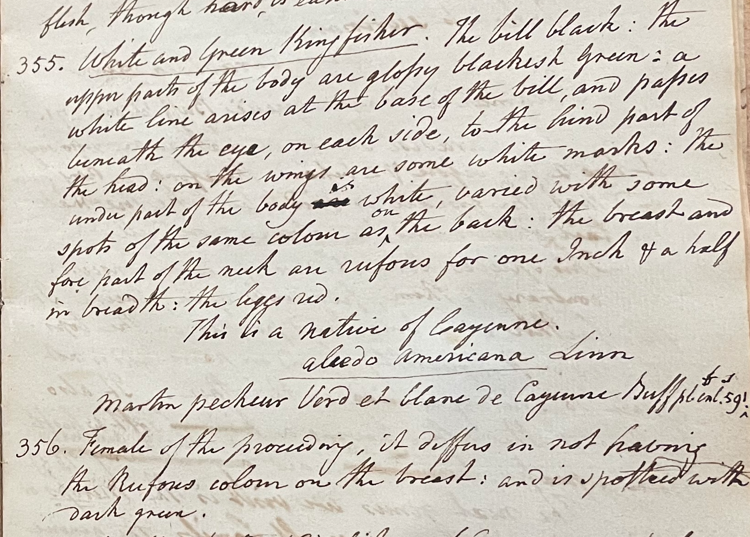
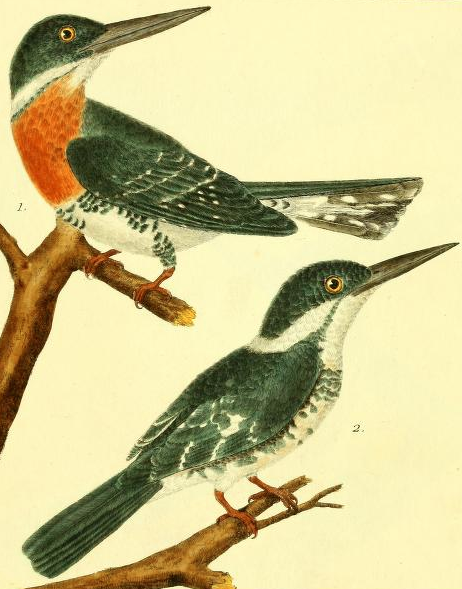
Charles Willson Peale (1741-1827) wrote, in his 19th Lecture (ca. 1799): "355. White and Green Kingfisher. The bill black; the upper parts of the body are glossy blackish green; a white line arises at the base of the bill, and passes beneath the eye, on each side, to the hind part of the head; on the wings are some white marks; the under part of the body is white; varied with some spots of the same colour as on the back; the breast and fore part of the neck are rufous for one Inch & a half in breadth; the legs red. This is a native of Cayenne. Alcedo americana Linn. Martin pecheur Verd et blanc de Cayenne Buff. pl. enl. 591. 356. Female of the preceeding; it differs in not having the Rufous colour on the breast; and is spotted with dark green." (Academy of Natural Sciences of Drexel University Archives, coll. 40)
Peale wrote, in "A Walk Through the Philad[elphi]a Museum" (1805–1806): "2138 & 2139. White & Green Kingfisher (A. americana) inhabits Cayenne." (Historical Society of Pennsylvania, coll. 0481)
Notes:
In 1793, Raphaelle Peale (1774-1825) travelled to Cayenne, French Guiana, to collect specimens for Peale's Museum. However, to the editor's (MRH) knowledge, there is no detailed inventory of the specimens he brought back, and there are many examples of specimens from northern South America that were donated by other people. For more discussion about Raphaelle's travels, see Lillian B. Miller, 1993, "Father and Son: The Relationship of Charles Willson Peale and Raphaelle Peale", The American Art Journal 25: 4-161. / https://doi.org/10.2307/1594599
Specimen Type:
Dead/preserved
Current Common Name:
Green Kingfisher
Current Scientific Name
Alcedinidae | Chloroceryle americana