Object Status:
Extant
Accession Date:
By 1799
Primary Source Reference:
Charles Willson Peale, Lecture on Natural History 17. (ca. 1799). Academy of Natural Sciences of Drexel University Archives, coll. 40. / https://ansp.org/research/library/archives/0000-0099/coll0040/
Additional Source Text:
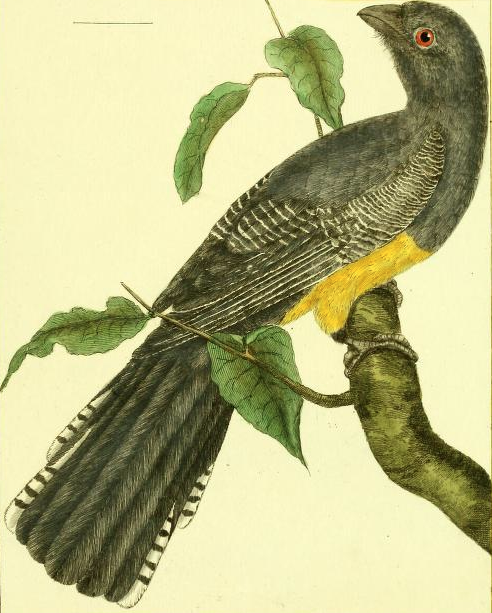
Charles Willson Peale (1741-1827) wrote, in his 17th Lecture (ca. 1799): "No. 245. Cinereous Curucui. Bill of a deep ash colour; the general colour of the body is a deep ash; the belly and under coverts yellow; short feathers of the wings finely [rayed] with white; quills of the wings rayed & striped with white; the outer feathers of the tail, and under parts rayed with white; wings extend but little way down the tail. Trogon strigilatus Linn. Couroucui de la Guiane Buff. pl. enl. 765. Cenereous Curucui Latham." (Academy of Natural Sciences of Drexel University Archives, coll. 40)
Peale wrote, in "A Walk Through the Philad[elphi]a Museum" (1805–1806): "These birds, with thick, short, Curved & serated on the edges belong to the genus Trogon or Curucui—from their note resembling that the sound of that word. They are chiefly natives of South America. Here is the Red bellyed (Trogon Curucui) [=T. curucui Linnaeus], and the Cenerious Curucuis (Trogon Strigilatus) [=T. viridis Linnaeus]. They are solitary Birds, that live in the heart of damp forests. They are cloathed so thickly with plumage, that they appear larger than in reality; they would oftain seem to equal the bulk of a Pidgeon, though they have not more flesh than a Thrush. Their feathers are so weakly rooted that is difficult to prepare specimens for the Cabinet." (Historical Society of Pennsylvania, coll. 0481)
Notes:
Peale did not specify the origin of the specimen described in his lecture, but it seems likely to be Cayenne, French Guiana, a major South American trade center in the 18th century. In 1793, Raphaelle Peale (1774-1825) travelled to Cayenne to collect specimens for Peale's Museum. However, to the editor's (MRH) knowledge, there is no detailed inventory of the specimens he brought back, and there are many examples of specimens from northern South America that were donated by other people. For more discussion about Raphaelle's travels, see Lillian B. Miller, 1993, "Father and Son: The Relationship of Charles Willson Peale and Raphaelle Peale", The American Art Journal 25: 4-161. / https://doi.org/10.2307/1594599
Specimen Type:
Dead/preserved
Current Common Name:
Green-backed Trogon
Current Scientific Name
Trogonidae | Trogon viridis