Object Status:
Unlocated
Accession Date:
By 1799
Primary Source Reference:
Charles Willson Peale, Lecture on Natural History 24. (ca. 1799). Academy of Natural Sciences of Drexel University Archives, coll. 40. / https://ansp.org/research/library/archives/0000-0099/coll0040/
Additional Source Text:
Charles Willson Peale (1741-1827) wrote, in his 24th Lecture (ca. 1799): "In the subject now before us, we can trace some resemblance to a reptile mounted on the body of a Bird. On account of this likeness, the Anhinga in Georgia is commonly called the Snake bird. The long, slender, and tapering neck, elongated still farther by a head and bill rounded in the same manner, and terminating like the snout of a serpent, is a tolerable likeness of that reptile, but this bird has still more striking resemblance to that tribe, in the manner in which it darts out its head at the fishes which it devours, or at the passengers who approach it." (Academy of Natural Sciences of Drexel University Archives, coll. 40)
Peale continued: "This genus is called Plotus. The characters are: Bill long, strait, sharp-pointed and toothed. Nostrils a long slit placed near the base. Neck of great length. Legs short. Toes 4 in number, all webbed togather [sic]. Only 3 species of this Bird are yet known with some varieties, found at Java and at Senegal … in South America. This [specimen] I received from Georgia, where they are not uncommon, yet, no authors have noticed them except Mr. [William] Bartram in his travels [i.e., Travels through North and South Carolina…, 1792], who says: 'They delight to sit in little peaceable communities, on the dry limbs of trees, hanging over the still waters, with their wings and tailed expanded, I suppose to cool and air themselves, when at the same time they behold their images in the watery mirror. At such times, when we approach them, they drop off the limbs into the water as if dead, and for a minute or two are not to be seen; when on a sudden at a vast distance, their long slender head and neck only appear, and have very much the appearance of a snake, and no other part of them are to be seen when swimming in the water, except sometimes the tip of their tail. In the heat of the day they are seen in great numbers, sailing very high in the air over lakes and rivers'." (ANSP Archives, coll. 40)
Peale continued: "620. Anhinga, or snake bird. the whole of this bird is black except some spots and stripes of white on the wing coverts and wings; and a few feathers on the back of the head in some measure resembling a [pending] crest of […] of which, rufous & black, slender feathers. it may be the Plotus melanogaster of Linnaeus? Ahinga de cayenne Buff. pl. enl. 959? Which plate I have yet seen. or Black-bellied Darter Lath. No. 2. They feed on fish, and their four toes being all webbed fit it well for swimming. Mr. Bartram thinks them very indifferent eating, yet another gentleman who had resided in that Country assures me that they are excellent food." (ANSP Archives, coll. 40)
Peale wrote, in "A Walk Through the Philad[elphi]a Museum" (1805–1806): "Having done with birds with such long necks with greater or less pouches attached to their Beaks, we might scarcely think to find a race still exceeding them but such is the appearance of the Anhinga, that at first sight we might suppose it a snake attached to the body of a Bird. The resemblance indeed is so striking that the Inhabitants of Georgia call it the snake-bird.—Its similitude to a reptile is most striking when it is swimming with its body so low that only its neck and the tip of its tail is seen. The Genus Plotus Anhinga or Darter contain but a few species, and all of them belong America & Africa and the adjacent Coasts. This was a stragler shot at Elkridge landing; high up the Patapsco river far distant from where any of them was seen before. It differs in the Plumage from the other that was brought from Georgia." (Historical Society of Pennsylvania, coll. 0481)
Alexander Wilson (1766-1813) described this species under the name "Black-bellied Darter, or Snake-bird / Plotus melanogaster" in American Ornithology vol. 9, published posthumously (Pl. 74), where "Peale Museum, No. 3188, male … [and] Peale's Museum, No. 3189, Female" were cited (Wilson 1814: 79–82). / https://www.biodiversitylibrary.org/item/175518#page/87/mode/1up (text) / https://www.biodiversitylibrary.org/item/175518#page/86/mode/1up (plate)
Notes:
Wilson (1814: 80) wrote: "Of this extraordinary species we can give little more than accurate descriptions, and tolerably good portraits, which were taken from two fine specimens, admirably set up and preserved in the museum of Mr. Peale." / https://www.biodiversitylibrary.org/item/175518#page/88/mode/1up
After Peale's Museum closed, a portion of Peale's bird collection was purchased in 1850 by Moses Kimball (1809–95), who displayed it at his "Boston Museum". An advertisement in the Boston Transcript, printed 1 October 1850, stated that Kimball had acquired "One Half of the celebrated Peale's Philadelphia Museum". The other half of Peale's birds had been sold to the circus promoter P. T. Barnum (1810–91) and would be subsequently destroyed in a fire at his "American Museum" in New York City in July 1865. When the Boston Museum closed, Kimball's Peale remnants passed temporarily to the Boston Society of Natural History, who disposed of them to Charles J. Maynard (1845-1929), a local taxidermist. The specimens were stored in a barn in Massachusetts for several years, then eventually were deposited at the Museum of Comparative Zoology (MCZ), Harvard University. By the time the collection was catalogued by Walter Faxon (1848-1920) at MCZ, in 1914, in virtually every case the original mounts and labels had been disassociated from the specimens, and an untold number were lost.
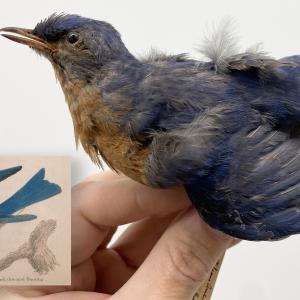
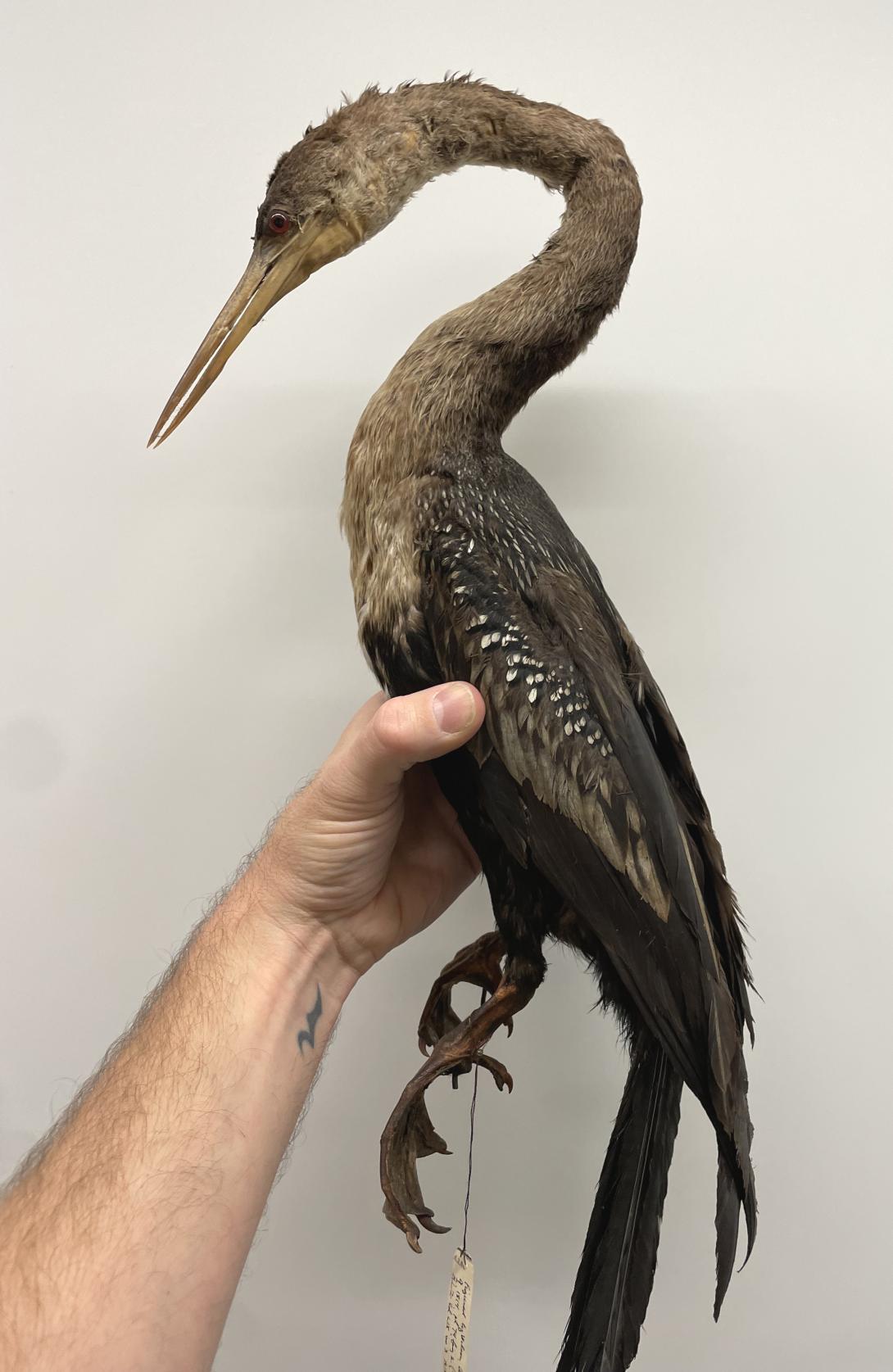
Walter Faxon, "Relics of Peale's Museum," Bulletin of the Museum of Comparative Zoology, 59, no. 3 (July 1915): 129, speculated that MCZ 67816 and 67817 (the latter shown here), two data-deficient specimens that were once in the Boston Museum collection, were “without doubt” the specimens illustrated by Wilson. / https://www.biodiversitylibrary.org/page/6339801#page/179/mode/1up
However, this seems unlikely because the bird with the retracted neck in Wilson's figure is stated to be an adult male, and this is confirmed by its black neck and upper breast; but MCZ 67817 is a female or immature bird, and its neck is less retracted. The bird with the extended neck in Wilson's figure is stated to be female, and this is confirmed by its brown neck and upper breast; but MCZ 67816, which also an extended neck, has a darker breast and lower neck and appears to be an immature male. Furthermore, neither specimen matches the description that Peale gave in his lecture ("the whole of this bird is black").
Specimen Type:
Dead/preserved
Current Common Name:
Anhinga
Current Scientific Name
Anhingidae | Anhinga anhinga
Repository:
Museum of Comparative Zoology, Harvard University (MCZ 67816 and 67817)