Object Status:
Unlocated
Accession Date:
By 1799
Primary Source Reference:
Charles Willson Peale, Lecture on Natural History 13. (ca. 1799). Academy of Natural Sciences of Drexel University Archives, coll. 40. / https://ansp.org/research/library/archives/0000-0099/coll0040/
Additional Source Text:
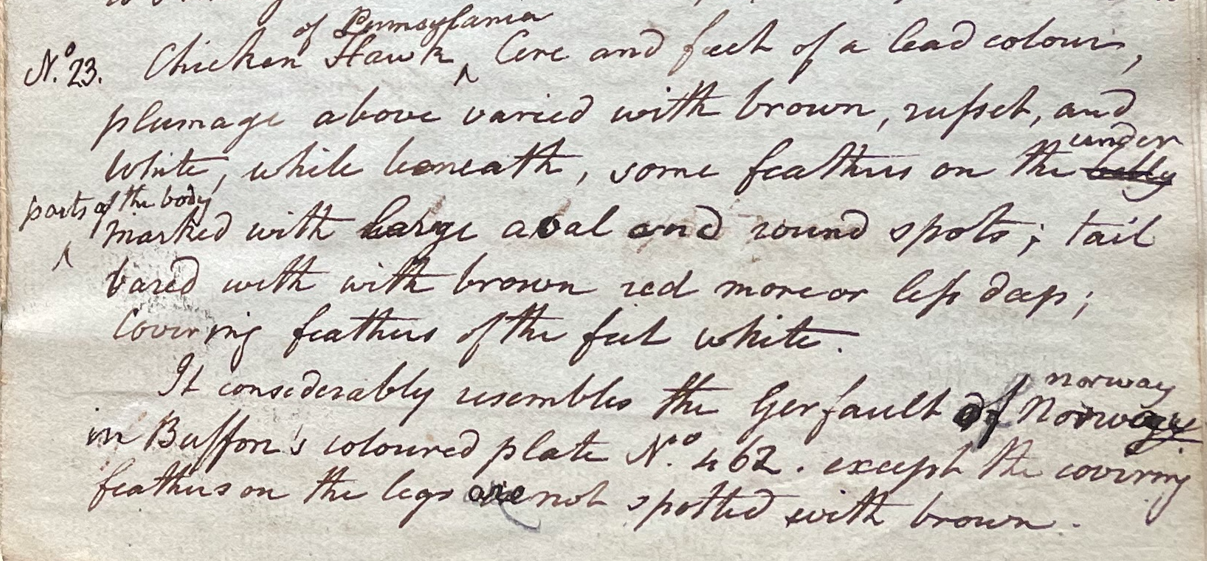
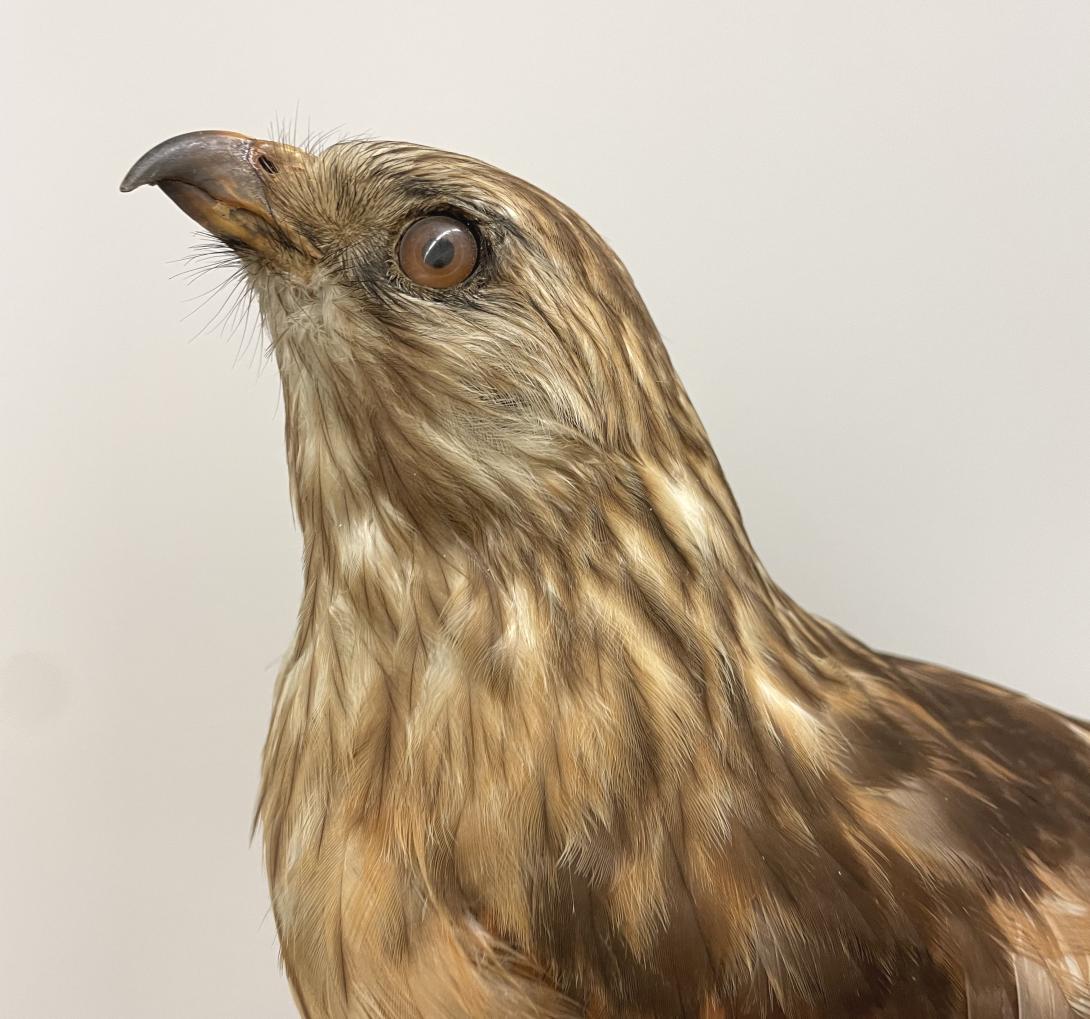
Charles Willson Peale (1741-1827) described an immature specimen, apparently of this species, in his 13th Lecture (ca. 1799). The only discrepancies in Peale's description are the colors of the cere and legs, which were probably the result of post-mortem color changes. However, after seeing a plate (462) in Buffon's work, he evidently confused the bird for a Gyrfalcon (Falco rusticolus) and therefore gave a lengthy account of the history and politics of European falconry - an interesting topic, though largely irrelevant to the natural history of the Red-shouldered Hawk.
Peale wrote: "No. 23. Chicken Hawk of Pennsylvania. Cere and feet of a lead colour; plumage above varied with brown, russet, and white, while beneath, some featers on the under parts of the body [are] marked with large oval and round spots; tail [barred] with brown red more or less deep; covering feathers of the tail white. It considerably resembles the "Gerfault de Norwege" (Norway) in Buffon's coloured plate No. 462, except the covering feathers on the legs are not spotted with Brown. Mr. Buffon speaks of this species of Hawk [i.e., Gerfault de Norwege = Gyrfalcon, Falco rusticolus] as being the best in falconry. They inhabit Russia Norway, Iceland, and Tartary, and are transported into France, Itally, and even into Persia and Turkey, and sold at an immence price. It is the Falco candicans of Linnaeus. The diversion of mankind, vary according to their different stages of improvement, from a rude to a cultivated state." (Academy of Natural Sciences of Drexel University Archives, coll. 40)
Peale continued, noting that he paraphrased the following information from "New System of Natural History p. III" (i.e., Peter Hill, 1792, A new system of the natural history of quadrupeds, birds, fishes, and insects, vol. 2, p. 111): "Falconry, which was formerly in Europe the principal amusement is now perhaps totally out of use. The history of this amusement might present a lively image of feudal tyranny and barbarity. As I mentioned before [in the account of Rough-legged Hawk, Buteo lagopus], a Person of Rank scarce stirred out without a hawk on his arm, which in old paintings, is the […] of nobility. Harold, afterwards King of England, when he went on a most important embassy into Normandy, is painted embarking with a bird on his fist, and a Dog under his arm. 'In those days, it was thought sufficient for noblemans' sons to wind their horn and carry their Hawk fair, and leave study and learning to meaner people." (ANSP Archives, coll. 40)
Peale continued, paraphrasing Hill (1792): "In every country of Europe, this diversion was in such high estimation, that Frederick, one of the emperors of Germany, did not think it below his dignity to write a laborious treatise upon falconry. Those extensive tracts which each chieftain seized, were but thinly inhabited, and poorly cultivated; the wild animals that occupied them were his most valued prerogative, and his only amusement. Before the culinary art was brought to its present perfection, game was almost the only delicacy of the table, as hawking was the only means by which it could be obtained. Hence the avidity with which this diversion was pursued; hence too, the multiplied and vigorous penalties by which Hawks and game were preserved. In every European kingdom, the complicated system of game laws, is the last bulwark that seems to resist the encroachments of freedom. Even in those countries where liberty is established, these laws are permitted to remain, a disgrace to legislation and to the liberal ideals of a commercial age. This amusement, which among our ancestors, displayed the pride of the rich, and the slavery of the poor, was attended with vast expence. In the reign of James 1st, Sir Thomas Monson is said to have given a thousand pounds for a cast of hawks; an amazing sum, if we consider the value of money at that age." (ANSP Archives, coll. 40)
Peale continued, now incorporating information from Thomas Pennant's Arctic Zoology vol. 2, pp. 204-205 (1785, London: Henry Hughs): "At a time when the people had no rights, and consequently were not respected, we are not to wonder at the rigour of the laws, enacted to preserve a pleasure that was purchased at so extravagant a rate. In the reign of Edward IIId, it was felony to steal a Hawk; to take its Eggs, even in a person's own ground, was punishable with imprisonment for a year and a day, besides a fine at the King's pleasure. In the reign of Queen Elizabeth, that imprisonment was reduced to 3 months; but the offender was to find security for his good behaviour for 7 years, or to lie in prison till he did procure it. Such, says Pennant, was the enviable state of the times in England. 'During the whole day, our gentry were imployed with the fowl of the air or the beasts of the field. In the evening, they celebrated their exploits with the most abandoned and brutish sorties known. At the same time, the inferior ranks of the people, by the most unjust and arbitrary laws, were liable to capital punishment, to fines, and the loss of liberty, for destroying the most noxious of the feathered race.' Even the Ladies were not without them […], for in an Ancient sculpture in the church of Milton Abbas, in Dorsetshire, appears the consort of King Arthur, with a falcon on her regal fist, [bearing] a bird; and perhaps to indulge his queen in his passion for the diversion, he demanded of his countrymen, some of their excellent Hounds, and of their best Hawks. Pennant, Arctic Zoology p. 204." (ANSP Archives, coll. 40)
Alexander Wilson (1766-1813) described an immature bird under the name "Winter Falcon / Falco hyemalis" in American Ornithology vol. 4 (Pl. 35), where "Peale's Museum, No. 272 & 273" were cited (Wilson (1811: 73). / https://www.biodiversitylibrary.org/item/175531#page/93/mode/1up (text) / https://www.biodiversitylibrary.org/item/175531#page/92/mode/1up (plate)
Wilson (1812) described adult specimens under the name "Red-shouldered Hawk / Falco lineatus" in vol. 6 (1812, Pl. 53), where "Peale's Museum, No. 205" was cited (Wilson 1812: 86). / https://www.biodiversitylibrary.org/item/175484#page/114/mode/1up (text) / https://www.biodiversitylibrary.org/item/175484#page/109/mode/1up (plate)
A mounted male specimen of "Falco lineatus (Red-shouldered H)" was listed in "A Catalogue of Duplicate Specimens...", May 1822. [unpublished] American Philosophical Society Library (Mss.B.P31).
Notes:
After Peale's Museum closed, a portion of Peale's bird collection was purchased in 1850 by Moses Kimball (1809–95), who displayed it at his "Boston Museum". An advertisement in the Boston Transcript, printed 1 October 1850, stated that Kimball had acquired "One Half of the celebrated Peale's Philadelphia Museum". The other half of Peale's birds had been sold to the circus promoter P. T. Barnum (1810–91) and would be subsequently destroyed in a fire at his "American Museum" in New York City in July 1865. When the Boston Museum closed, Kimball's Peale remnants passed temporarily to the Boston Society of Natural History, who disposed of them to Charles J. Maynard (1845-1929), a local taxidermist. The specimens were stored in a barn in Massachusetts for several years, then eventually were deposited at the Museum of Comparative Zoology (MCZ), Harvard University. By the time the collection was catalogued by Walter Faxon (1848-1920) at MCZ, in 1914, in virtually every case the original mounts and labels had been disassociated from the specimens, and an untold number were lost.
Walter Faxon, "Relics of Peale's Museum," Bulletin of the Museum of Comparative Zoology, 59, no. 3 (July 1915): 134, speculated that a data-deficient specimen (MCZ 67845) from the Boston Museum collection, was "Probably the model for Wilson's figure." This may be true, but the only evidence is circumstantial, and Peale evidently had this species mounted by 1799. / https://www.biodiversitylibrary.org/page/6339801#page/184/mode/1up
Specimen Type:
Dead/preserved
Current Common Name:
Red-shouldered Hawk
Current Scientific Name
Accipitridae | Buteo lineatus
Repository:
Museum of Comparative Zoology, Harvard University (MCZ 67845)