Object Status:
Extant
Accession Date:
29 June 1790
Primary Source Reference:
Pennsylvania Packet, 29 June 1790.
Additional Source Text:
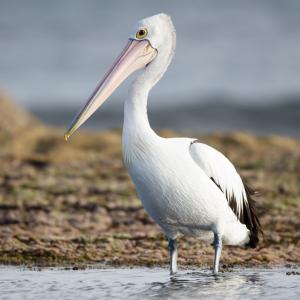
Notices in the Pennsylvania Packet (Philadelphia) and Herald of Freedom (Boston), on 29 June and 13 July 1790, respectively, announced the Museum's acquisition of an "American Swan, alive."
Charles Willson Peale (1741-1827) wrote, in his 21st Lecture (ca. 1799): "No. 481. Swan. This American Bird has a black bill, somewhat cylindric; yellow cere; white plumage. Anas Cygnus Linn. Cigne Sauvage. Buff. pl. enl. 913. Elk, hooper, or Wild Swan. British Zoology. The Swan is the most majestic, and beautiful, not withstanding the uniformity of his plumage, and one o fhte greatest and noblest of aquatic birds. Some authors have called him the sovereign of the various tribes that inhabit the water. His empire, however, is maintained by gentleness of disposition, and peaceable deportment, rather than by strength and superior size. He lives rather like a friend than a master among the feathered tribe." (Academy of Natural Sciences of Drexel University Archives, coll. 40)
Peale continued: "Buffon says the noble ease and freedom of its motions on the water bespeak it not only the first of the winted sailors, but the finest model presented by nature for the art of navigation. Its raised neck, and its round swelling breast exhibit the prow of a ship cleaving the waves; its broad stomach represents the keel; its body, pressed down before, rises behind into the stern; the tail is a genuine rudder; its feet are broad oars; and its wings, half opened to the wind, and gently inflated, are the sails which impel the animated machine." (ANSP Archives, coll. 40)
Peale continued: "I had this bird living. It was presented to the museum, on condition that the woman, who used to feed it, might have her mission to see it as often as she pleased. Her visits were daily at first; she seemed to enjoy much pleasure in caressing her former Pet, and the bird on his part expressed the satisfaction he felt on meeting with her, at each time she came to the museum. The distance of some squares to walk, joined to want of time, caused an intermission in her visits for some days; after such intervals, the joy of the Bird seemed more expressive. Some time after, one, two, three or more days elapsed, without a visit. The Swan still maintained his great attachment. Although in her absence he did not want friends, who tryed to court his friendship by supplying him with every comfort. Yet as soon as his former mistress made her appearance, he would run to her, flap his wings round her, holding his bill to her face, and cooing the softest notes, and seemed really almost to talk in plaintive sounds. The woman then, to show us how much the Swan was attached to her, would run through several rooms of the House, then into the garden, backwards and forewards, while the affectionate swan continued to follow through all her windings, clasping his wings round her, and shewing almost as plain as words could speak, how glad he was to see her. At last, a whole month elapsed without a single visit to this endearing swan. He heard her voise outside of the gate, and before he saw her, knew it was his former friend, and instantly began his song of joy!" (ANSP Archives, coll. 40)
Peale continued: "One of my sons, fond of Botany, had the charge of the garden, and finding the swan troublesome, he drove him out, with a small switch; for this insult, [the Swan] never liked him afterwards. But my Brother, admiring the softness of some of its notes and the pleasing docility of the Animal, took pleasure to come and ingratiate himself in his favour, and the Swan most sencible [sic] of his attention, never failed to express his satisfaction when they met. It will naturally occur, that we felt the loss of so intelligent a bird. When I look on it, the remembrance alone, of its expressive manners, gives me pleasure." (ANSP Archives, coll. 40)
Peale continued: "The Swan may be said to have two distinct voices, one shrill and very loud, with which it used to give alarm. The other, soft and harmonious; modulated to express love and friendship, such as was used in the expressions I have just related, something of the tone of the flute, mixed with another like a sound of talking. The passage of the wind-pope through this breast bone making a turn in the hinder part, returning back & then passing round the colar bones to the lungs & must give that tone of voice, so very remarkable in this Animal, and different from most other birds. Among the Ancients, these were favorite birds. They were consecrated to Apollo and Muses, and hence they were supposed to be musical birds. The Swans were farther alleged to utter their most tender and affecting melody, a short time before their death; and were supposed to view that event, the aspect of which chills other Animals with horror, with such composure as naturally dictated those soft and touching accents, with which they bid adieu to life. Numbers of these birds visit the Chasapeak [Chesapeake] Bay every winter, they are but seldom shot; are shy, and feed on bars farthest from the shores of that Bay. Their flesh is dark and except when young is very indifferent fare. Their feathers are valuable, and the skin after the large feathers are taken off especially about the underparts is covered with a fine down, which composes those soft Tippers worn by ladies and for puffs used with hair-powder." (ANSP Archives, coll. 40)
A slip of loose paper tucked into Peale's 36th lecture contains a list of waterbirds with the following entry: "American Swan" (ANSP Archives, coll. 40).
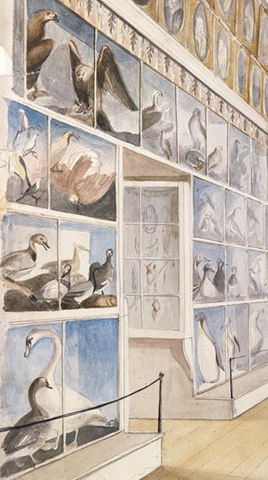
Peale wrote, in "A Walk Through the Philad[elphi]a Museum" (1805-1806): "We will now turn our attention to those we are better acquainted with – That stately Swan I remember [when it was] living, it was an affectionate animal to those who used it kindly, how charmingly it Cooed & gently clasped its wings round a friend that had been absent for some time, and would follow such, from place to place with strong expressions of rapturous pleasure and on the other hand to those from whom it had received insult, it would beat with its wings and pinch with its beak, useing a harsh note like a scolding voice. / It is matter of surprise to hear from the same pipe such coarse & such soft sounds, of anger or as passion dictated — The wind pipe of this species passes through a cavity in the breast bone to the lower end, then turns & comes back to the front, then divides entering into the lungs" (Historical Society of Pennsylvania, coll. 0481).
On 9 January 1822, a notice in Poulson's American Daily Advertiser mentioned the donation of a "Trachea of the Swan" by Dr. Richard Harlan (1796-1843), which may have been of this species.
Specimen Type:
Live (later taxidermied)
Current Common Name:
Tundra Swan
Current Scientific Name
Anatidae | Cygnus columbianus