Object Status:
Extant
Accession Date:
By 1799
Primary Source Reference:
Charles Willson Peale, Lecture on Natural History 22. (ca. 1799). Academy of Natural Sciences of Drexel University Archives, coll. 40. / https://ansp.org/research/library/archives/0000-0099/coll0040/
Additional Source Text:
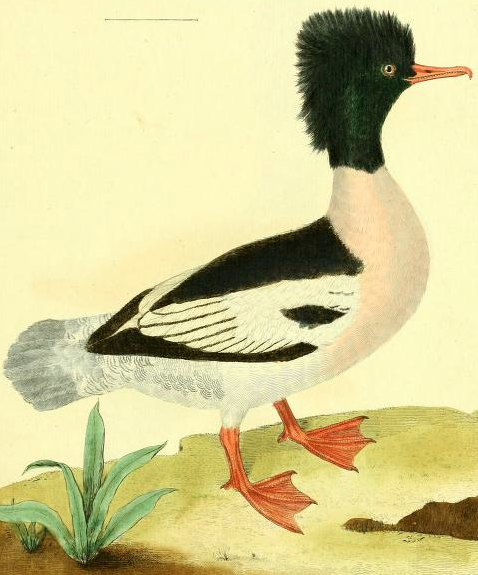
Charles Willson Peale (1741-1827) wrote, in his 22nd Lecture (ca. 1799): "550. Goosander. Bill red. 3 Inches long, toothed on both edges of the mandibles; tip of the upper much bent, and of the under a little swelling; Irides red; head is full of feathers on the top and back part; colour of that and half the neck, a fine glossy greenish black, the rest of the neck and under parts white; the upper part of the back, black; scapulars nearest the body black; the others white; the lower part of the back, and tail, brownish ash colour; 12 of the wing quils are black; secondaries mostly white, and 5 or 6 of them fringed with greenish black on the outer margins; the tail consists of 18 ash-coloured feathers, the shafts of which are dusky; feet orange colour. Mergus merganser Linn. L'Harles Buff. pl. enl. 951. female 953. Goosander Pennant No. 465. Latham No. 1 p. 418." (Academy of Natural Sciences of Drexel University Archives, coll. 40)
Peale continued: "551. The female is a ferruginous red on the Head & upper part of the neck; a pendant crest. throat white. Irides red; the Back, coverts of the wings and tail, cenerious; primaries dusky; Breast & middle of the under part of the body white; wings barred with white. The tongues of these birds are thick, set with small bristles pointing backward; a happy contrivance for holding the slipping fishes, and conducting them into the birds throat. They are said to be very voracious. As this bird is obliged to search for its food by diving, it is capable of remaining a long time under water; and for this purpose, is furnished with this curious bone at the end of the wind pipe, forming a considerable cavity from which to pipes descend to the lungs. this lays on front near the collar bones." (ANSP Archives, coll. 40)
Peale continued: "From the food that these birds feed on their flesh becomes fishy, but if raped in cloaths of Vinager a few days they become very tolerable eating. Inhabit all the middle states during winter, and retires in April to the northern parts to breed. They are said to breed in every latitude in the Russian empire; but mostly in the north. Is common in Kamtschatka, extends through northern Europe to Iceland and Greenland. Continues the whole year in the Orknies; but visits South Britain only in severe winters. Swims with its body very deep in the water." (ANSP Archives, coll. 40)
Alexander Wilson (1766-1813) described this species under the name "Goosander / Mergus merganser" in American Ornithology vol. 8, published posthumously (Pl. 68), where "Peale's Museum, No. 2932" (male) and "Peale's Museum, No. 2933" (female) were cited (Wilson 1814: 68, 71, respectively). / https://www.biodiversitylibrary.org/item/175758#page/82/mode/1up (male) / https://www.biodiversitylibrary.org/item/175758#page/87/mode/1up (female) / https://www.biodiversitylibrary.org/item/175758#page/83/mode/1up (plate)
Specimen Type:
Dead/preserved
Current Common Name:
Common Merganser
Current Scientific Name
Anatidae | Mergus merganser