Object Status:
Unlocated
Accession Date:
By 1799
Primary Source Reference:
Natural History Lecture No. 10 (1799), Academy of Natural Sciences of Drexel University
Additional Source Text:
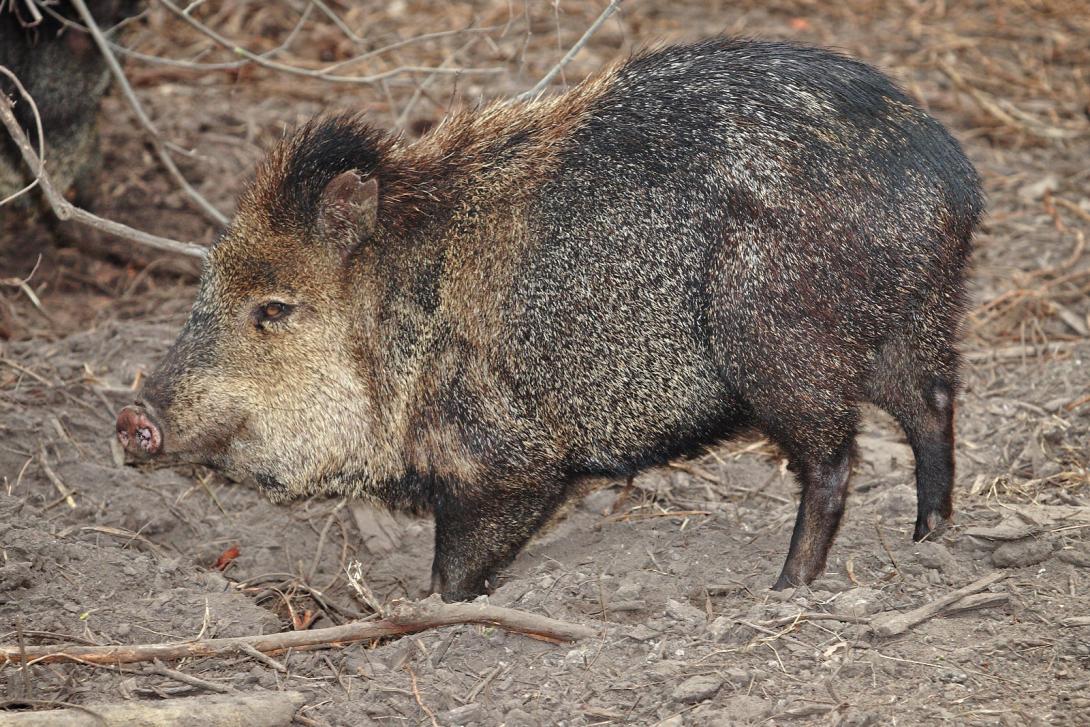
"The Pecary, at first view, resembles a small hog; the form of its body, the shape of its head, the length of its snout, and form of its legs, are intirely like it: however, when we come to examine it nearer, the differences begin to appear. The body is not so bulky; its legs not so long; its bristles much thicker and stronger than those of the Hog, resembling rather the quills of a porcupine, than hair; instead of a tail, it has only a little fleshy protuberance, which does not cover its posteriors; but, that which is still more extraordinary, and in which it differs from all other quadrupeds whatever, is, that it has on its back, a hole (lump resembling the navil in other animals), which is found to separate a liquor of a very strong smell.
"The Pecary is the only creature that has those kind of Glands which discharge the muskey substance, on that part of the body. (Some have them under the belly, and others under the tail; but this creature, by a conformation peculiar to itself, has them on its back.) This Hole is situated on that part of the back, which is over the hind legs; it is, in general, so covered with long bristles, that it cannot be seen, except they be drawn aside. A small space then appears, almost bare, and only beset with a few short fine hairs. In the middle it rises like a lump; and in this there is an orifice about the size of a common goose quill. This hole or bag is not above an Inch in depth: and round it, under the skin, are situated a number of small glands, which distill a whitish liquor, in colour and substance, resembling that obtained from the Civet. Some have said that it also smelt agreeable, Mr. Buffon, and Mr. Goldsmith thought it strong and offensive, This is the second I have had alive, and sometimes I have thought their smell rather disagreeable, than otherwise. The Picary is numerous in all parts of south America."
In his "Walk through the Phil[adelphi]a Museum" (1805-1806), p. 41, Peale wrote that the specimen "is very singular, its bristles so coarse as almost to resemble porcupine quills. It has on its back a hole, from which exudes a liquor extremely offensive. It is a native of South America, it will not mix with the common hog, and therefore it may be considered a distinct species."
Notes:
The collared peccary (Pecari tajacu) is a mammal in the family Tayassuidae found in North, Central, and South America.
On 25 Dec 1806 the Museum received a specimen, and on 16 Sep 1808 the Museum received a living specimen from La Guaira (present-day Venezuela) given by William Bennet. Peale Museum Accessions Book, Historical Society of Pennsylvania, pp. 20, 34
Specimen Type:
Live (presumably eventually taxidermied/preserved)
Peale's Common Name:
Pecary
Peale's Scientific Name:
Sus tajassu
Current Common Name:
Collared peccary
Current Scientific Name
Pecari tajacu