Object Status:
Unlocated
Accession Date:
1798
Primary Source Reference:
Natural History Lecture No. 8 (1799), Academy of Natural Sciences of Drexel University
Additional Source Text:
"This a female with her young one was brought alive to this City, but the severity of the Winter of 1798 was more than they could bear, and every precaution to preserve them proved fruitless. Natives of Java and Ceylon – they cannot exist long in cold climate. They are gentle, familiar, tho’ timid and their agility is such that it is said, with how much truth I cannot say, they can leap over a wall 12 feet high. The male was frightened by the firing of some cannon, jumped over-board and was lost. The Pair would have been a great acquisition; more especially as some authors have said that they have no horns."
In his "Walk through the Phil[adelphi]a Museum" (1805), pp. 35-36, Peale wrote of the Museum's two Indian musks (which he called Moschus Meminna): "A female with her young one. Natives of Java & Ceylon -- They are pretty and possess suprising agility -- It is said they can leap over a wall of 12 feet height. They are gentle & familier, tho’ timid."
Notes:
In 1804 the Museum received "Moscus Meminna from India, brought by Capn. Turner of the British Army." Peale Museum Accessions Book, Historical Society of Pennsylvania, p. 9
And two years later George Harrison (1762–1845), a Philadelphia merchant and later U.S. Navy agent in Philadelphia, gave the Museum "Two Indian Musks, presented living, since dead and preserved." United States Gazette (Philadelphia), 7 Feb 1806.
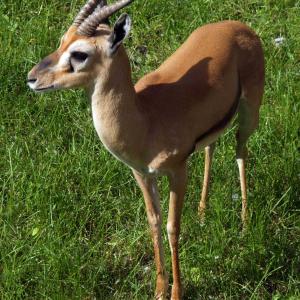
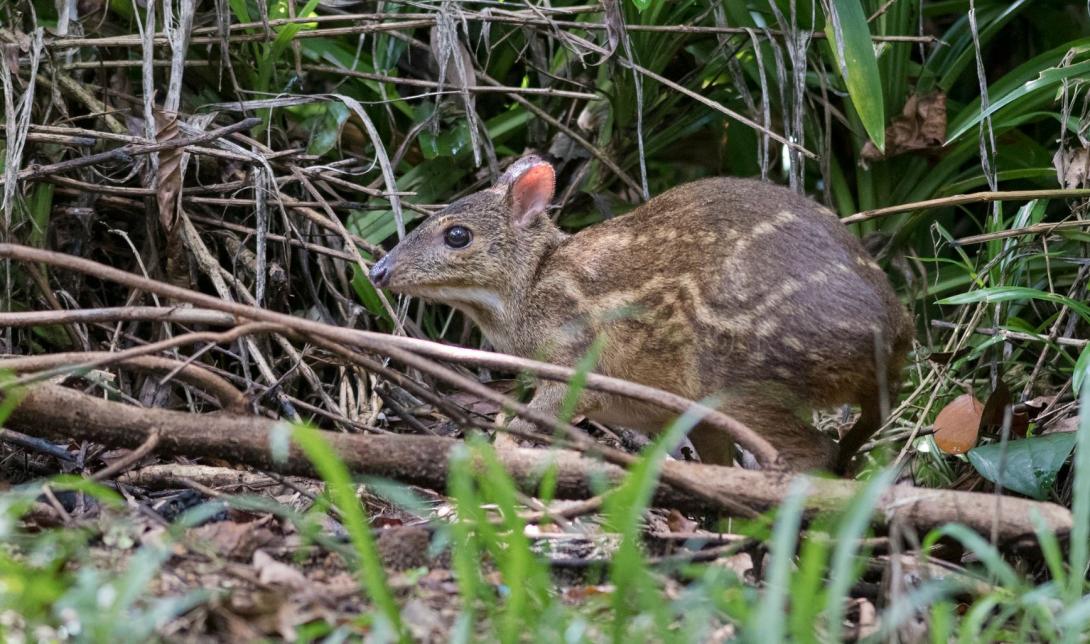
In the early 19th century Moschus (now Moschiola) meminna was thought to be the only species in the genus Moschus. In the 21st century, this is increasingly divided into up to three parapatric species. Peale described the Museum's specimens as "Natives of Java & Ceylon [Sri Lanka]" or from India. Thus the Museum could have had either of the two species from Sri Lanka (Sri Lankan spotted chevrotain, M. meminna; and yellow-striped chevrotain, M. kathygre) or the species from the South Asian mainland north to Nepal (Indian spotted chevrotain, M. indica). The Sri Lankan spotted chevrotain is pictured here.
Specimen Type:
Live (presumably eventually taxidermied/preserved)
Peale's Common Name:
Indian musk
Peale's Scientific Name:
Moschus Meminna
Current Common Name:
Chevrotain
Current Scientific Name
Moschiola