Object Status:
Unlocated
Accession Date:
June 29, 1790
Primary Source Reference:
Pennsylvania Packet (Philadelphia), 29 June 1790
Additional Source Text:
In his Natural History Lecture No. 5 (1799), Academy of Natural Sciences of Drexel University, Peale wrote: "It is a timid, simple Animal. If we may judge from the capacity of the skull, on comparing it with that of the Dog, we might call it the most stupid of Animals. Having no means of escape, a hunter with a few dogs, may make great havoc among them, -- but as it is a warm climate their fur is of little Value.
"Not being able to defend itself, or fleet enough to run away, they are easily taken. On coming suddenly on them, they will lay down, will snarl when you attempt to touch them, but take them by tail, they will twist it round your finger, hanging by it will suffer itself to be carried away.
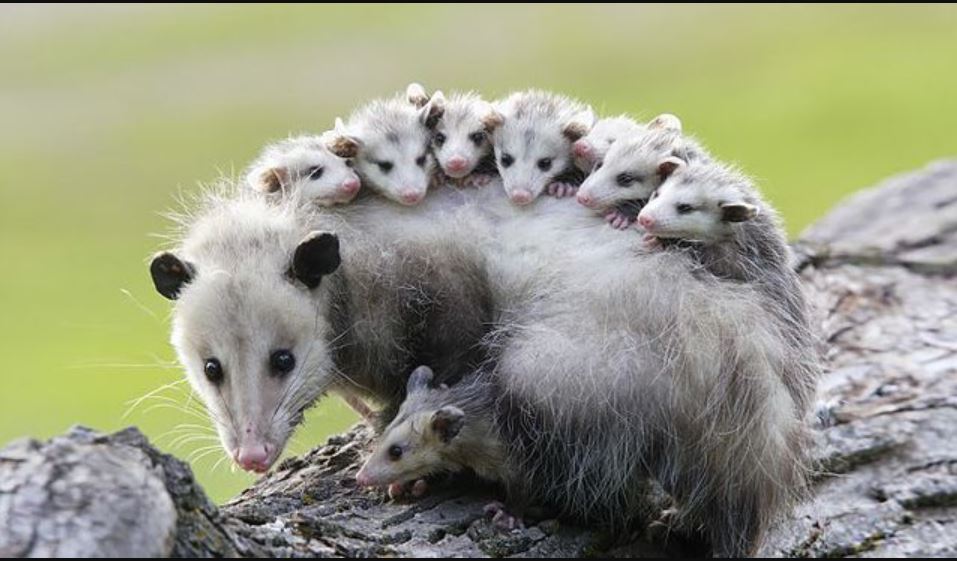
"In the beginning of the spring 1773, I purchased a live female Opossum. I few days after, showing it to some Visitors at the Museum, I was surprised to find a number of young ones adhereing to the teats within the pouch. They were still naked, about the size newborn mice, appeared blind, and strongly attached to the teats, so much so as to look like growing fast to them. As I had long been desirous of having an Opossum in this situation, I did not fail to examine it very frequently.
"So curious and interesting a subject did not fail to excite a number of Visitors to examine the fact, and some no doubt, whose curiosity was greatest, desirous perhaps to ascertain whether they were really growing fast, might have handled them too roughly. For when they had grown to about an Inch in length, I found one entirely out of the Pouch, which I replaced, upon which it readily attached itself again to the teat. Some days afterwards I found one dead, but whether the same which had been accidentally detached before, it was not in my power to determine.
"They bring forth numbers of young at a time, the female suffers greatly in raising them. I have seen nine, the size of those before us, some in the pouch, other hanging round, sticking fast with their paws and holding with their tails, a perfect load for the Opossum to carry.
"The feet of the Opossum, more than Monkies, resemble the human hand, the nails excepted.
" Its flesh is esteemed by many persons equal to young Pork."
In his Walk through the Philad[elphi]a Museum (1805-1806), p. 25, Peale wrote: "The Oposom is a timid Animal, if you come upon it suddenly it will lye down and affect to be dead, but take it by the tail, it will [twist around?] your finger & in that manner may be carried about. The young attach themselves to the female as those before us, or enter into the pouch, if they are not too large. We sometimes find them with 12 or 13 young ones, but the most common number is [blank]."
Also listed in Herald of Freedom (Boston), 13 July 1790
Notes:
The only species native to North America is the Virginia opossum (Didelphis virginiana).
The opossum was described at some length in the Scientific and Descriptive Catalogue of Peale's Museum (Philadelphia, 1796), pp. 43-44.
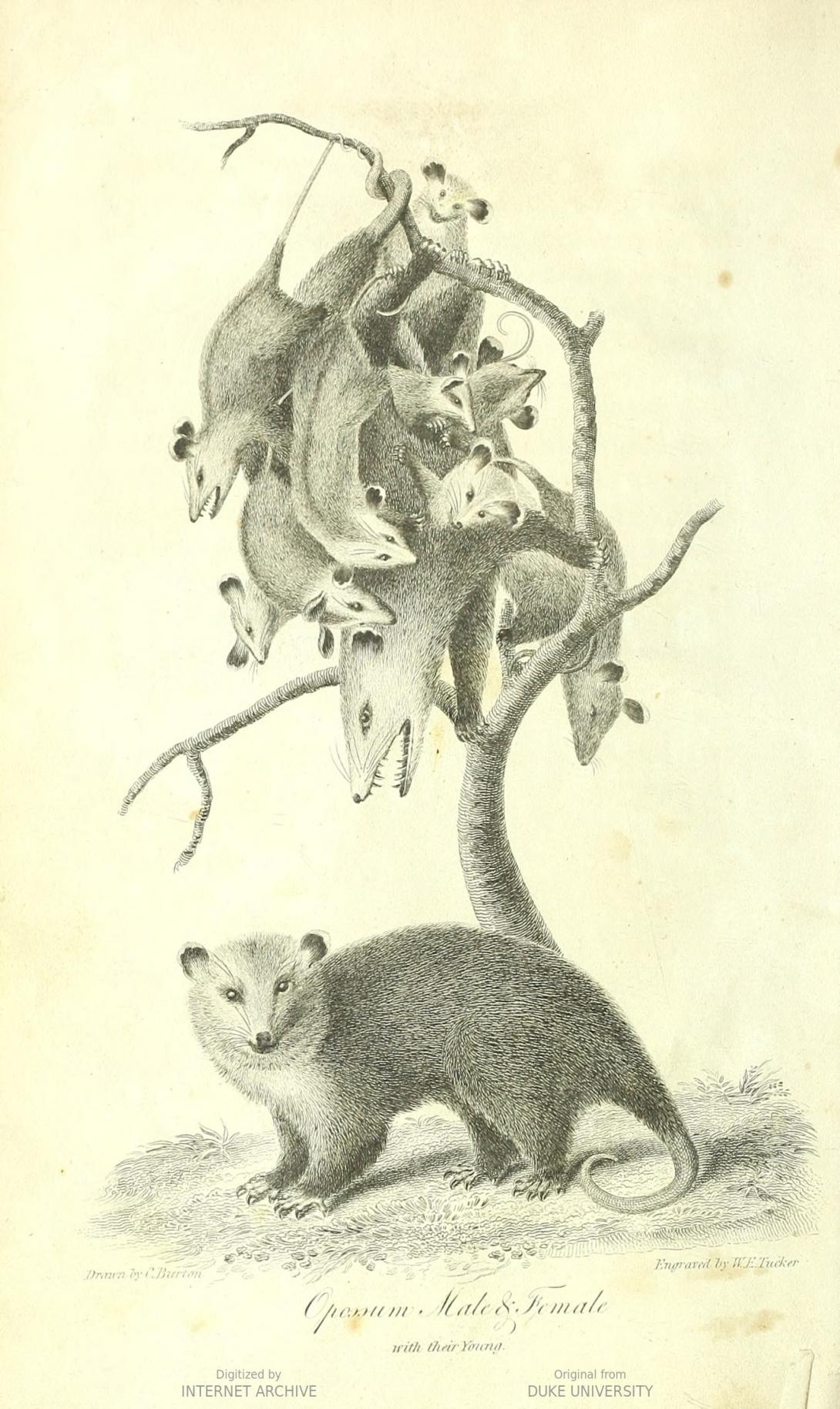
John D. Godman wrote an extensive description of the opossum in his American Natural History. Part I. Mastology, 3 vols. (Philadelphia, 1826-1828), 1: 4-16, likely based on a specimen in the Museum. The image (engraved by W. E. Tucker after a drawing by C. Burton) follows p. 4.
Rembrandt Peale related "Interesting Facts Relative to the Opossum" in Philadelphia Museum, or Register of Natural History and the Arts, 1, no. 1 (January 1824): 6-8 / https://archive.org/details/sim_philadelphia-museum-or-register-of-natu…
The donor, John Foulke, M.D. (1757-1796), served on the staff of Pennsylvania Hospital and was an active member of the American Philosophical Society. Franklin Papers, Founders Online, National Archives, https://founders.archives.gov/documents/Franklin/01-32-02-0191
The Museum also received an opossum with five young on 5 Nov 1806 from Samuel Sellers. Accessions Book, p. 19
Specimen Type:
Live (presumably eventually taxidermied/preserved)
Peale's Common Name:
Opossum
Peale's Scientific Name:
Sarigue, Buff.; Didelphis opossom, Lin.
Current Common Name:
Virginia opossum
Current Scientific Name
Didelphis virginiana