Object Status:
Unlocated
Accession Date:
By 1796
Primary Source Reference:
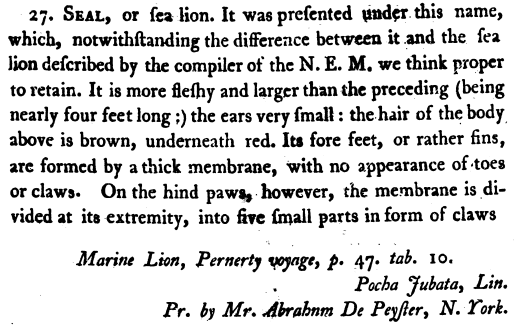
A Scientific and Descriptive Catalogue of Peale's Museum (Philadelphia, 1796), p. 24
Additional Source Text:
In his Natural History Lecture No. 3 (1799), Academy of Natural Sciences of Drexel University, Peale wrote: "This imperfect preservation of a Sea Lion, by its size bespeaks it to be a young. The Sea Lion, full grown, measures upwards of 16 feet in length. However, it appears that there are two sorts of Sea Lions, one with a mane & much larger than the other kind. They are found near the South Pole. The Historical Journal of Pernetty gives this account. 'The hair that covers the back part of the head, neck and shoulders, is at least as long as the hair of the Goat. It gives this amphibious Animal an air of resemblance to the common Lion of the forest, excepting the difference of size. The Sea Lions of the kind I speak are 25 feet in length, and from 19 to 20 in their greatest circumference. In other respects they resemble the common Sea Lions. Those of the small kind have a head resembling a mastiff, with close cropped ears.' . . . This young Sea Lion differs considerably from the Seal, having no claws before, but only fins, and on the upper side of the hind fins some nails. Therefore on the land this Animal must be more helpless than the common Seal, which has considerable claws."
Notes:
Sea lions, of which there are numerous species, do not inhabit the waters of the North Atlantic. It is not known where the Peale Museum specimen came from. His Natural History Lecture describes a young specimen. Presumably the Museum had acquired a mature specimen by about 1825, when Anne Newport Royall visited and recorded her reaction to the sea lion: "What surprised me is the eye, which is of glass, very large, full, fierce, and as natural as though it were living; even the eye lash was entire. The animal in size is enormous, greater than the largest ox." Anne Newport Royall, Sketches of the History, Life, and Manners, in the United States (New Haven, 1826), p. 213.
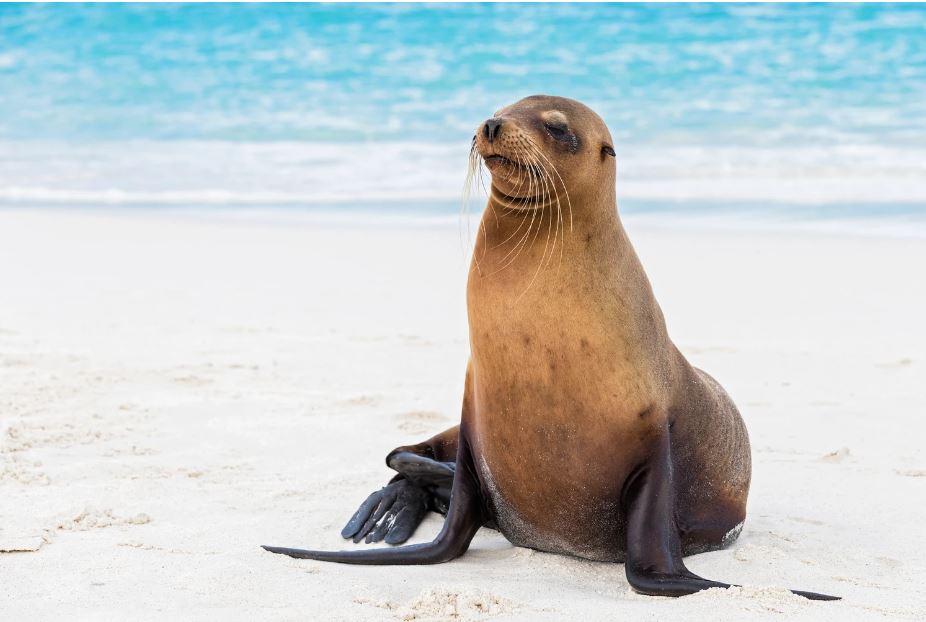
Pictured here is a Galápagos sea lion (Zalophus wollebaeki) .
The donor, Abraham De Peyster (1763-1801), was the brother of Peale's second wife Elizabeth (1765-1804).
Specimen Type:
Dead/preserved
Peale's Common Name:
Seal, or sea lion
Peale's Scientific Name:
Phoca jubata, Lin.
Current Common Name:
Sea lion