Object Status:
Unlocated
Accession Date:
By 1799
Primary Source Reference:
Natural History Lecture No. 6 (1799), Academy of Natural Sciences of Drexel University
Additional Source Text:
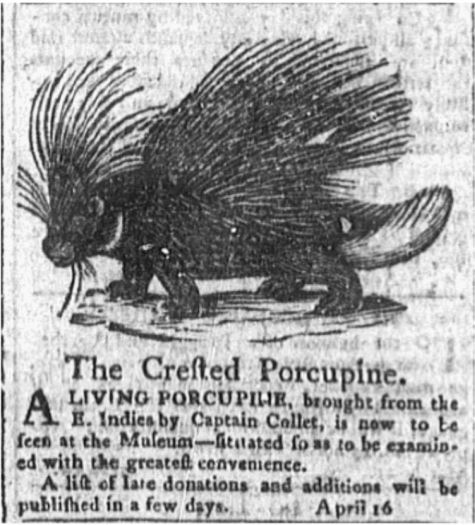
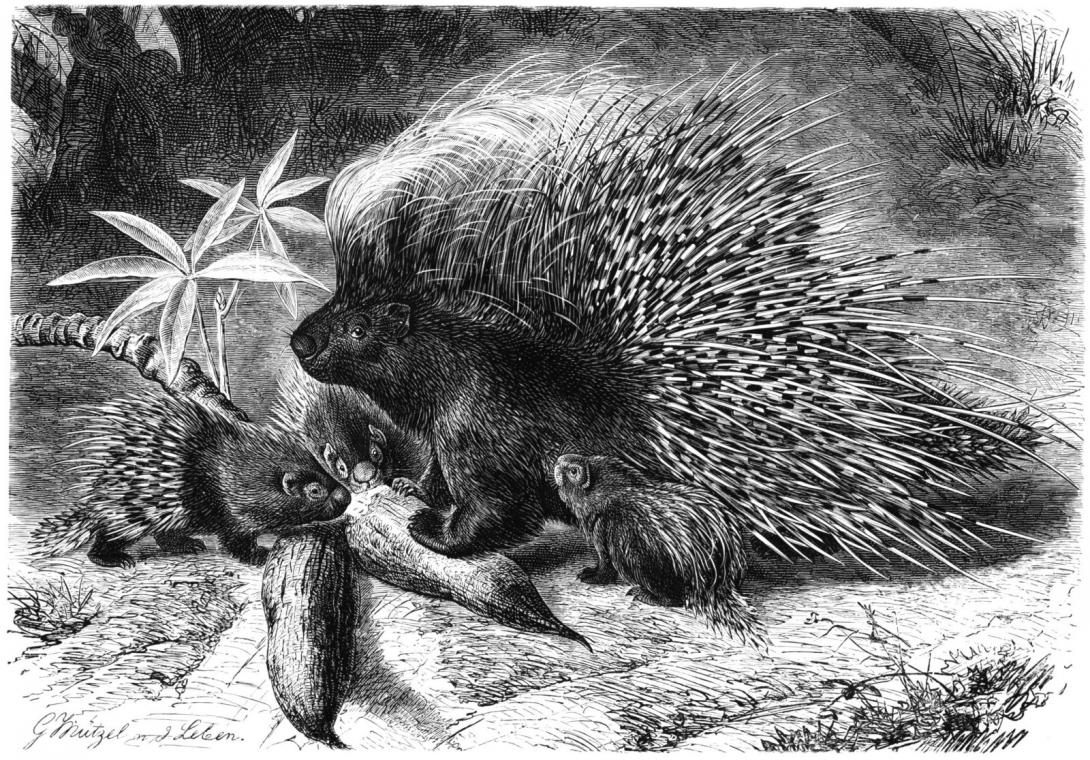
"Histrix Cristato, or crested Porcupine, which I have alive. It is an Animal too dangerous and difficult to remove, therefore I hope [for] your excuse for not bringing it into the Room.
"I shall endeavor to give the best account of its manners, as far as my observation yet extends, and also the oppinion of some authors. The size of one full grown is said to be about 2 feet long and 15 Inches high. My Porcupine appears now much larger than when I first received it, and probably has now gained its full groath; its quills is also longer and thicker – they are of various sizes on different parts of its body.
"It is an Animal that seems to partake much of the Nature of the Hege-Hog; having this formidable apparatus of arms, rather to defend itself, than to annoy the enemy. Some persons have supposed that it is capable of discharging them at its foes and killing at a distance; but this opinion has been entirely discredited of late; and by repeated tryals I have observed that when irritated it runs back with such force as to stick its quills fast even into wood, so far and firmly, that on the retreat of the Porcupine, they are frequently left sticking into whatever it ran against; It is evident that the quills remain fixed in the skin until the regular period of moulting them, as birds do their feathers or quadrupeds their hair.
"Some authors say that the Porcupine never attempts to bite. This is not strictly true, for this will sometimes make a snap and snort like a Hog at the same time; I have felt and know the power of his teeth – However his great dependance for security is on his quills. It is said if hunted by a dog or wolf, it instantly climbs up a tree, and continues there until it has wearied out the patience of its adversary; the Wolf knows by experience how fruitless it would be to wait, he therefore leaves the porcupine above, and seeks out for a new adventure.
"It is probable, therefore, that the Porcupine is seldom the aggressor; and attacked by the bolder animals, it only directs its quills so as always pointing towards the enemy. These are an ample protection; and, as we are assured by Kolbin, at such times, even the Lyon himself will not venture to make an attack. From such, therefore, the Porcupine can defend itself; and for subsistence, chiefly hunts serpants, and all other reptiles. Travellers universally assure us, that, between the Serpant & the Porcupine there exists an irreconcileable enmity, and that they never meet without a mortal engagement. The Porcupine, on those occasions, is said to roll itself upon the serpant, and thus destroy and devour it."
In his "Walk through the Phil[adelphi]a Museum" (1805-1806), p. 27, Peale describes ". . . Animals with two cutting Teeth in each Jaw. The most formidable is the Crested Porcupine (Hystrix cristata). It comes from Africa. With those long quills erected on every side, he defies all his Enemies. The Idea of shooting out their quills, is now proved to be eronious -- but it sometimes happens that when they pierce leather woolen & similar substances, the Animal loses its quills which are but feebly held by their Roots."
Guide to the Philadelphia Museum (1805) adds: "Some of whose quills measure 13 inches."
Notes:
The crested porcupine (Hystrix cristata) also known as the African crested porcupine, is a species of rodent in the family Hystricidae found in Italy, North Africa, and sub-Saharan Africa.
Specimen Type:
Live (presumably eventually taxidermied/preserved)
Peale's Common Name:
Crested porcupine
Peale's Scientific Name:
Hystrix cristata
Current Common Name:
Crested porcupine
Current Scientific Name
Hystrix cristata