Object Status:
Unlocated
Accession Date:
By 1796
Primary Source Reference:
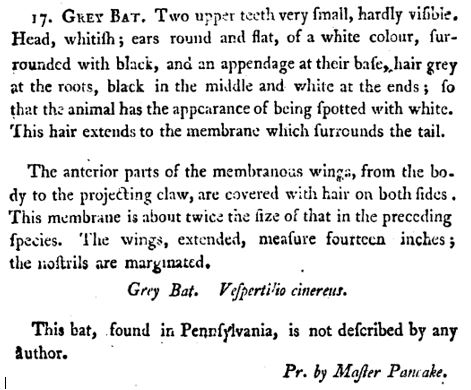
A Scientific and Descriptive Catalogue of Peale's Museum (Philadelphia, 1796), p. 14
Notes:
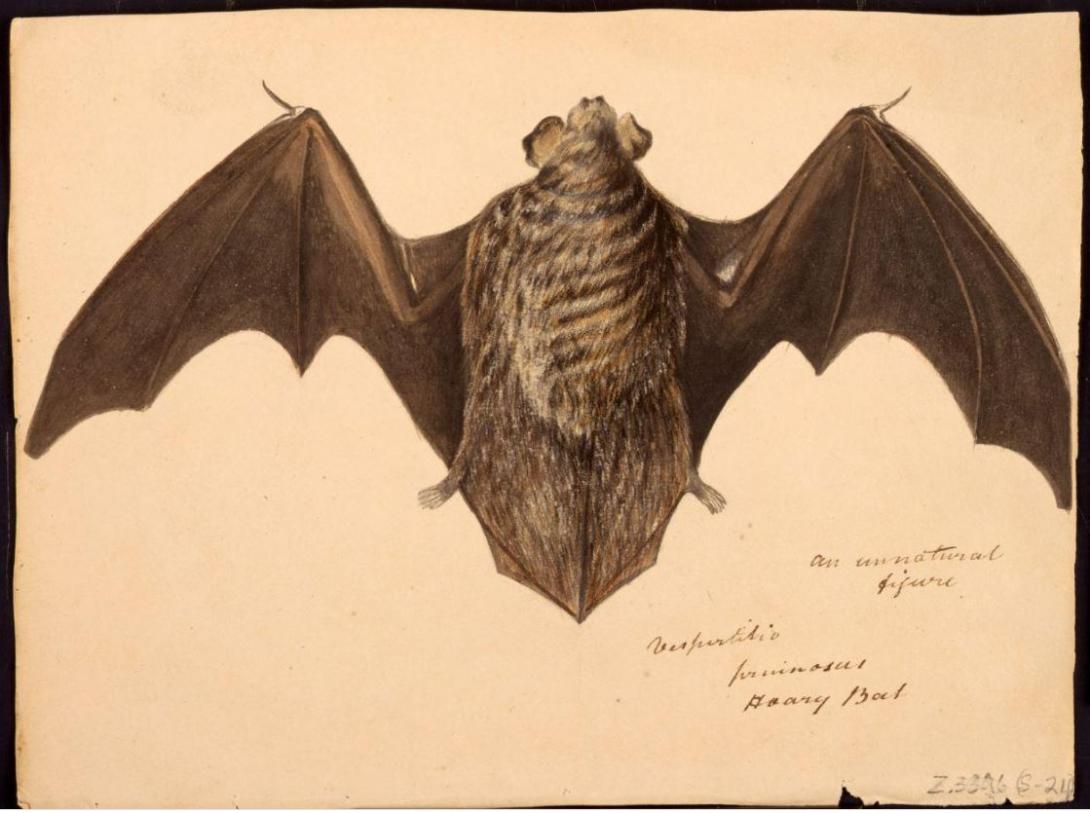
This specimen, which may have been the type specimen for this species, was later described by John D. Godman in his American Natural History. Part I. Mastology, 3 vols. (Philadelphia, 1826-1828), 1: 68-70 / https://hdl.handle.net/2027/dul1.ark:/13960/t4wh6dv4h?urlappend=%3Bseq=…
Godman wrote: "This Bat [which he called the Hoary bat and which Thomas Say in 1823 designated as Vespertilio pruinosus] is nearly four and a-half inches long, and was common in the vicinity of Engineer Encampment, where the [Long] expedition to the Rocky Mountains wintered. Mr. Thomas Nuttall, the justly distinguished botanist, observed it also at Council Bluffs. A specimen captured near Philadelphia, was presented to the Philadelphia museum, by the late professor [Benjamin Smith] Barton."
Specimen Type:
Dead/preserved
Peale's Common Name:
Grey Bat
Peale's Scientific Name:
Vespertilio cinereus
Current Common Name:
Hoary bat
Current Scientific Name
Lasiurus cinereus