Object Status:
Unlocated
Accession Date:
By 1825
Primary Source Reference:
Richard Harlan, Fauna Americana: Being a Description of the Mammiferous Animals Inhabiting North America (Philadelphia, 1825), pp. 32-33 / https://www.biodiversitylibrary.org/page/3194288
Additional Source Text:
"A specimen in the Philadelphia Museum, labelled, 'American white mole,' No. 872."
Notes:
Peale recorded a mole in "Walk through the Museum" (1805-1806), p. 26, where he assigned the animal to the genus Talpa and where he quoted a passage from Oliver Goldsmith, An History of the Earth, and Animated Nature, 8 vols. (London, 1791), 4: 85-93: "Goldsmith says, 'as we have seen some quadrupeds formed to crop the surface of the fields, and others to live upon tops of Trees, so the mole is formed to live wholly under the earth, as if nature meant that no place should be left intirely untenanted.' Altho obliged to bore its way through the ground to get Insects, its proper food, yet it has its enjoyments, and no Animal has a more slick or glossy skin, nor is fatter. They are not blind as is commonly supposed, but have Eyes very small and [covered with?] hair, to protect them from Injury."
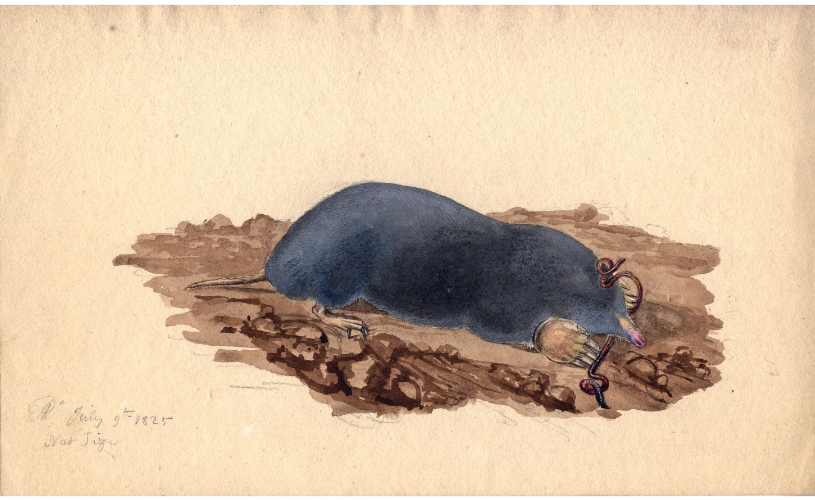
John D. Godman also described what he called the shrew mole in American Natural History. Part I. Mastology, 3 vols. (Philadelphia, 1826-1828), 1: 84-96, where he related information about the live animal kept by Titian Ramsay Peale, whose watercolor is pictured here / https://www.biodiversitylibrary.org/page/49165370
Specimen Type:
Dead/preserved
Peale's Common Name:
American white mole (Harlan's name), Shrew-mole (Godman's name)
Peale's Scientific Name:
Talpa
Current Common Name:
Eastern mole or common mole
Current Scientific Name
Scalopus aquaticus