Object Status:
Unlocated
Accession Date:
January 25, 1794
Primary Source Reference:
Dunlap's American Daily Advertiser (Philadelphia), 25 Jan 1794
Additional Source Text:
" . . . is just received. By the account which mons. Buffon gives of the Elk, it appears that he was not acquainted with this American animal: he particularly omits all notices of the curious apertures adjoining the eyes of this Elk."
In his "Walk through the Phil[adelphi]a Museum" (1805-1806), pp. 36-37, Peale wrote: "Here we see the Male and female Elk. Not known by Buffon; for he has confounded the Moose and Elk together. They are widely different; the former having almated horns, such as you see against that wall -- the Elk has round and branching horns. It is a much handsommer Animal than the moose deer. The Elk has been used in harness, but having the timidity natural to all ruminating Animals, on the least fright, start off; and as their muscular strength, in flight renders them superior to most quadrupeds they are therefore more dangerous in the draught of Carriages. Hunters generally suppose, when the Elk is hard run, that it breathes through the tear holes. This is not true, for there is no communication between them and the Lungs -- Besides they are stronger built than common Deer, have a shorter tail, and are farther distinguished by a broad patch of a lighter colour on the Rump."
In his Natural History Lecture No. 8 (1799), Academy of Natural Sciences of Drexel University, Peale wrote: "This female Elk I had alive something more than one year. Perhaps I should have supported her for a greater length of time, had she not began to bark the trees in the State-House Gardens. However, I had her long enough to learn much of her disposition and powers.
"Haltered, she was gentle and perfectly good humoured – so familiar that I could do nothing when within reach of her rope for her fondling on me. If by accident she got loose, she was so sensible of the enjoyment of liberty that we generally found it a difficult task to get her again. Altho she would come at my call and suffer me to handle her, yet the sight of a bridle would make her spring away in an Instant.
"I can never forget the narrow escape I once had by endeavoring to catch her.
"I coiled a long rope and put it in my pocket and left out only a piece of the end with a loop, which I carefully kept out of her sight. Calling her to me, I stroked her gently, making much of her, until I made sure of putting the rope over her head. No sooner was this done, but she darted off like an arrow from a bow, and the rope not delivering sufficiently quick from my pocket, the Elk jerked me round, & in an instant, threw me off my feet, thus thrown, I was dragged on my back about 20 yards, in expectation every moment of having my brains beat out. But most luckily, the shirt of my coat gave way, and was torn off, and thus my life most providentially saved. This instance may serve to show how dangerous an Animal the Elk would be to domesticate for the draft; as well as their agility and strength. I have heard that the American Elk have been used in a carriage, but from my observations on this Animal when alive, I should never advise any person to make trial, or venture to drive them in any sort of Carriage. They have the timidity natural to all ruminating Animals, on the least fright start off – Their muscular strength in flight renders them superior to most quadrupeds.
"The Hunters generally suppose that when the Elk is hard run that it breathes through these tear holes: When this Animal was alive I made repeated trials to discover if the breath had a passage through them, by holding her nose, stopping her mouth, and holding a mirror opposite them, but I never discovered the least moisture on the glass. When the Animal was dissected, no communication was found between them and the Lungs. One of these tear holes, as they are commonly called, I have preserved open, which shews that the bottom within has no visible holes on the surface – on the other side the tear hole is left as it generally appears.
"Having heard that these Animals have no gall-bladder – I gave it the closest examination, & I did not discover any thing to the contrary.
"The tail of the elk is much shorter in proportion to the size of the Animal, than the tail of the common Deer.
"This broad patch of a lighter colour on the rump (crupper) than the other parts of its body is a distinct character of the Elk. Like other venison, the flesh of this Animal is esteemed excellent.
"This American Buck is not of the largest size; one or two years additional age, would have given it greater Magnitude. It however, may be called more than a middle sized one. It measures in height 3 feet 3 Inches, from the nose to the insertion of its tail 6 feet 1 Inch. In dissecting this deer I found between the toes of each foot a small, hard, skin bag, containing a substance something like a soft wax of a very strong Scent. It may not be peculiar to this species, but common to the whole genus, and no doubt is what the Dog scents.
"This female of the same species perhaps not fully grown. As I mentioned before, it is 5 or 6 years before they acquire their full size."
Notes:
Buffon assumed that the so-called "American elk" was analogous to the European elk (Alces alces) and that its smaller size was further evidence that animals degenerated in America. In fact, the American elk, or wapiti (Cervus canadensis) is a round-horned deer most closely related to the red deer of Europe. The "curious apertures adjoining the eyes" that Peale mentions are the preorbital glands, exocrine glands found in many species of hoofed animals, which are homologous to the lacrimal gland found in humans. These glands are trenchlike slits of dark blue to black, nearly bare skin extending from the medial canthus of each eye. The live specimen Peale lists here was kept alive in the Statehouse Yard until 1795. When it resisted captivity and had to be slaughtered, its meat was served at a special dinner in February 1795. (Selected Papers, 2, part 1: 203n)
Gazette of the United States (Philadelphia), 17 Feb 1795 reported "A Female Elk, preserved in the Museum," with the additional text: "The idea which the hunters have of its breathing through the holes near the eyes when run hard, is a mistake, as this preservation plainly shews, altho' these holes are large at the entrance, they reach only about one inch in depth, and end in a round bottom, with no visible opening further. When this idea of its breathing through these holes, was suggested to the proprietor, he applied a small mirror, over and near the holes, holding at the same time, the nose and mouth closed, to stop breath; on which no dampness ever appeared on the glass, in several trials. The proprietor had learnt, that the Elk had no gall-bladder -- which induced him to attend closely to inspect this Elk, when it was killed and dressed; but no Gall Bladder, or anything as a substitute, appeared."
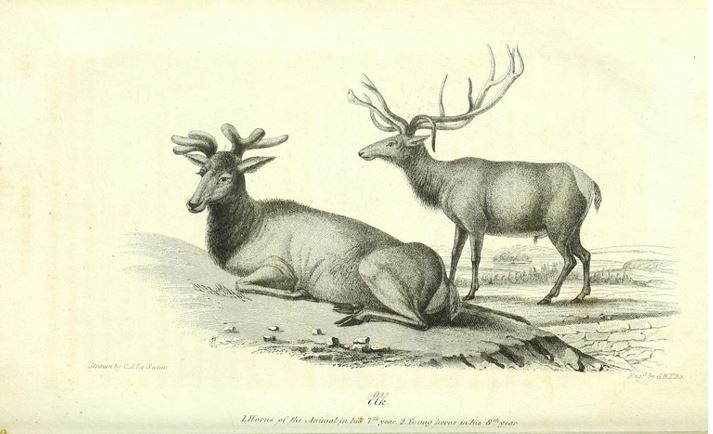
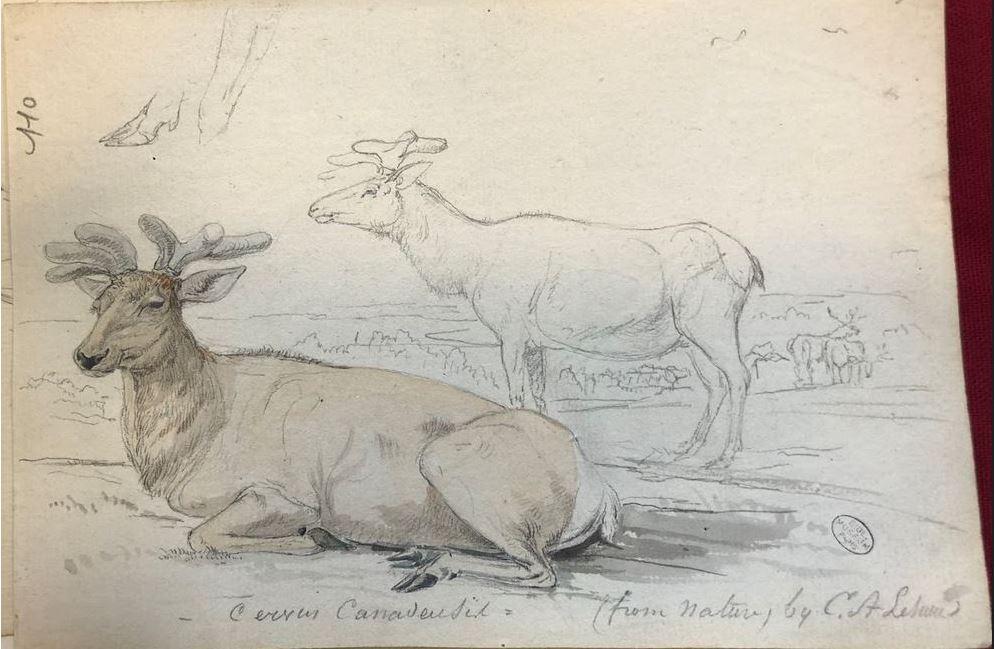
Charles-Alexandre LeSueur made a drawing of the elk, pictured here, when he was in Philadelphia, 1816-1825 (he noted "from nature" but actually from the preserved animal). G. B. Ellis's engraving of LeSueur's drawing, also pictured here, illustrated John D. Godman's description of the elk in his American Natural History. Part I. Mastology, 3 vols. (Philadelphia, 1826-1828), 2: 294-304 and plate. For the illustration at the right of a male elk with full-grown antlers Ellis may have relied on two sets of elk antlers acquired by the Museum in 1792 (see entry for "A pair of Elk Horns") and in 1821 (see entry for "A pair or Elks horns, from [blank]").
Specimen Type:
Live (presumably eventually taxidermied/preserved)
Peale's Common Name:
Elk
Current Common Name:
American elk
Current Scientific Name
Cervus canadensis