Object Status:
Unlocated
Accession Date:
January 28, 1808
Primary Source Reference:
Peale Museum Accessions Book, Historical Society of Pennsylvania, p. 28
Additional Source Text:
Aurora. General Advertiser (Philadelphia), 5 Feb 1808, adds: Two tame young Grisly Bears from the source of the Missouri, where they grow so large as to weigh 800 wt. These at present, weigh 70 pounds each. To gratify public curiosity, they will be exhibited in the Museum for 10 days, (viz until the 13th February Inclusive, after which they cannot be seen, as the Museum does not conveniently admit of the exhibition of live animals.) These shaggy tyrants of the woods, with tremendous paws, are fierce combatants and are similar to those which forced Captain Lewis to take shelter in a river for an hour."
In his "Walk through the Philad[elphi]a. Museum" (1805-1806), p. 24, Peale wrote: "Had that Grisley-Bear been suffered to gain his full size, it would have become a [sizible?] Animal, perhaps double its [current?] size [?] it was killed from a [fear?] of its doing mischief as it is said to be a ferocious species. It was brought alive to this City from the Missourie. Its claws, although yet small, are double the length of this black bear. The Meat of Bears is a desireable food, and the Skins make excellent beds for travellers in the Western woods." Peale also described the bears in his Autobiography Selected Papers, 5: 356.
Notes:
The male and female bear cubs had been acquired by Zebulon Montgomery Pike in 1807 during his expedition up the Arkansas River. He sent them to Jefferson in Washington, describing them in a letter of 29 Oct 1807 as "a pair of Grisly Bears (mail & femail) which I brought from the divideing ridges, of the Pacific, & Atlantic Oceans.—They are certainly of a different species from any Bears we had in the Antient limits of the United States; and are considered by the natives of that Country as the most ferocious Animals of the Continent." Jefferson then sent them to Peale. In acknowledging receipt on 5 Nov 1807, Jefferson told Pike: "this most formidable animal of our continent is so little known in the US. that I have thought I could not better further your views, & turn to it’s proper account the great trouble you have had in bringing them so far, than by proposing to send them to mr Peale. he is always glad to recieve living animals which are rare, and to nourish them for exhibition to the numerous visitants of his museum. he is attentive too in watching their manners & other circumstances which enter into the history of their species" / Jefferson Papers, Founders Online, National Archives / https://founders.archives.gov/documents/Jefferson/99-01-02-6676 ; https://founders.archives.gov/documents/Jefferson/99-01-02-6721 (These are Early Access documents)
As they grew they became unmanageable and dangerous and had to be put down, after which they were preserved and displayed in the Museum. See Selected Papers, 2, part 2: 1041-1065 passim; 5: 356; and Gaye Wilson, "Grizzly Bears," at https://www.monticello.org/site/research-and-collections/grizzly-bears
After killing the grizzlies, Peale smoked some of the meat; "the other hind quarter I sent to Mr. Jefferson, I have not yet heard how he liked it -- perhaps its being very bloody may on sight of it may have been disgusting to him." Selected Papers, 2, part 1: 650
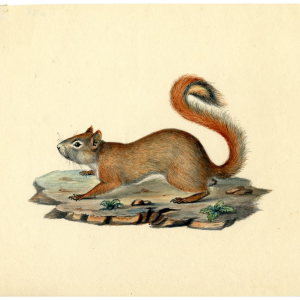
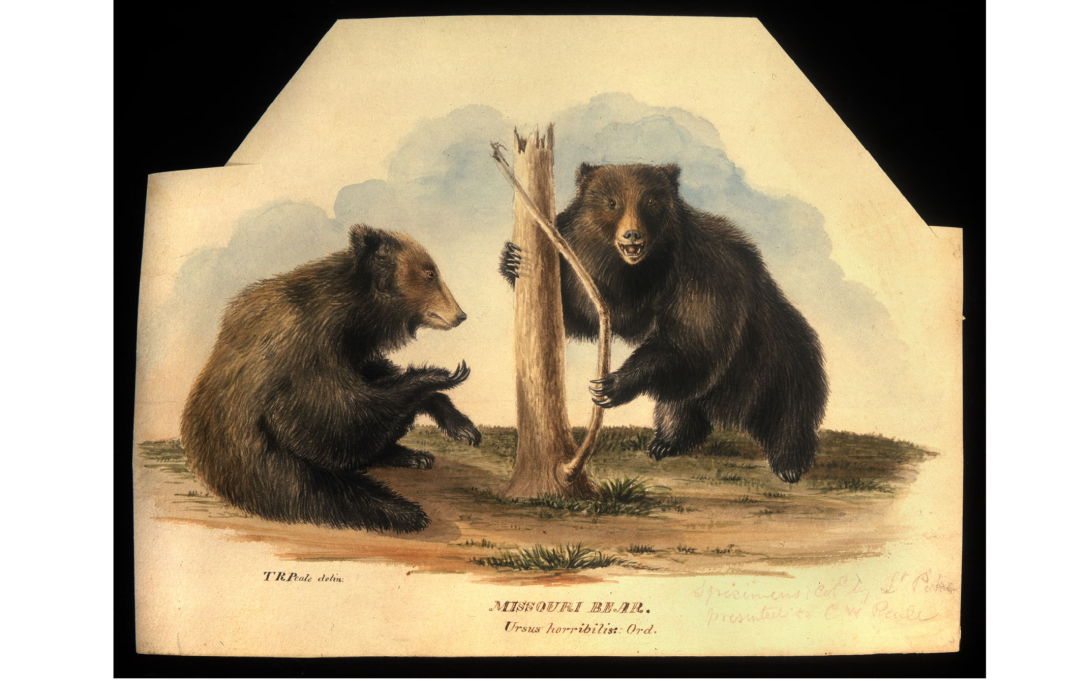
Titian Ramsay Peale's watercolor, from the preserved specimens on display at the Museum, is pictured here.
Richard Harlan describes this species in Fauna Americana: Being a Description of the Mammiferous Animals Inhabiting North America (Philadelphia, 1825), pp. 48-50 / https://www.biodiversitylibrary.org/page/3194390
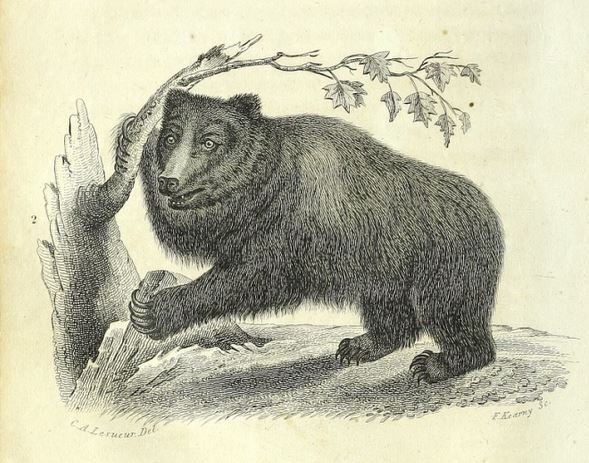
John Godman describes and illustrates this species, which he identifies as Ursus horribilis, or the "Brown Bear of Lewis & Clark,"in American Natural History, 1: 131-143 / https://hdl.handle.net/2027/dul1.ark:/13960/t4wh6dv4h?urlappend=%3Bseq=…; a detail of the image, an engraving by Francis Kearny after a drawing by C. A. Lesueur, is pictured here.
Specimen Type:
Living/Live (presumably eventually taxidermied/preserved)
Peale's Common Name:
Grizzly bear
Peale's Scientific Name:
Ursus horribilis Ord
Current Common Name:
Grizzly bear
Current Scientific Name
Ursus arctos horribilis