Object Status:
Extant
Accession Date:
By 1799
Primary Source Reference:
Charles Willson Peale, Lecture on Natural History 33. (ca. 1799). Academy of Natural Sciences of Drexel University Archives, coll. 40. / https://ansp.org/research/library/archives/0000-0099/coll0040/
Additional Source Text:
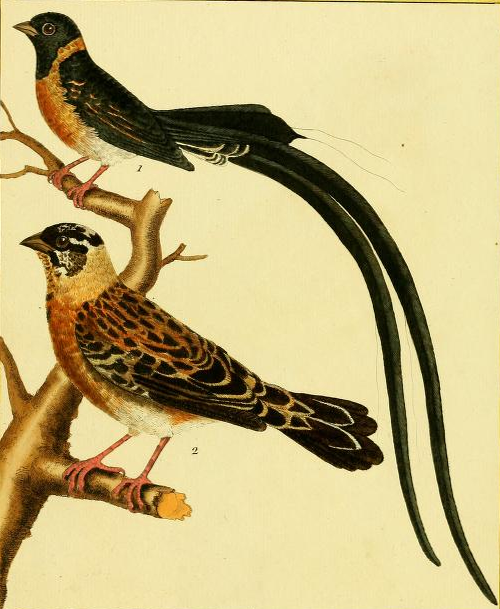
Charles Willson Peale (1741-1827) wrote, in his 33rd Lecture (ca. 1799): "No. 1488. Whidah Bunting. rather less than a hedge sparrow; head, neck, wings & tail black; behind the neck & breast orange underneath near the tail, and legs white; the 2 middle tail fathers 4 Inches long, very broad, and ending in a long thread; the 2 next are about 13 Inches in length, broad in the middle, narrower at the end, and rather pointed; from the middle of the last arises another long thread; the rest of the tail feathers are only 2 ¼ Inches long; the 2 long ones are placed somewhat vertically, and appear undulated across, and are more [glossy] than the others. The feet flesh colour. Emberiza Paradisaea Linn. La Veuve à collier. Buff. pl. enl. 194." (Academy of Natural Sciences of Drexel University Archives, coll. 40)
Peale continued: "This species molts twice in a year. The male wants the long feathers 6 months out of 12. This specimen has its summer dress. It is pretty common at Angola, and other parts of Africa; and it is called La Veuve, or Widow Bird, from the colour, but this is said to be a corruption of the word Whidah, the name of a fort in Africa, in the neighbourhood of which they are common." (ANSP Archives, coll. 40)
On 21 May 1805, "pair of widow birds, living" donated by Bellvue Soisson was entered in the Peale Museum Accessions Book, p. 5 (Historical Society of Pennsylvania, coll. 0481).
Peale wrote, in "A Walk Through the Philad[elphi]a Museum" (1805–1806): "The most remarkable in the next case of this genus is the Meadow-Bunting (E. Paradisaea) it common at Angola in Africa, they molt twice in a year, the male is without those long tail feathers 6 months out of 12." (HSP, coll. 0481)
On 25 July 1810, a donation of "Two living Widah Birds, (Loxia Paradicia)" by Joseph or Josiah Lyons (perhaps Philadelphia merchant Joseph Lyon) was entered in the Peale Museum Accessions Book, p. 51 (HSP, coll. 0481).
Specimen Type:
Dead/preserved
Current Common Name:
Long-tailed Paradise Whydah
Current Scientific Name
Viduidae | Vidua paradisaea