Object Status:
Extant
Accession Date:
By 1808
Primary Source Reference:
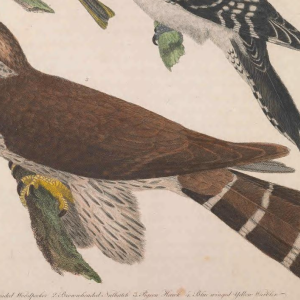
Alexander Wilson (1808). American ornithology, or, The natural history of the birds of the United States: illustrated with plates engraved and colored from original drawings taken from nature. Volume 1, Plate 2. Philadelphia: Bradford and Inskeep, Robert Carr. / https://www.biodiversitylibrary.org/item/175530#page/45/mode/1up (text) / https://www.biodiversitylibrary.org/item/175530#page/44/mode/1up (plate)
Additional Source Text:
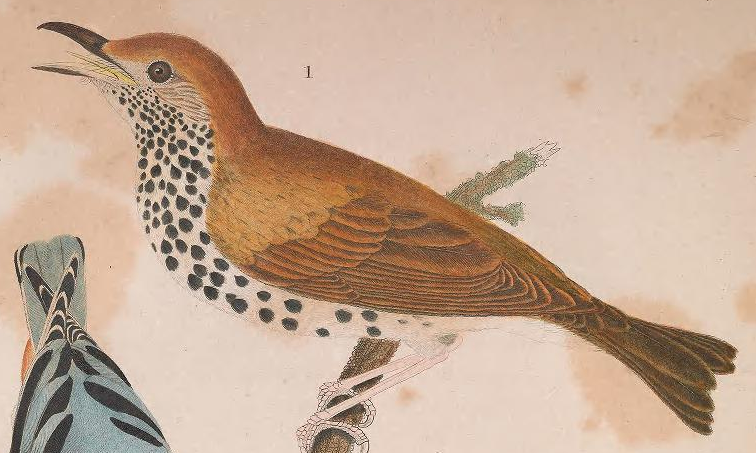
Alexander Wilson (1766-1813) described this species under the name "Wood Thrush / Turdus melodus" in American Ornithology vol. 1 (Pl. 2), where "Peale's Museum No. 5264" was cited (Wilson 1808: 29).
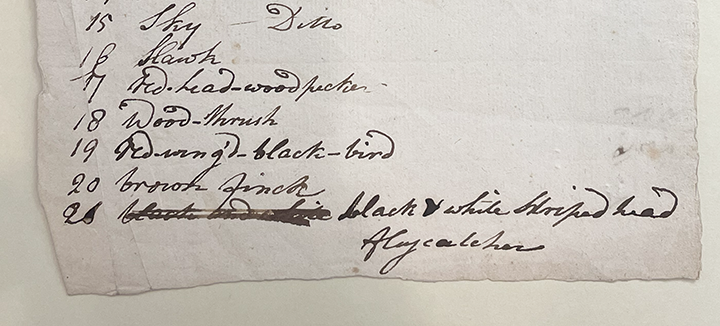
An undated list of 21 bird specimens in Charles Willson Peale's (1741-1827) handwriting (shown here) includes one "Wood-thrush" (American Philosophical Society Library, Mss.B.P31).
Notes:
The name “Turdus melodus” originated with William Bartram, who, according to Wilson (1808), “seems to have been the first and almost only naturalist who has taken notice of the merits of this bird.” The conspicuous absence in Peale’s writings of this common species, which breeds near Philadelphia and was undoubtedly mounted in the Philadelphia Museum (see Wilson 1808: 29, American Ornithology vol. 1), suggests that he confused H. mustelina with the smaller nightingale-thrushes (Catharus spp.) under the taxonomic composite name T. minor. The appearance of the name "wood-thrush" on Peale's undated list of 21 specimens suggests that it may have been written after he conferred with Wilson (APS Library, Mss.B.P31). For a full discussion, see Matthew R. Halley, 2018, "The ambiguous identity of Turdus mustelinus Wilson, and a neotype designation for the Veery Catharus fuscescens (Stephens),"Bulletin of the British Ornithologists’ Club 138: 78-91. / https://doi.org/10.25226/bboc.v138i2.2018.a3
Specimen Type:
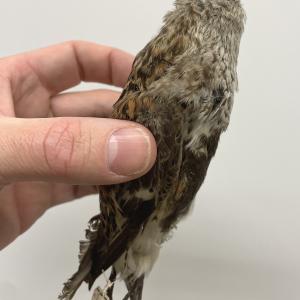
Dead/preserved
Current Common Name:
Wood Thrush
Current Scientific Name
Turdidae | Hylocichla mustelina