Object Status:
Unlocated
Accession Date:
By 1799
Primary Source Reference:
Charles Willson Peale, Lecture on Natural History 28. (ca. 1799). Academy of Natural Sciences of Drexel University Archives, coll. 40. / https://ansp.org/research/library/archives/0000-0099/coll0040/
Additional Source Text:
Charles Willson Peale (1741-1827) wrote, in his 28th Lecture (ca. 1799): "No. 1037 is a cock Wild Turkey taken in Baltimore County, Maryland. Its weight was 20 pounds; some it is said are much heavier. We may suppose if found very fat, a few more pounds weight might be added, but I am not inclined to believe, that they are ever found to exceed 30 [pounds] weight, in which case they must be very old and excessively fat, yet this is far short of what some travelers assert, even to [a] weight [of] 40 pounds." (Academy of Natural Sciences of Drexel University Archives, coll. 40)
Peale continued: "I have seen many of them wild in the state of Maryland, and have been astonished at their fleetness in running, which they do not continue for any considerable length of time; but if pursued by dogs, it is said they fly and light on Trees, where they are easily shot, and are so insensible of danger as not to fly when shot at; the survivors remain unmoved by the death of their companions. [A footnote indicates this information was sourced from "Du Pratz, 224"]." (ANSP Archives, coll. 40)
Peale continued: "This fine shining coppery coloured plumage is common to the males. The females have not such bright colours; are generally brown, and they are smaller. Wild Turkies preserve a sameness of colouring. The tame, as usial with domestic animals vary. The Linnaean name is Meleagris Gallo-pavo. Le Dindon Buff. pl. enl. 97. The Indians make a most elegant cloathing of the feathers. They twist the inner webs into a strong double thread of hemp, or inside bark of the Mulberry-tree, and work it like matting. It appears very rich and glossy, and as fine as silk shag. [A footnote indicates this information was sourced from "Lawson, 18: […], 423"]. They also make fans of the tails; and the French of Louisiana sometimes make embrellas by the junction of four tails. [A footnote indicates this information was sourced from "Du Pratz, ii: 85"]. The flesh of the wild Turky is said to be superior in flavor to the tame, but redder." (ANSP Archives, coll. 40)
Peale wrote, in "A Walk Through the Philad[elphi]a Museum" (1805–1806): "It may be thought by some people that the next genus Meleagris or Turkey, as being so common a bird might be past by without notice, but view that stately bird Turkey and consider it the original stock from which all Europe has been supplied with the domestic Turkey – They were carried into England about the year 1521. This was not fat and yet it weighed 20 pounds. I have heard that some of them have been found much heavier." (Historical Society of Pennsylvania, coll. 0481)
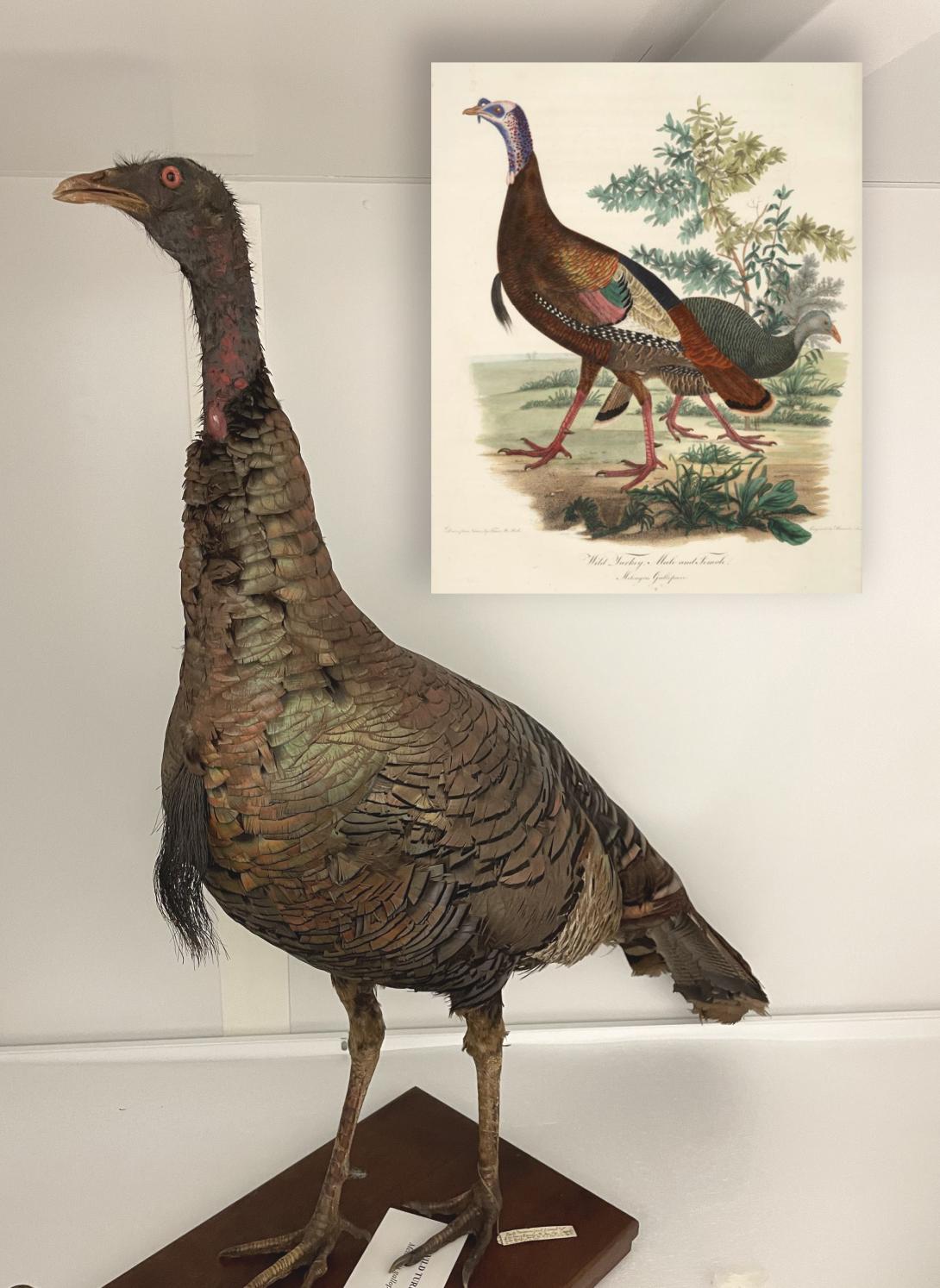
Titian Ramsay Peale (1799-1885) deposited "1 Wild Turkey Cock" on 23 March 1821, after returning from the Long Expedition, as recorded in the Peale Museum Accessions Book, p. 112 (Historical Society of Pennsylvania, coll. 0481). Titian also painted this species (shown here) at "Missouri [T.]" on 3 June 1819"drawing" was not mentioned in the Accessions Book (HSP, coll. 0481). Titian's painting (shown here) is now preserved in the American Philosophical Society Library (Mss.B.P31.15d, 37).
Two unmounted specimens of "Meleagris gallopavo (Wild Turkey)", a female from Florida and a male from Missouri, were listed in "A Catalogue of Duplicate Specimens...", May 1822. [unpublished] American Philosophical Society Library (Mss.B.P31).
Charles Lucien Bonaparte (1803–1857) described this species under the name "Wild Turkey / Meleagris gallopavo" in his continuation of American Ornithology vol. 1 (1825, Pl. 9), but did not cite any Peale Museum specimens (Bonaparte 1825: 79). Titian's drawing was engraved by Alexander Lawson (ca. 1772-1846) for the work. / https://search.library.wisc.edu/digital/AFKPEJIASN54OC8L/pages/A6QJ4IF6…
Notes:
After Peale's Museum closed, a portion of Peale's bird collection was purchased in 1850 by Moses Kimball (1809–95), who displayed it at his "Boston Museum". An advertisement in the Boston Transcript, printed 1 October 1850, stated that Kimball had acquired "One Half of the celebrated Peale's Philadelphia Museum". The other half of Peale's birds had been sold to the circus promoter P. T. Barnum (1810–91) and would be subsequently destroyed in a fire at his "American Museum" in New York City in July 1865. When the Boston Museum closed, Kimball's Peale remnants passed temporarily to the Boston Society of Natural History, who disposed of them to Charles J. Maynard (1845-1929), a local taxidermist. The specimens were stored in a barn in Massachusetts for several years, then eventually were deposited at the Museum of Comparative Zoology (MCZ), Harvard University. By the time the collection was catalogued by Walter Faxon (1848-1920) at MCZ, in 1914, in virtually every case the original mounts and labels had been disassociated from the specimens, and an untold number were lost. Walter Faxon, "Relics of Peale's Museum," Bulletin of the Museum of Comparative Zoology, 59, no. 3 (July 1915): 130, wrote that a data-deficient specimen (MCZ 67842) from the Boston Museum collection was "without much doubt the original of T. R. Peale's beautiful figure of the Wild Turkey Cock in Bonaparte's "American Ornithology." According to Bonaparte (1825: 103), the illustrated "male was selected from among many specimens, shot in the month of April, near Engineer Cantonment, on the Missouri". / https://search.library.wisc.edu/digital/AFKPEJIASN54OC8L/pages/AF2CYT3I… However, to the editor's (MRH) knowledge, there is no way to determine whether MCZ 67842 is that Missouri bird, or the Baltimore County, Maryland, specimen mentioned by Peale in his lecture, or the Florida duplicate mentioned in the "Catalogue of Duplicate Specimens..." (APS Library, Mss.B.P31) Here, for simplicity, we state that Titian R. Peale (1799-1885) deposited the Long Expedition specimens at Peale's Museum. However, it should be noted that the specimens did not belong to Titian, and were not his to give away. Officially, they were the property of the United States government, and as such were formally deposited by Major Stephen Harriman Long (1784-1864), who led the government-sponsored expedition. The Peale Museum Accessions Book, pp. 112-113 (Historical Society of Pennsylvania, coll. 0481) contains an "Invoice of Zoological Specimens and Drawings prepared by Titian Peale, Assistant Naturalist for the Exploring Expedition, and deposited in the Philadelphia Museum by Majr. S. H. Long, Maj. U.S. Engr. pursuant to instructions of the Secretary of War." At the conclusion of the invoice, "Rubens Peale [1784-1865], manager" signed the following statement: "Received, Philadelphia Museum, March 23d. 1821. of Majr. S. H. Long, the several articles, specified in the above Invoice, as a deposit for safe keeping, preservation and Exhibition; and I hereby promise, as agent for the Institution to hold the said articles subject to the orders of the War Department, thru the said Maj. Long." (HSP, coll. 0481)
Specimen Type:
Dead/preserved
Current Common Name:
Wild Turkey
Current Scientific Name
Phasianidae | Meleagris gallopavo
Repository:
Museum of Comparative Zoology, Harvard University (MCZ 67842)
![Titian Ramsay Peale, 3 June 1819, "Missouri T[erritor]y".](/sites/default/files/2026-04/WITU_Titian1.png)